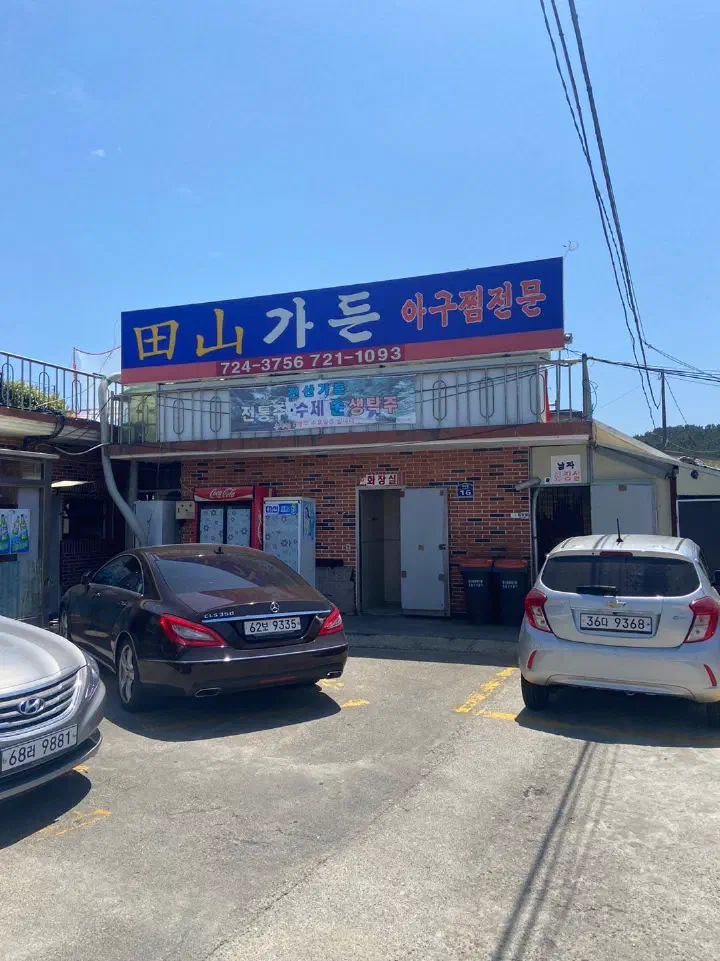
There’s a blue-roofed old house on the edge of Hangni, a small harbor village past Ilgwang Beach in Gijang, that locals keep coming back to for one fish only.
Jeonsan Garden (전산가든) has been cooking monkfish - and nothing but monkfish - since around 2001.
The menu is two lines long: agujjim (아구찜), the spicy braised monkfish, and agu-suyuk (아구수육), a steamed monkfish plate you rarely find anywhere else.

Busan people often group it with two other restaurants as the “three great agujjim houses of Gijang.”
What sets this one apart is the seasoning: sancho (산초, a numbing peppercorn related to Sichuan pepper) and bangah (방아, Korean mint), two herbs used almost exclusively in this corner of the country.

Exterior and blue signboard of Jeonsan Garden, a monkfish restaurant in Hangni village, Gijang, Busan

The basics

The address is 16 Hangni-gil, Ilgwang-eup, Gijang-gun, Busan.
It opens at 11 a.m. and closes around 8 p.m., but note the early last order - between 6:30 and 7 p.m. - so plan dinner on the early side.
It closes every Wednesday, unless that Wednesday is a public holiday.
There’s no app-based waitlist; you write your name on a paper sheet at the door and wait. Groups can reserve by phone (051-721-1093).

📍 View Jeonsan Garden (전산가든) on Google Maps →

Who this place suits

This is where Busan families take their parents.
On weekday afternoons most tables are locals in their 60s and 70s; on weekends it’s three generations around one big platter.
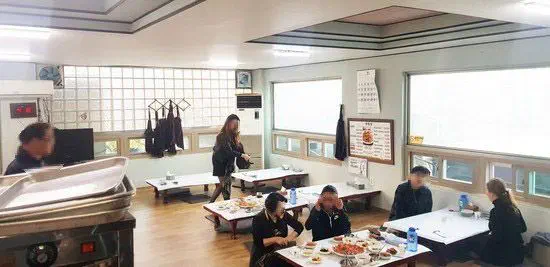
There are high chairs for babies and several private-ish rooms in the annex buildings, so it works well for family gatherings.
If you’re after a quiet, polished dining room, this isn’t that - it’s a loud, busy, well-worn country house, and that’s the charm.

Expect a wait.
On weekends the sign-up sheet starts filling before the 11 a.m. opening, and even weekdays can hit full house before noon.
Turnover is fast, though, so lines move quicker than they look.
Coming at 2-3 p.m. is the easiest way to skip the crowd.

Renovated dining room at Jeonsan Garden with tables and chairs and local diners at lunch

Agujjim: the sancho-and-bangah difference

When you order the braised monkfish, the staff ask two questions: whether you want sancho and bangah in it, and how spicy.
There are five heat levels from mild to extra hot; “normal” lands around the heat of Korea’s Shin Ramyun, which is genuinely spicy.
A word of caution for visitors: Korean “medium” here can be a lot if you’re not used to chili heat, so going one level down is a safe move. Have some rice ready.

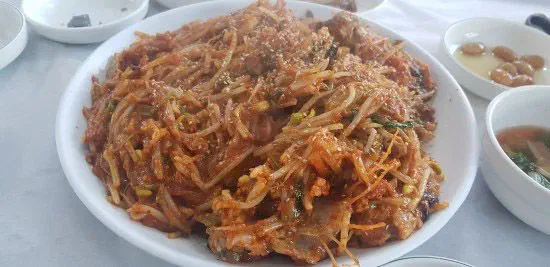
The monkfish is fresh, never frozen, and it shows - the flesh stays bouncy and clean-tasting with zero fishiness.
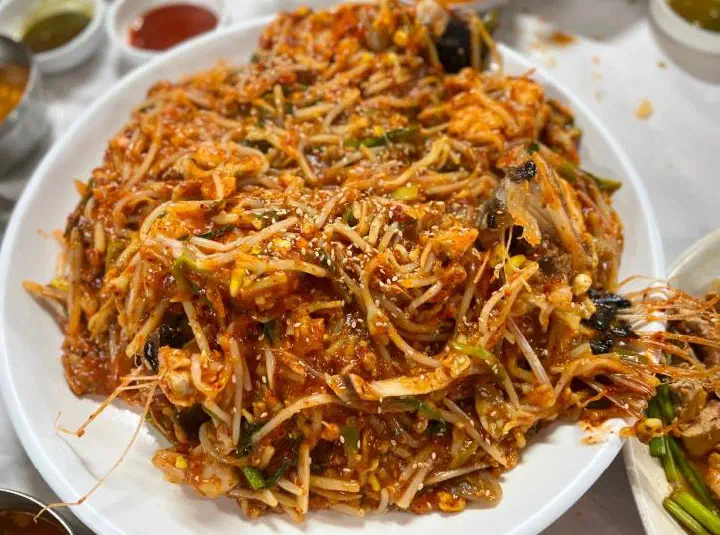
The sauce isn’t a blunt chili-paste burn; it’s savory first, then the tingling of sancho and the herbal lift of bangah come through.
Those two herbs are the whole point.
They’re divisive even among Koreans from other regions, but once the flavor clicks, ordinary agujjim starts tasting flat.
If you skip them, the sauce is pleasant but loses what makes this house special, so I’d say keep them in unless you’re very averse to herbs like coriander.

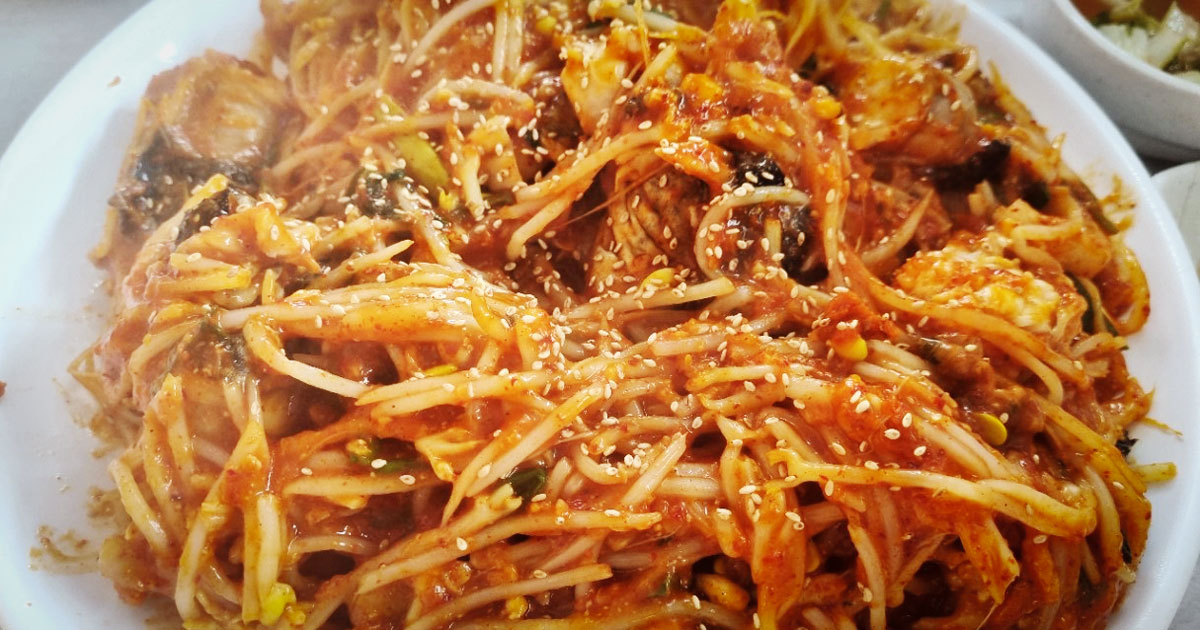
Close-up of spicy braised monkfish with sancho and bangah, fresh monkfish and bean sprouts in red sauce

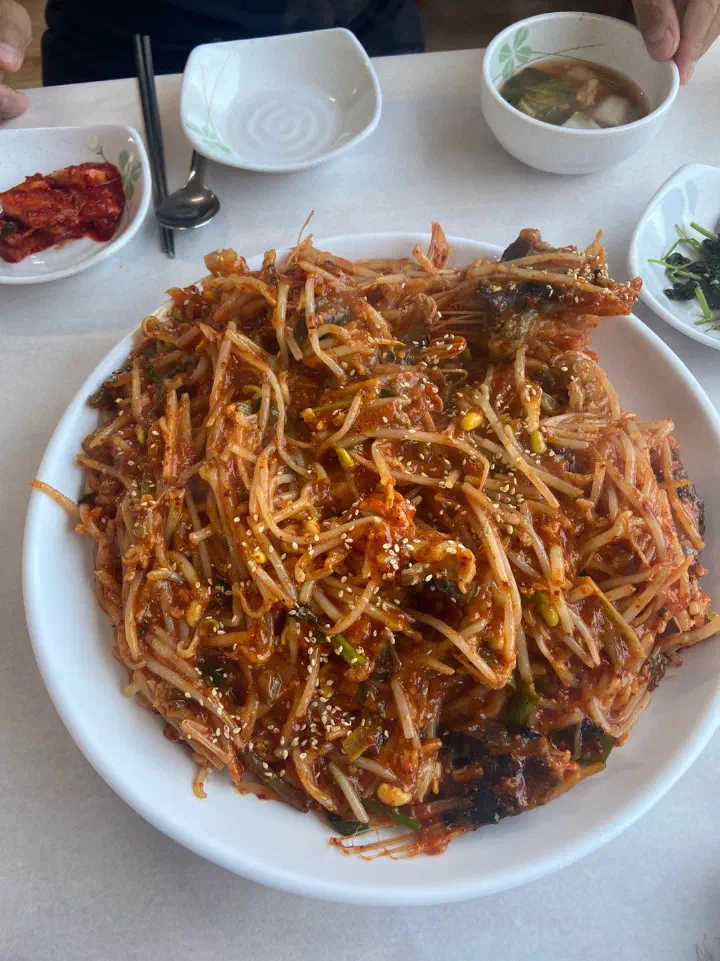
Portions are enormous.
The “small” feeds two to three adults; the “medium” can defeat a party of five.
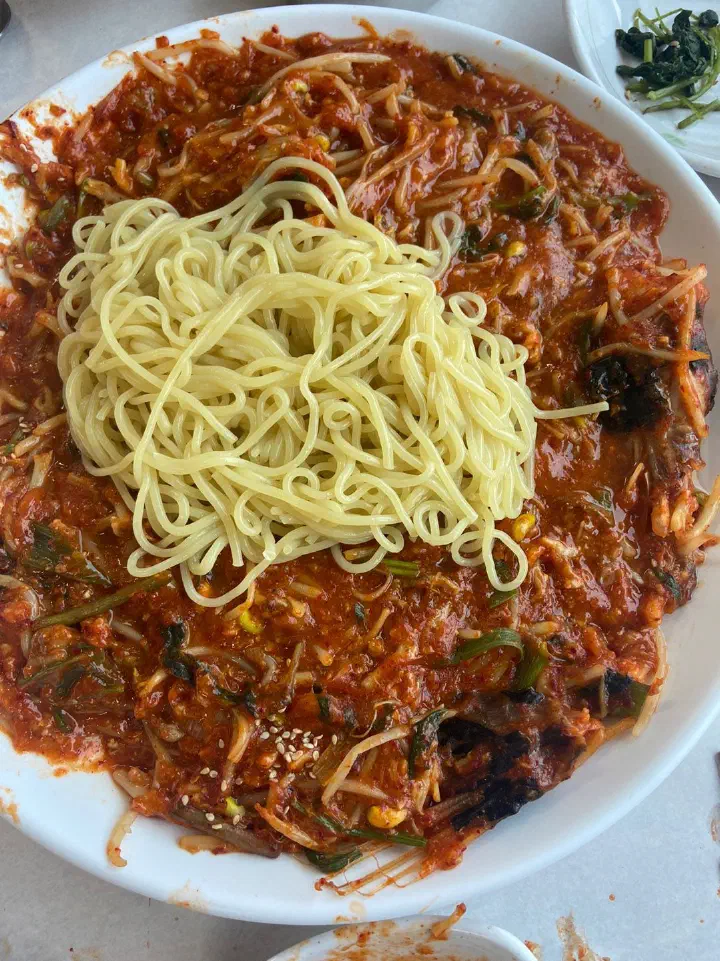
Crunchy soybean sprouts and sea squirts fill out the platter, and the standard finishing move is adding a chewy potato-starch noodle “sari” to mop up the leftover sauce.

Chewy potato-starch noodle sari added to the leftover agujjim sauce at Jeonsan Garden

Agu-suyuk: the real signature

Plenty of places braise monkfish; almost nobody steams it like this.
The suyuk arrives lightly seasoned with a reddish tint, crowned with generous slabs of monkfish liver - ankimo, if you know the Japanese term.
The liver is the highlight: dense, creamy, foie-gras-like, and best smeared over a piece of the flesh like a sauce.
Around it you get stomach, intestine, fins, and skin, each with a different texture.
Eat the stomach first while it’s hot - it turns rubbery as it cools.

The suyuk comes with a bowl of spicy monkfish broth on the side, and the plate itself is not spicy at all, which makes it the answer when someone at your table can’t handle heat.

One insider tip: tables that order the suyuk can add a mideodeok-jjim (미더덕찜), sea squirts and bean sprouts cooked in the agujjim sauce.
Save a few pieces of suyuk, mix them in, and you’ve effectively had both dishes in one sitting - ideal for a party of two.

Plate of monkfish braised with crunchy bean sprouts and mideodeok sea squirts in spicy sauce

Banchan and the room

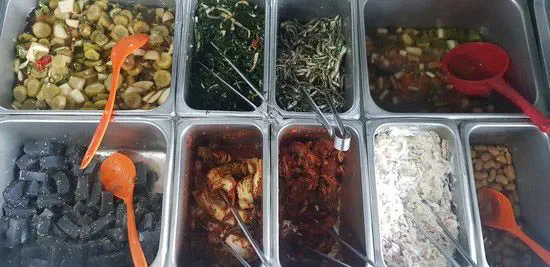
The seven or so side dishes are properly homemade: seaweed dressed with fish sauce, sweet braised sword beans, and a startling-looking braised monkfish mouth that regulars fight over - the bits of flesh around the jaw are chewy like jelly.
Self-serve banchan bar at Jeonsan Garden with seaweed salad, braised sword beans, kimchi and other Gyeongsang-style side dishes

The building used to be a floor-seating countryside restaurant, but a renovation a few years back switched everything to tables and chairs, which makes it much easier for anyone who struggles with sitting on the floor.
From the window seats you can see the Hangni breakwater and the sea.

The restaurant has been on Korean TV several times, including E-channel’s “Saturday Loves Food” in June 2022, and celebrity autographs line the wall.
TV fame brought younger crowds, but the backbone of the clientele is still regulars who’ve eaten here for decades.

Prices

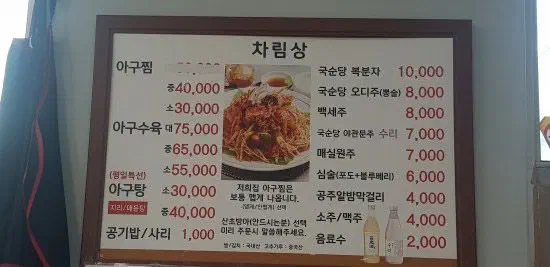
A small agujjim is 45,000 won and a small suyuk 65,000 won; there’s also a 50,000-won suyuk sized for two.
Prices have crept up over the years - the small braise was 30,000 won back in 2019 - but given the portions, most people leave feeling it was fair.
Rice is ordered separately, and leftovers can be packed to go for a small container fee, which many tables end up needing.

Menu board at Jeonsan Garden showing prices for agujjim, agu-suyuk and traditional Korean liquors

Practical notes for foreign travelers

Credit cards are no problem here - any internationally accepted card works, as at almost every restaurant in Korea - though it’s worth carrying a little cash in Korea generally, since the odd market stall or homemade drink can be cash-only.
There’s no tipping culture in Korea; leaving extra money would only confuse the staff.
Don’t expect much English, but ordering is easy: the menu has two dishes, so pointing and holding up fingers for the size does the job. Some younger staff understand basic English.
For directions, skip Google Maps for walking or transit routes in Korea - it’s unreliable here - and use Naver Map or Kakao Map instead. Kakao T is the taxi app to have.

Getting there without a car: take the Donghae Line commuter train to Ilgwang Station, then a taxi - it’s within base-fare distance, about 5 minutes.
A city bus stops right in front (Hangni entrance stop) but runs infrequently.
After lunch, the Hangni breakwater and Ilgwang Beach are close by for a sea-breeze walk, with several cafes along the water.
One more caution: the restrooms are outside the building and fairly basic, and the room gets loud at peak hours.

📍 View Jeonsan Garden (전산가든) on Google Maps →

Verdict

Jeonsan Garden is rough around the edges - old building, outdoor toilets, a dining room that roars at lunchtime.
It’s also one of the most distinctive fish meals you can have around Busan.
Fresh monkfish, a sauce perfumed with herbs you won’t meet outside Gyeongsang Province, portions that humble big eaters, and a steamed monkfish-liver plate that would cost a fortune as ankimo in a Japanese restaurant.

Full table setting at Jeonsan Garden with a small-size agujjim, side dishes and soup
If you’re driving the Gijang coast or staying near Ilgwang Beach, this is a meal worth planning around.