Cockles are a southern thing in Korea. Beolgyo, down on the south coast, is the name people know.
So it is a little odd that Gangneung, on the opposite side of the country, has turned cockle rice bowls into a local specialty.
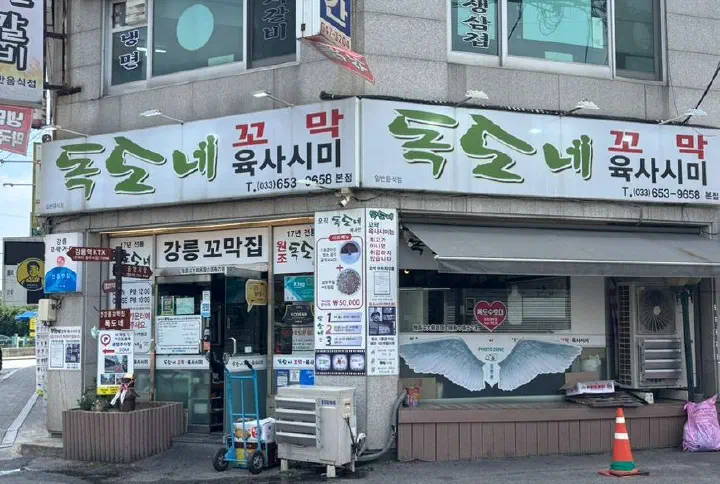
Dokdone (독도네), in the Okcheon-dong neighborhood, is one of the two names behind it, alongside the better known Eomjine.

Storefront and signage of Dokdone cockle restaurant in Okcheon-dong, Gangneung

The basics

Address: 47 Okcheon-ro, Gangneung-si, Gangwon State
Phone: 033-653-9658
Hours: 12:00 - 21:40, last order at 20:40
Closed: every Tuesday
Parking: no private lot, public lots nearby
Takeout available

📍 View Dokdone (강릉꼬막집 독도네 본점) on Google Maps →

From Gangneung KTX station it’s about 700 meters, a ten minute walk.
Gangneung Jungang Market and the Wolhwa-geori promenade are roughly ten minutes on foot in the other direction.
If you’re traveling without a car, this is one of the easier Gangneung restaurants to reach.

Worth knowing before you set off: Google Maps walking and transit directions are unreliable in Korea. Naver Map or KakaoMap will route you properly, and Kakao T handles taxis if you’d rather not walk.

The rice paddle line

There are only about seven tables inside, so the room fills fast.
Lunch and dinner peaks usually mean a wait, and arriving right at the noon opening is what gets you into the first seating.

You write your name and phone number on a list, and they hand you a numbered wooden rice paddle, pulled from a jar by the door. A rice paddle, not a buzzer.
Nobody explains it in English, but the paddle is your ticket. Hold onto it and come back when they call your number.

Turnover is quick enough that you can walk a block or two and come back.
Evenings run slower, though, since a lot of tables are drinking rather than eating and leaving.

Mid-afternoon, around three, is the quiet stretch. Two or three tables occupied, no line at all.

What to order

The menu is short. Seasoned cockles, raw beef slices, seasoned raw beef, and that’s it.

Kkomak muchim, small (꼬막무침): 37,000 won, includes the cockle rice bowl, sized for two
Kkomak muchim, large: 58,000 won, for three or four
Cockles plus half portion of raw beef or seasoned raw beef: 50,000 won
Yuk sashimi (육사시미), raw beef slices: 35,000 won
Yukhoe muchim (육회무침), seasoned raw beef: 35,000 won
Extra half portion of raw beef: 19,000 won
Extra rice bowl: 3,000 won
Bowl of rice: 2,000 won

For two people the 50,000 won combination makes the most sense. It runs 6,000 won cheaper than ordering the two dishes separately, and it is more food than most pairs finish.

Three people is the awkward number here, since scaling up means jumping to the large size and the per-person cost climbs. There’s no single-serving option either, so solo diners are out of luck.

Prices have barely moved in years. The small cockle dish ran 35,000 won with rice charged separately not long ago; it’s 37,000 now, rice included.

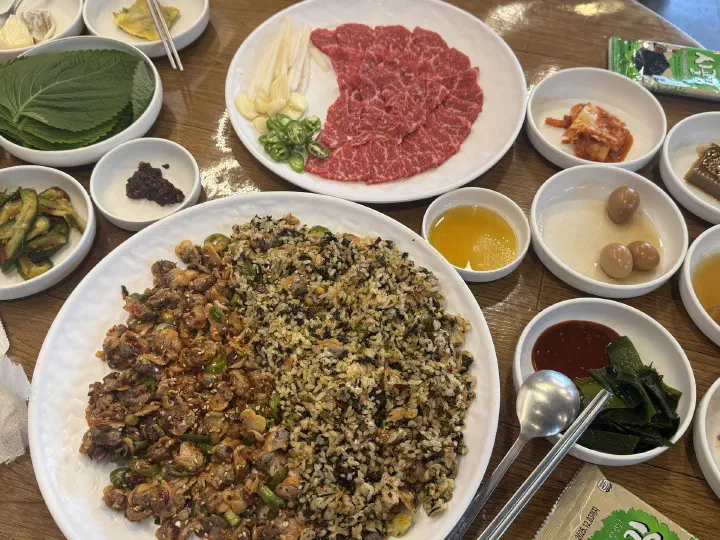
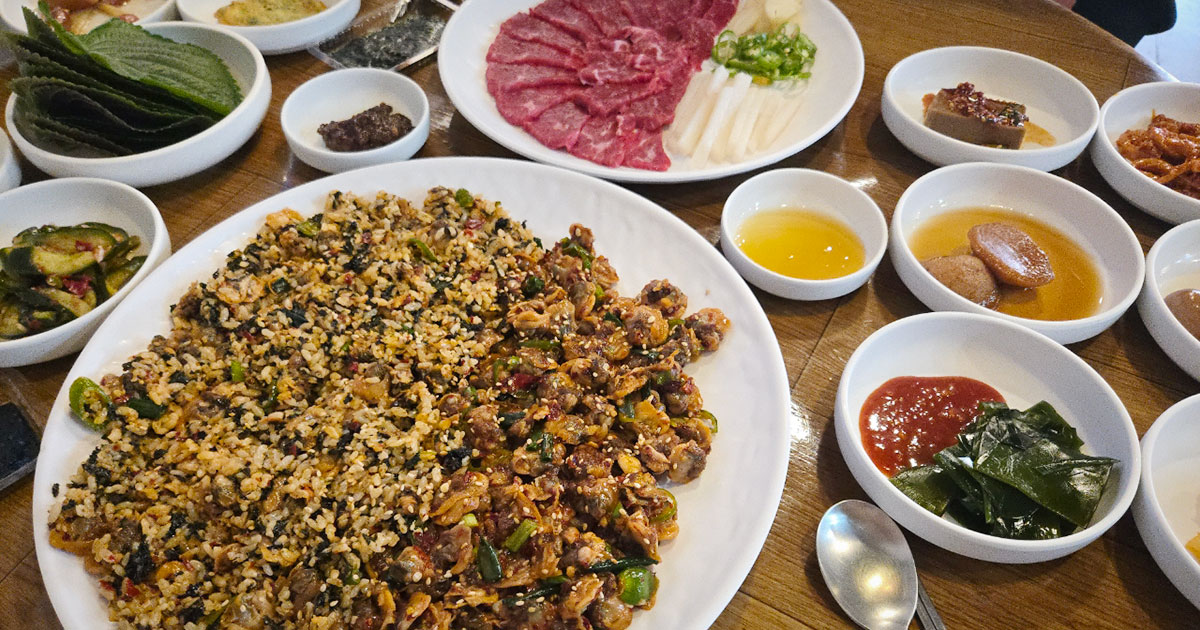
The 50,000 won combination set at Dokdone with seasoned cockles, rice bowl and raw beef

The cockles themselves

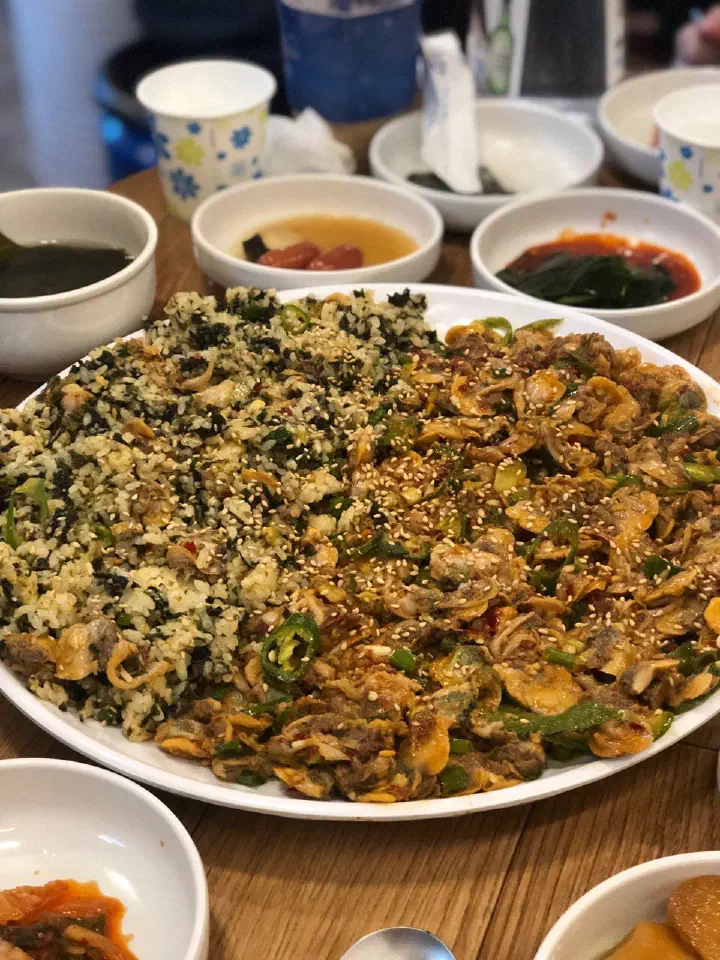
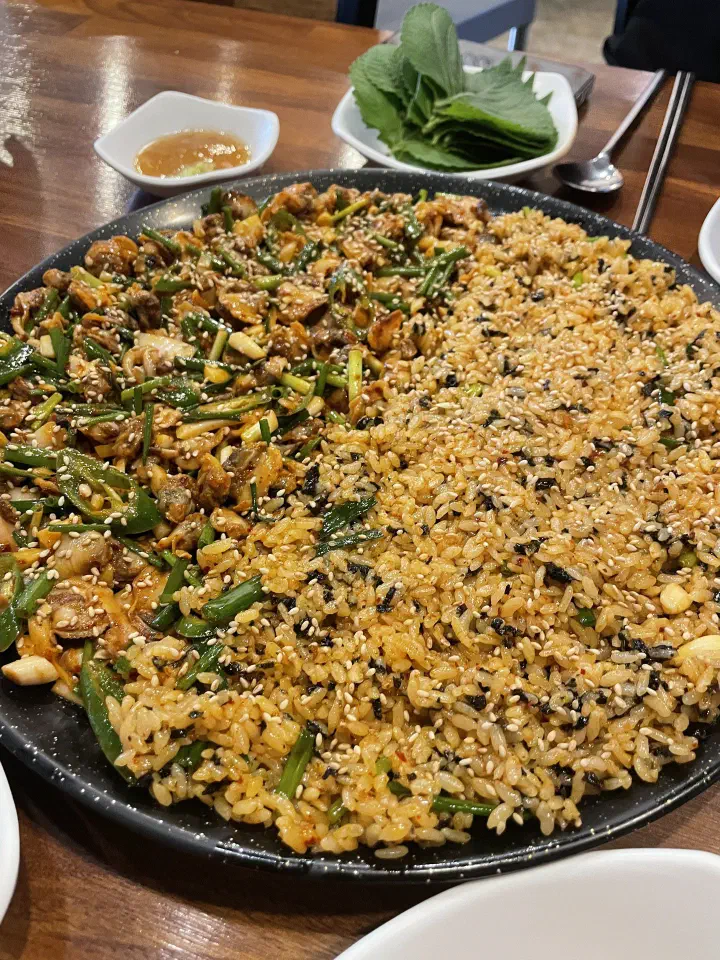
One large plate arrives with seasoned cockles on one half and the rice bowl on the other, already mixed and ready to eat.

Seasoned cockles and cockle rice bowl split across one large plate at Dokdone

A sign on the wall says the cockles come only from Yeosu and Beolgyo, and that they’re purged of grit before cooking. You won’t be grinding sand between your teeth here.
They are cooked so the meat stays plump and springy, without that shrunken, rubbery texture.

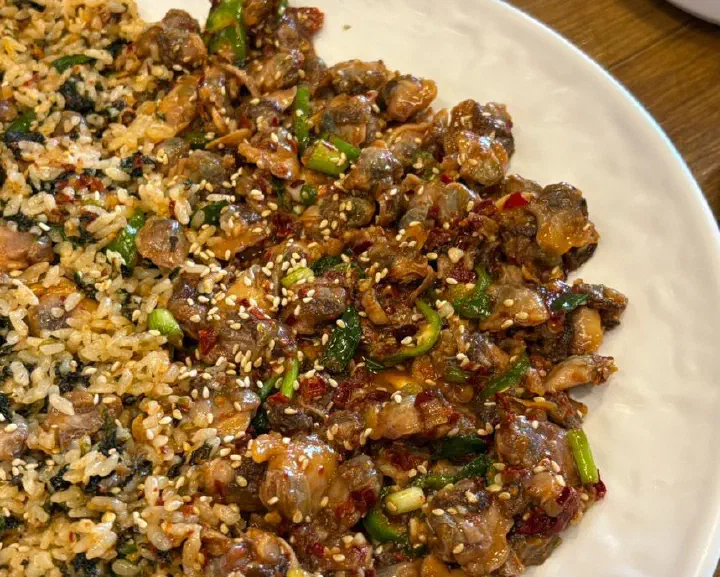
The seasoning is soy-sauce based, with perilla oil running underneath it. There are chili slices scattered through, but if you eat around them the dish is not spicy.
The first bite reads sweet, then the savory side builds as you go.

Close-up of Dokdone’s seasoned cockles with sesame seeds and green chili slices

Fair warning on the salt. This is a salty dish by Korean standards, and Korean standards are already salty. If you normally eat lightly seasoned food, this will be too much.
It’s also exactly why the place works as a drinking spot.

The rice half is the opposite, mild and nutty on its own. It is meant to be alternated with the salty cockles rather than eaten straight through.

The chilies mixed through are Cheongyang peppers, which are seriously hot by any standard, so eat around them unless you know what you’re doing. Staff will leave them out if you ask when ordering, and pointing at the menu while saying “no chili” gets the message across.

How to wrap it

There is a correct way to eat this, and the owner will show you.

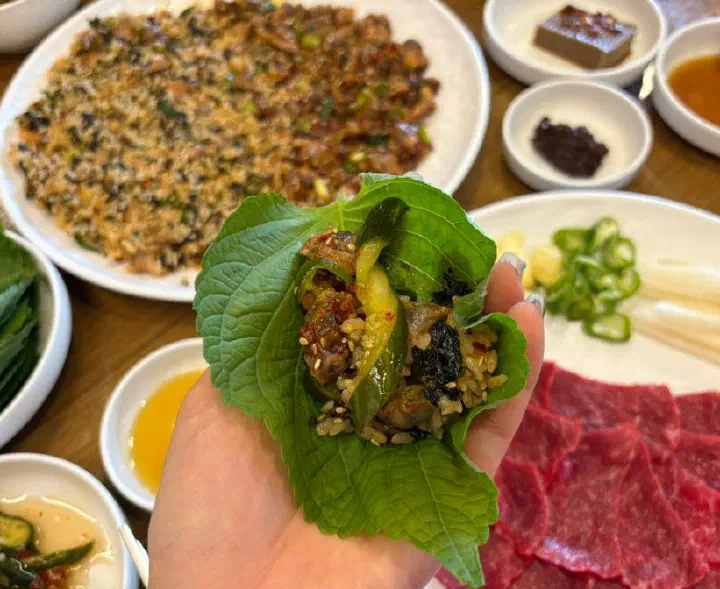
Lay a perilla leaf flat, put a sheet of roasted seaweed on top, add a spoonful of the rice, pile seasoned cockles over that, and finish with a piece of the pickled cucumber side dish. Wrap and eat in one bite.

A perilla leaf wrap filled with cockle rice and seasoned cockles at Dokdone

The cucumber ends up being the best thing on the table. Lightly salted, then dressed, still crunchy, with enough acidity to clear your mouth when the cockles start feeling heavy. Regulars ask for refills.

If you want more rice, you can order another portion, but only if at least half the cockles are left. So do not mix everything together at the start. Spoon it out gradually and you keep the option open.

Dokdone’s cockle plate served with a bowl of perilla leaves and sesame oil dip

About the raw beef

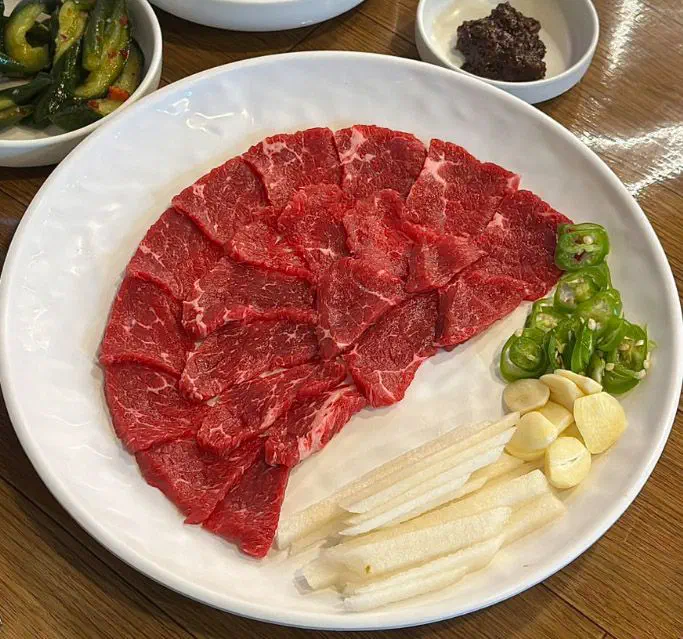
The raw beef comes from seolgit, a lean muscle in the round, on grade-1-or-better female cattle. They buy it outside the auction system, vacuum-sealed straight from the processor, and break it down in their own cutting room near Dongbu Market.

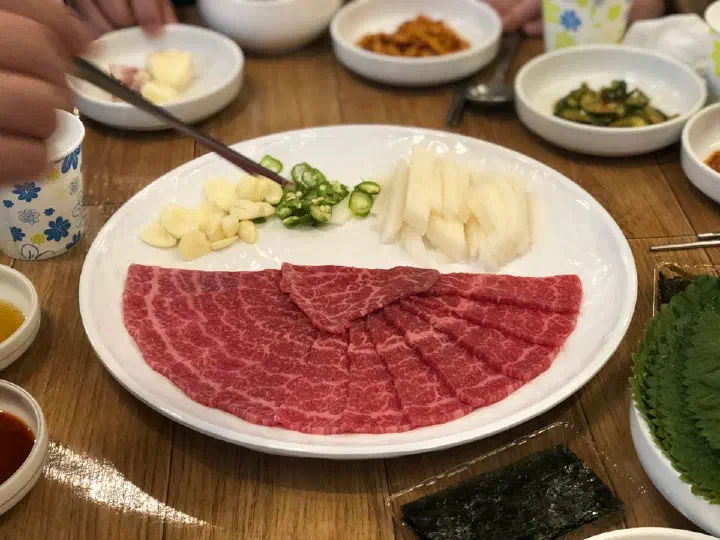
Plate of yuk sashimi raw beef slices with garlic, green chili and Korean pear at Dokdone

The texture is dense and chewy rather than soft. Dipped in sesame oil and salt it turns toasty, and a faint sweetness comes out the longer you chew. No off smell, which is the usual worry with raw beef.

There is a method here too: beef into the sesame oil, garlic and chili into the soybean paste.

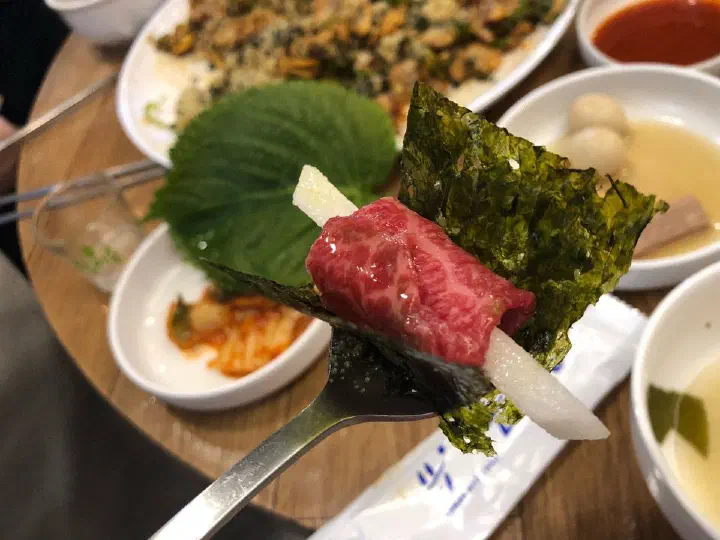
A slice of raw beef and Korean pear wrapped in roasted seaweed

The beef is good without being remarkable. If you’ve eaten raw beef elsewhere in Korea it will feel familiar, and whether it pairs well with cockles is a matter of taste. As a half portion inside the set, it earns its place.

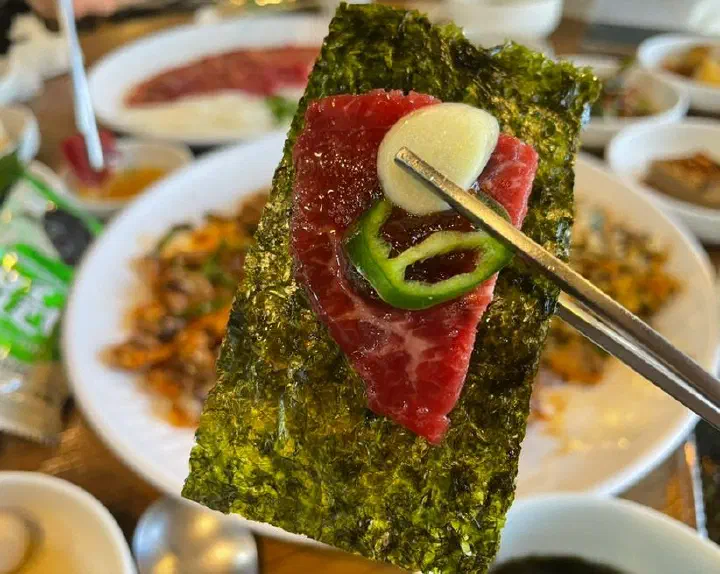
Raw beef topped with garlic and green chili on a sheet of seaweed, held with chopsticks

Side dishes and the seaweed soup

The banchan lands before the main dishes. Acorn jelly, that pickled cucumber, a savory pancake, sausage stir-fry, quail eggs, seasoned kelp with red chili sauce, braised potato, perilla leaves, kimchi, fruit salad. Ten or so small plates, each set down in its assigned spot on the table.

Banchan side dishes including pickled cucumber, kimchi and sesame oil dip at Dokdone

The miyeokguk - seaweed soup - is the quiet workhorse of the table. Finely cut seaweed simmered long enough that the broth turns deep and savory. A spoonful between bites of salty cockles settles things down, and it takes the edge off if the chili gets to you.

Refills are what people remember about this place. Nobody has to ask. Staff circle the room, notice an empty dish, and replace it. It happens constantly.

Service can vary. The owner and the younger staff are warm, though the older servers can come across as brusque, particularly during the dead hours when the room is half empty.

Payment is by card almost everywhere in Korea, and this place is no exception, so an international card will work fine. Korea has no tipping culture either, and leaving extra money on the table will only confuse the staff.

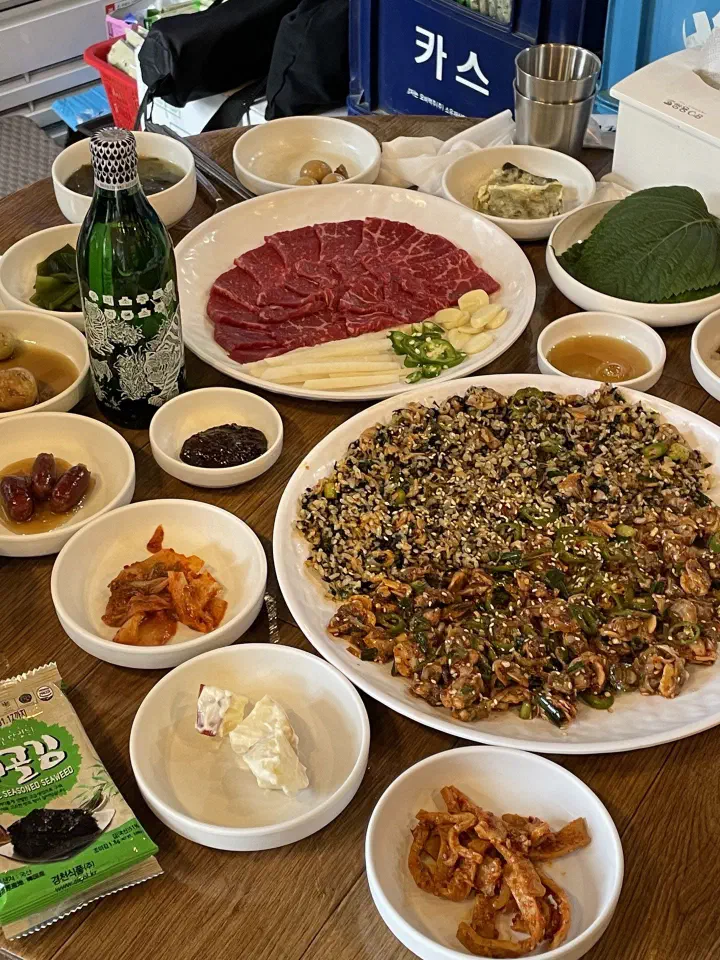
Dokdone’s cockle dish with a bottle of soju, seaweed soup and side dishes

Parking and other details

No private lot. The street out front is narrow and not a real option.

The easiest choice is the Dongbu Market public lot, three minutes on foot, with the first hour free. Paid hours run 10:00 to 19:00 Monday through Saturday, and public holidays are free.
There used to be a free lot across from the Nonghyup bank, but a sign went up in June 2026 saying it’s no longer available. The restaurant now points people toward the public parking about 30 meters away, next to a jokbal (pig’s trotter) shop called The Jokbal.
Budget roughly 2,000 won for parking if you drive.

Because the cockle dish is served cool by design, it survives the ride back to a hotel room better than most Korean food does.
You do have to come in person to place a takeout order, though. No phone orders. Plenty of people who hit a long wait switch to takeout and eat back at the hotel instead.

One more rule worth knowing: tables seated before six in the evening are limited to two bottles of alcohol.

The menu board is dense and covered in handwritten additions, which makes it hard to scan. English and Japanese menus exist, but ordering mostly comes down to pointing and holding up fingers. Staff don’t generally speak much English, and it doesn’t matter much in a two-dish restaurant.

Dokdone and Eomjine

Search for cockle rice bowls in Gangneung and Eomjine comes up first. Dokdone has been the steady second name for just as long.

Among people who have tried both, opinions split. Eomjine leans harder on sesame oil. Dokdone pushes the soy sauce further, with more depth behind the salt. Eomjine is the bigger operation, Dokdone the small room.
Only Dokdone offers the two-person combination set.

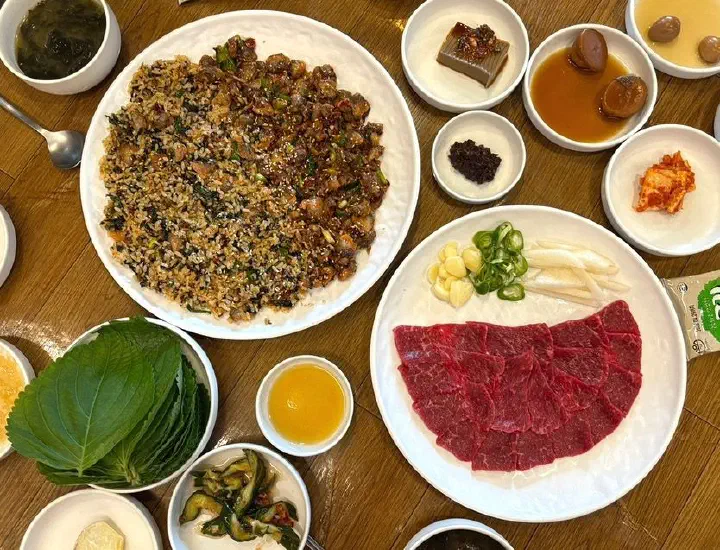
Overhead view of Dokdone’s two-person set with cockle rice bowl, raw beef and ten side dishes

Locals in Gangneung tend to bring visiting friends here. The place has been running more than twenty years, has appeared on national TV several times, and has the signed celebrity photographs on the walls to prove it.
The house motto posted in the kitchen translates roughly to “listen to the son” - the second generation is clearly running things now.

There’s another line near the register: there may be first-time customers, but there are no customers who come only once. Corny, sure, but the number of repeat diners backs it up.

Who this is for

If you like cockles, this belongs near the top of a Gangneung food list. The shellfish is clean and properly cooked, and the perilla leaf wrap with cucumber is the part you won’t get at the cockle place down the street.

The salt level is real, parking is a hassle, and there’s nothing on the menu sized for one.

For two people, especially with a drink involved, or as a first or last meal near the station, it does the job. Skip the peak hours and you’ll get an unhurried table.

📍 View Dokdone (강릉꼬막집 독도네 본점) on Google Maps →