Gangneung has two dishes travelers keep chasing: soft tofu in Chodang, and jang kalguksu (장칼국수) almost everywhere else.
For the second, the name that keeps coming up is Geumcheon Kalguksu (금천칼국수).
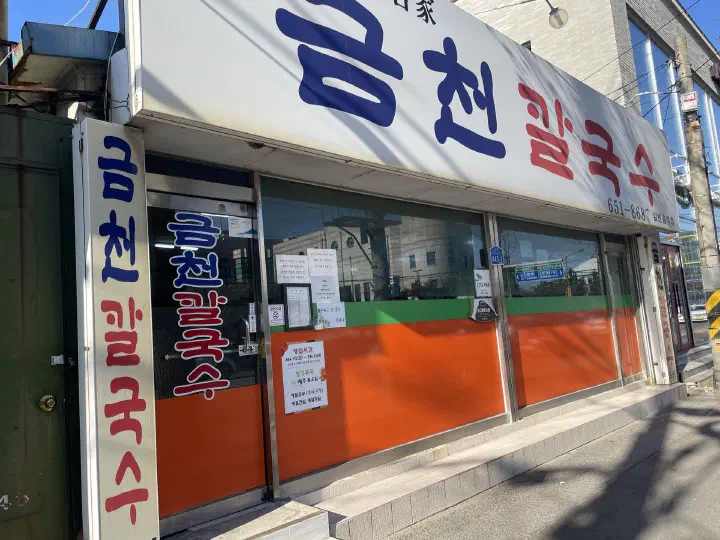
It is a small, worn old place across the street from the city library, and it runs on a paper list taped by the door.
No app, no remote check-in, no reservations.
Which means the whole visit turns on when you show up.

Exterior of Geumcheon Kalguksu in Gangneung with its blue Korean signboard

The basics

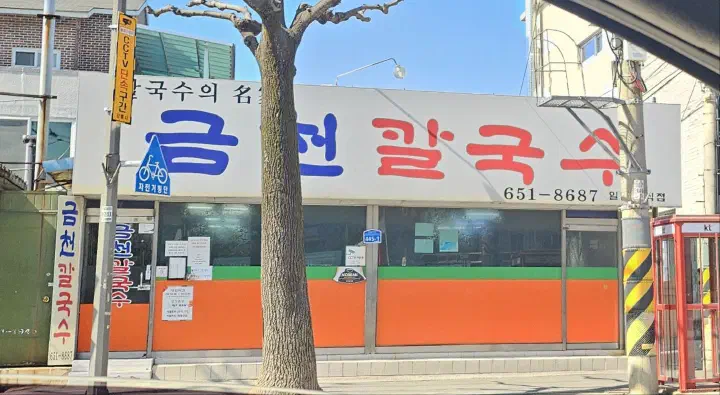
445-1 Gangneung-daero, directly across from Gangneung City Library.
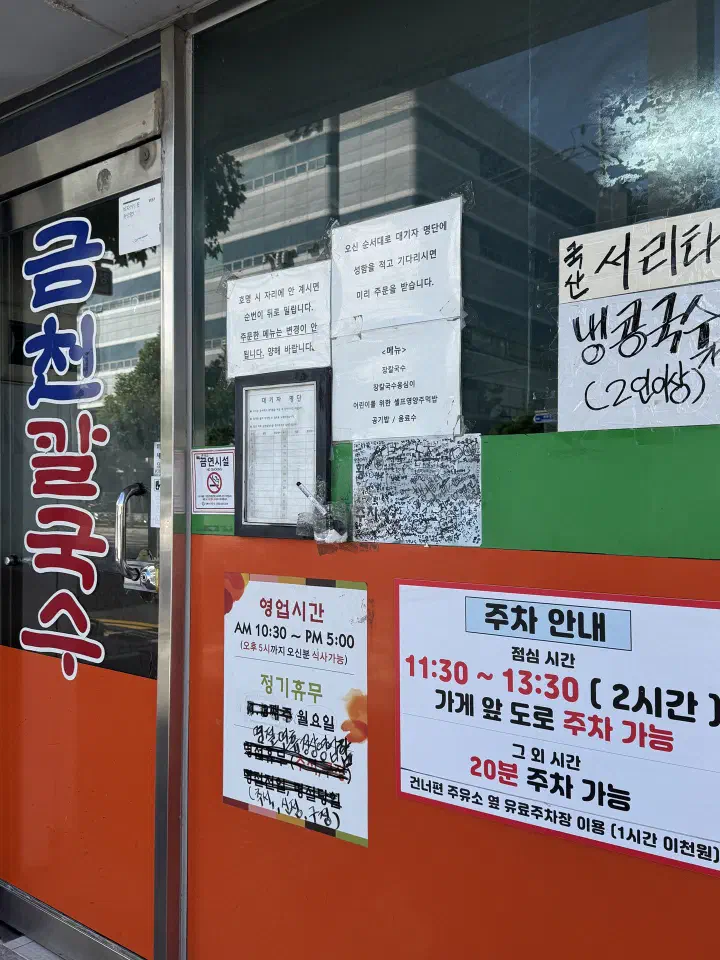
Open 10:30 to 17:00, closed Mondays.
There is a phone number, 033-651-8687, but nobody there takes bookings on it.
The kitchen shuts at 17:00, though if you are through the door by then you will get fed.

Street view of Geumcheon Kalguksu on Gangneung-daero across from the city library

📍 View Geumcheon Kalguksu (금천칼국수) on Google Maps →

One note on maps: Google Maps walking and transit directions are unreliable in Korea.
Naver Map or KakaoMap will get you there properly, and both have enough English to be usable.

How the line works

When you arrive, find the sheet of paper by the entrance and write your name and the number of people in your group.
That is the entire system.
Nothing digital, nothing remote, so you have to physically stay near the door until your name is called.

Paper waiting list and parking notice taped to the entrance window of Geumcheon Kalguksu

At some point while you wait, someone comes out and takes your order right there in line.
If you have wandered off when they reach your name, your turn slides down the list or gets dropped.
The order also cannot be changed afterward, so decide before you write your name down.

That early order is why food often hits the table a couple of minutes after you sit down, at least on a quiet morning.
Without it the wait would feel a lot worse than it does.

When to show up

Time of day matters far more than the day of the week here.
From 10:30 opening until about 11:30, tables are often free and you can walk straight in.
From 11:30 the line starts building, and 12:00 to 13:00 is the worst stretch, when even a weekday can cost you 20 to 40 minutes.

Weekends and midsummer push it further.
Sunday lunch can run close to an hour, and on a busy morning a 10:15 arrival can land you eighteenth in line.
If you want an opening-time seat on a weekend, aim for 10:00.

After 13:30 the crowd thins noticeably, and by late afternoon you can usually sit down right away.
If your schedule allows a late lunch, that is the easiest window by far.

Do not expect a fast turnover once you are inside.
At peak the kitchen batches bowls, so the wait at the table can stretch to 15 or 20 minutes, and clearing tables is slow on top of that.
Sometimes the room looks half empty while people are still standing outside.

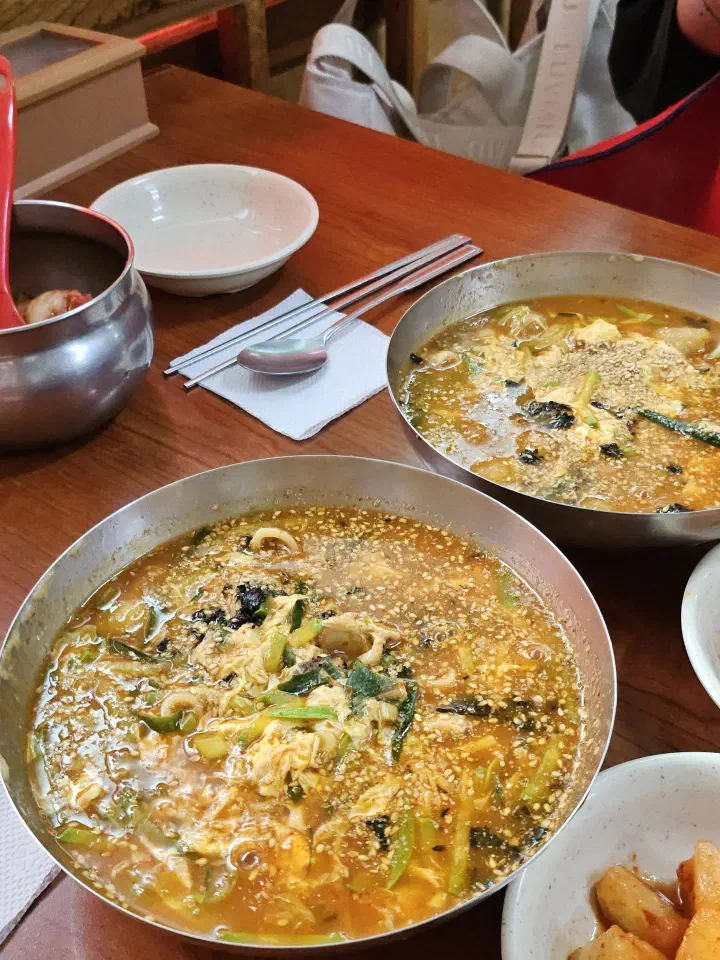
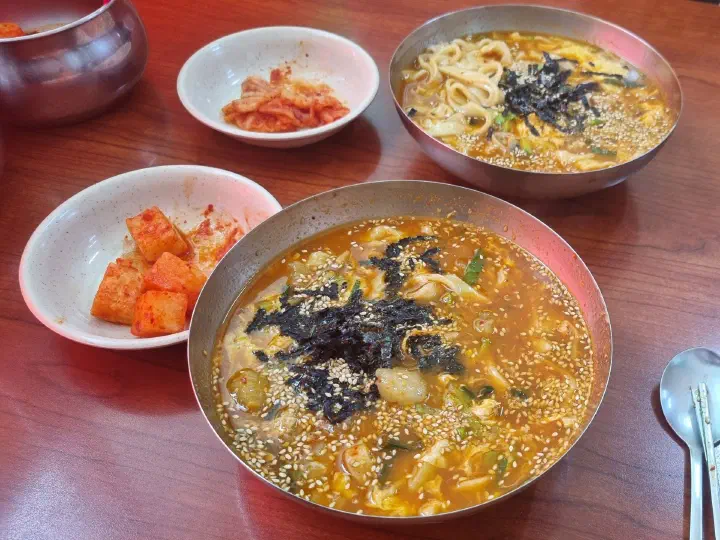
Two bowls of jang kalguksu served on a low wooden table at Geumcheon Kalguksu

Parking is its own problem

There is no lot. Drivers tend to find this out too late.

You can park on the street right in front, but only between 11:30 and 13:30, for a maximum of two hours.
Outside that window the limit drops to twenty minutes, which is not enough for a meal.

The practical option is the Ponam paid lot, next to the gas station across the road at 436 Gangneung-daero.
It is a four-minute walk, and it costs 2,000 won for the first hour, then 1,000 won per additional 30 minutes.
Circling the back alleys for a free space costs you more time than the fee is worth.

The library lot across the street is free, but an attendant sometimes asks whether you are actually using the library, so it is not a reliable plan.
If you are not driving, a taxi from Gangneung Station takes about 20 minutes, and Kakao T is the app to call one with.

Three dishes, plus rice

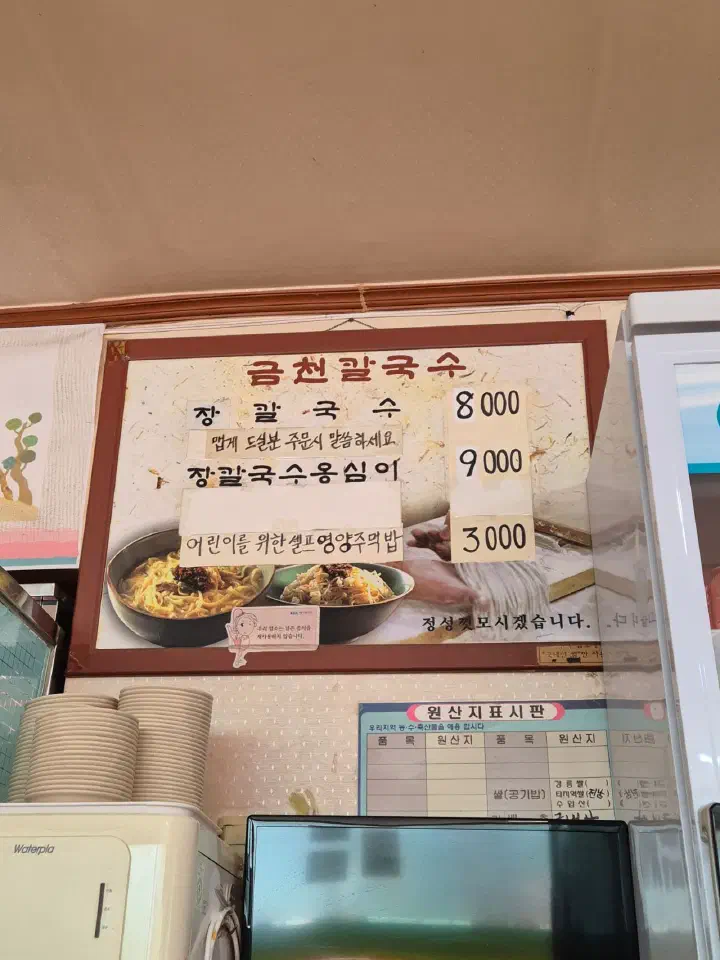
Jang kalguksu is 9,000 won.
Jang kalguksu ongsimi (장칼국수옹심이), the same soup with potato dumplings mixed in, is 10,000 won.
Yeongyang jumeokbap (영양주먹밥), a seasoned rice ball you mix yourself, is 3,000 won, and plain rice is 1,000 won.
In summer they add a cold black soybean noodle soup, but it only comes as an order for two, so solo diners are out.

Handwritten Korean menu board with jang kalguksu prices at Geumcheon Kalguksu

The price sat at 8,000 won for years before moving to 9,000, which is still modest for a restaurant this well known in a tourist city.

About the heat: you can ask for it spicier, but you cannot ask for it milder.
This is spicy by Korean standards, call it Shin Ramyun and maybe a notch past it.
If you have not built up a tolerance, plan accordingly.
Order the standard version and get rice or a rice ball on the side to take the edge off.

Card payment is fine here, as it is in nearly every Korean restaurant, and international cards work without any fuss.
There is no tipping in Korea, and leaving money on the table will only confuse the staff.
English is limited, but the menu is short enough that pointing and holding up fingers gets the job done.

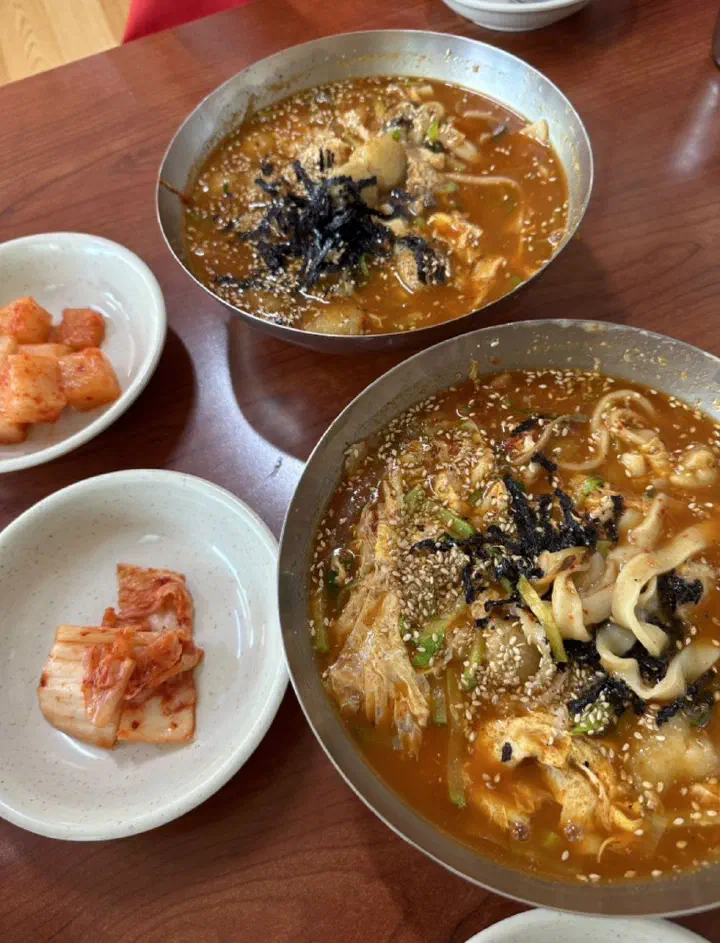
Jang kalguksu and jang kalguksu ongsimi served with cabbage kimchi and kkakdugi

What the bowl is actually like

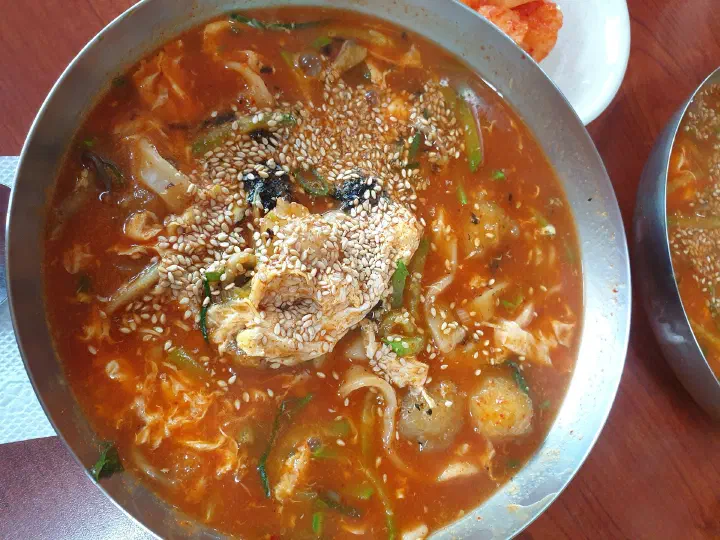
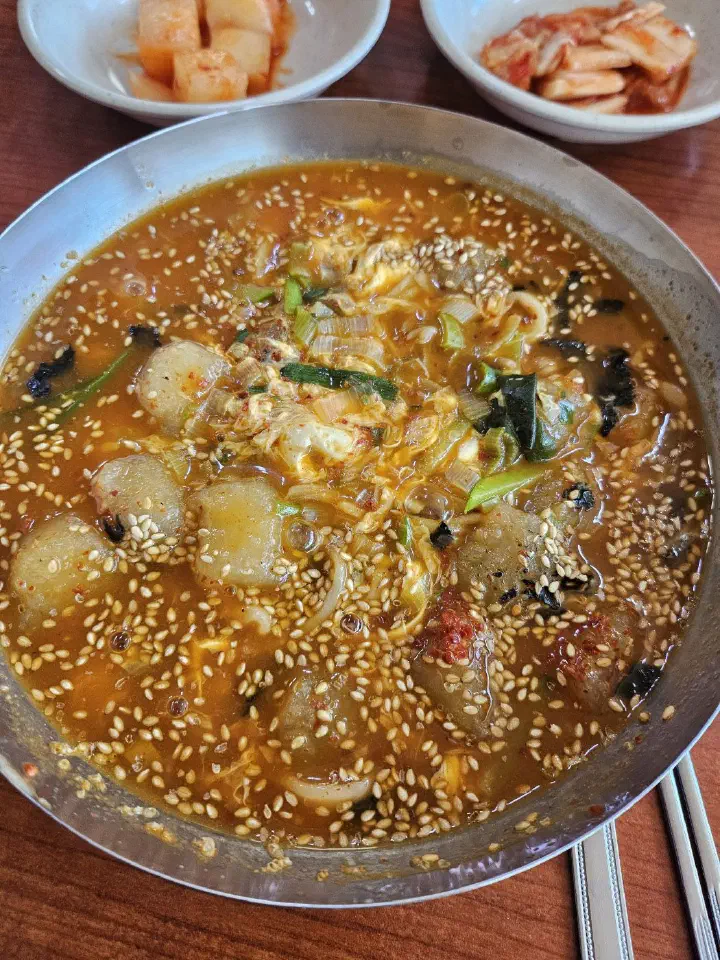
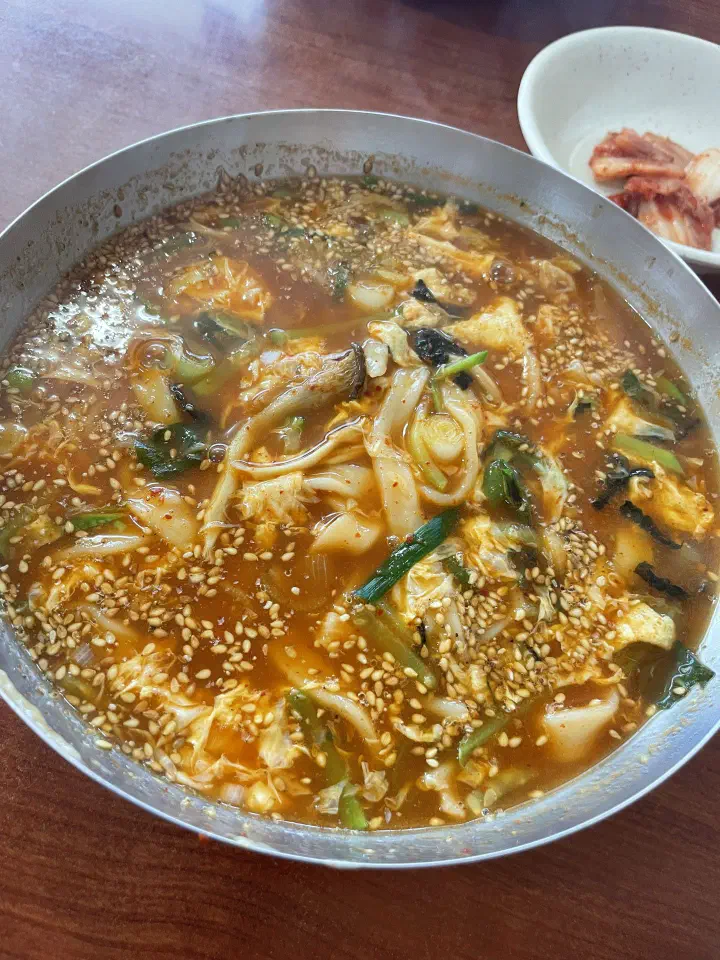
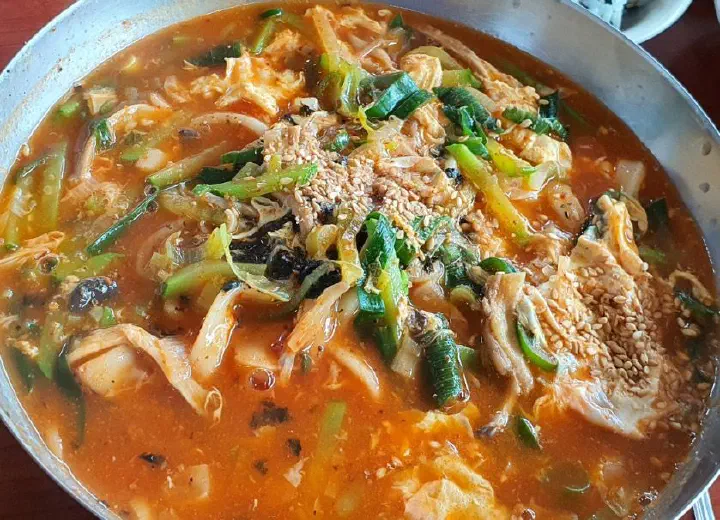
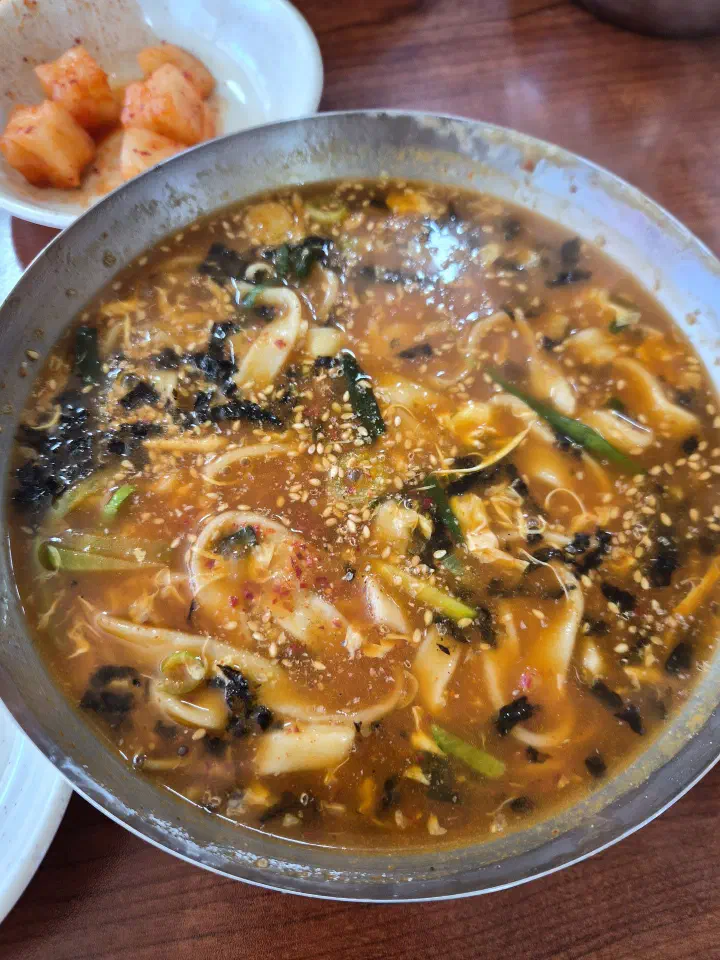
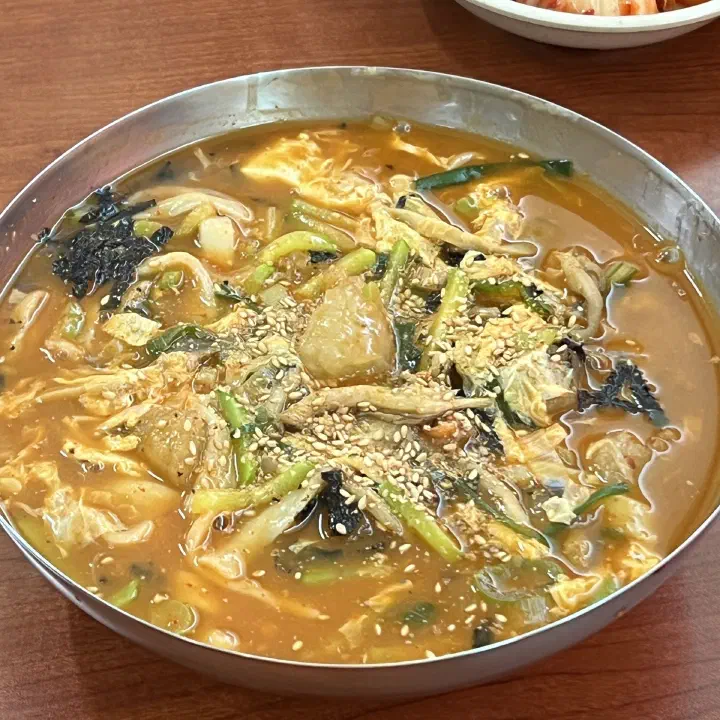
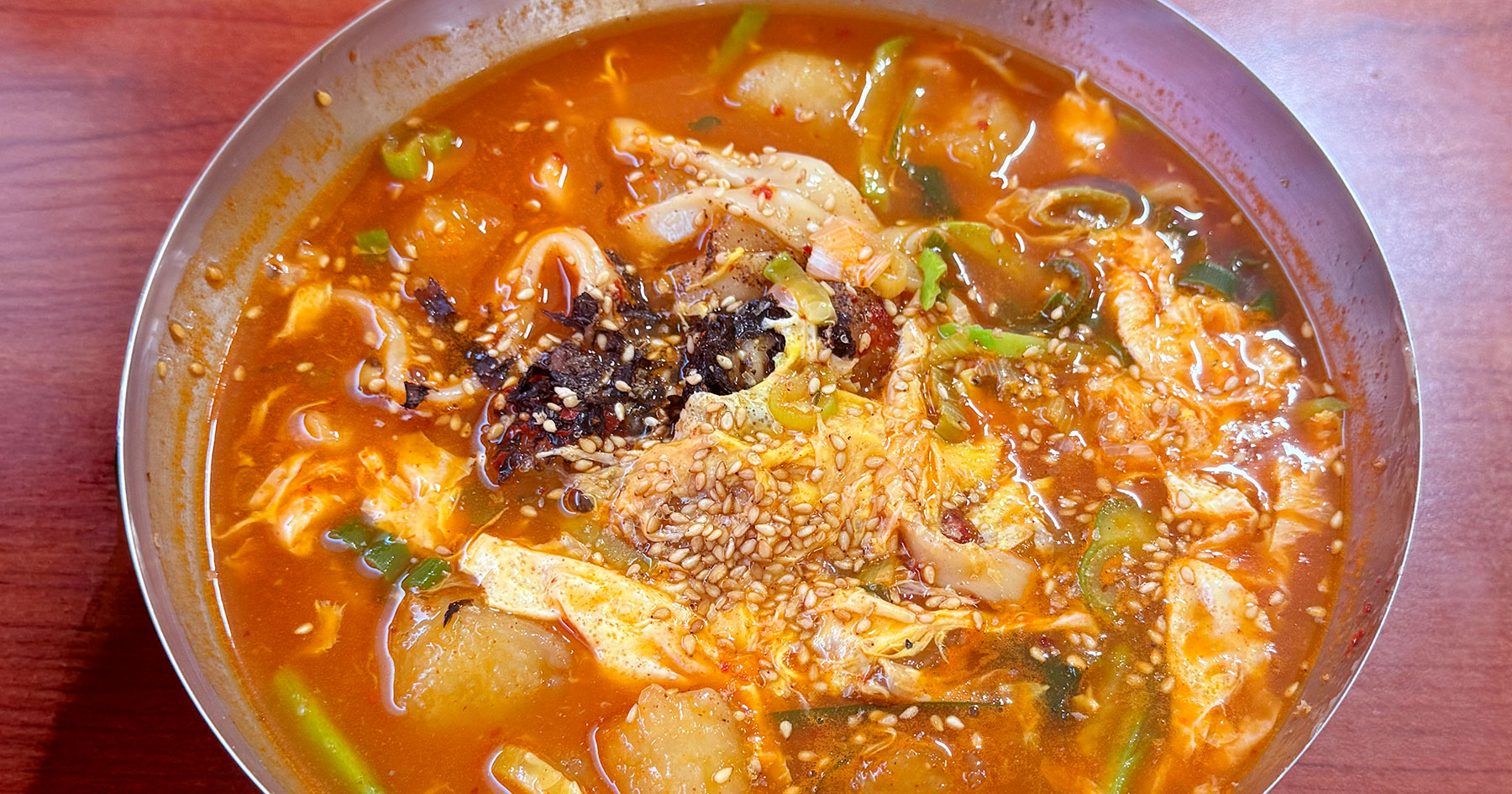
The broth is red and thick, built on gochujang, with sliced zucchini, egg swirled through it, dried seaweed flakes, and a heavy scatter of sesame on top.
It is rich without being heavy or muddy, and the first spoonful reads more nutty than fiery.
The burn arrives a few bites later, the kind that has you blotting your forehead by the halfway mark.

Close-up of the red gochujang broth of jang kalguksu covered in toasted sesame seeds

The sesame is why so many people compare it to instant ramen broth, specifically Ottogi’s Chamkkae Ramyun.
People are not neutral about that.
It is either the thing they drive back for, or the thing that makes the broth taste manufactured to them.
If you came for a deep, fermented doenjang-style soup, look elsewhere.

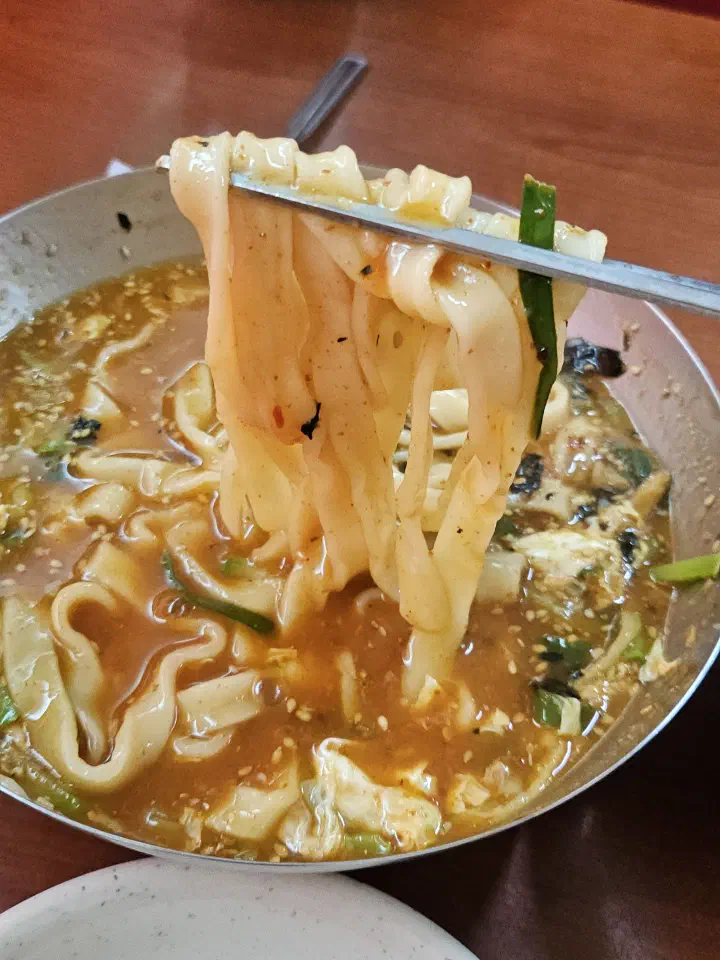
The noodles are wide and thick, and they carry the broth well enough that a bare chopstickful still tastes like the soup.
Not everyone wants noodles that thick, though; you can taste the flour in them.
The potato chunks buried in the bowl are one of the best parts, soft and floury and worth fishing for.

Wide, thick knife-cut kalguksu noodles lifted from the broth with chopsticks

The ongsimi version is what this place is known for locally, since it was the first in Gangneung to put potato dumplings into jang kalguksu.
The dumplings are chewy and dense, the broth runs slightly thicker with them in it, and it costs only 1,000 won more.
Not everyone loves them; a fair number find them dry instead of springy.
For two people, ordering one of each and sharing is the usual move.

Bowl of jang kalguksu ongsimi with chewy potato dumplings in spicy broth

The kimchi is not an afterthought

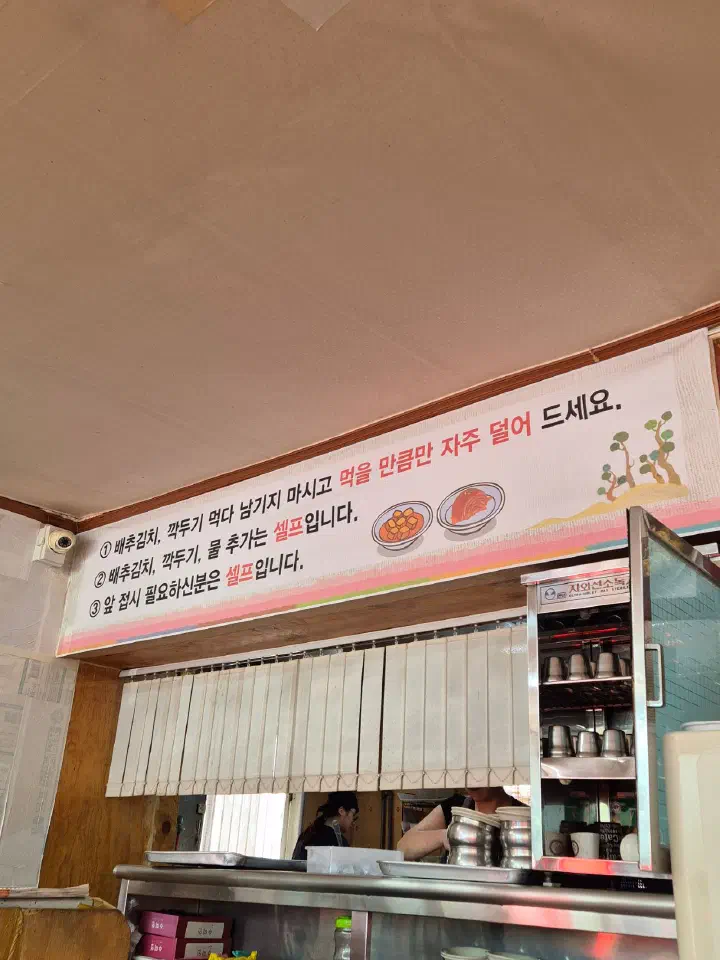
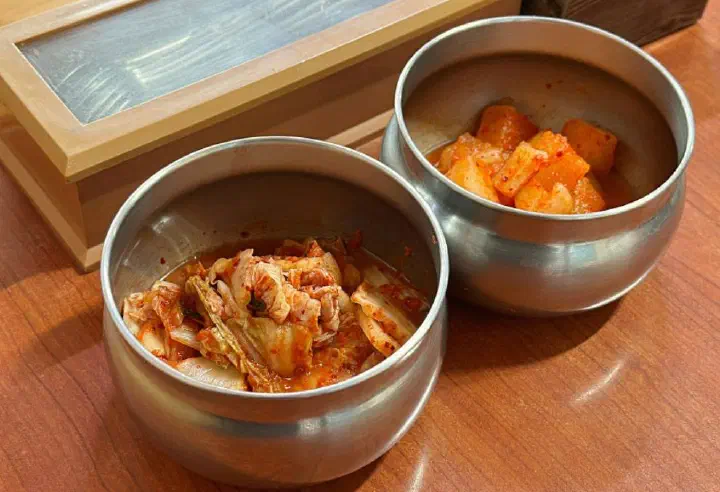
There is a large container at each table with cabbage kimchi and kkakdugi, the cubed radish kind, and you spoon what you want onto a small plate.
A sign asks you to take small amounts at a time rather than piling it up and leaving it, which is a fair request in a place this busy.

Korean sign at Geumcheon Kalguksu asking diners to serve themselves small portions of kimchi

The kkakdugi is the better of the two, sharp and faintly sweet, and it takes the edge off the broth.
The cabbage kimchi leans sweeter and gets somewhat lost against a soup this strongly seasoned.
Take a little, go back for more, and you will end up eating far more of it than you expected.

Cabbage kimchi and cubed radish kkakdugi in stainless steel bowls at Geumcheon Kalguksu

The room itself

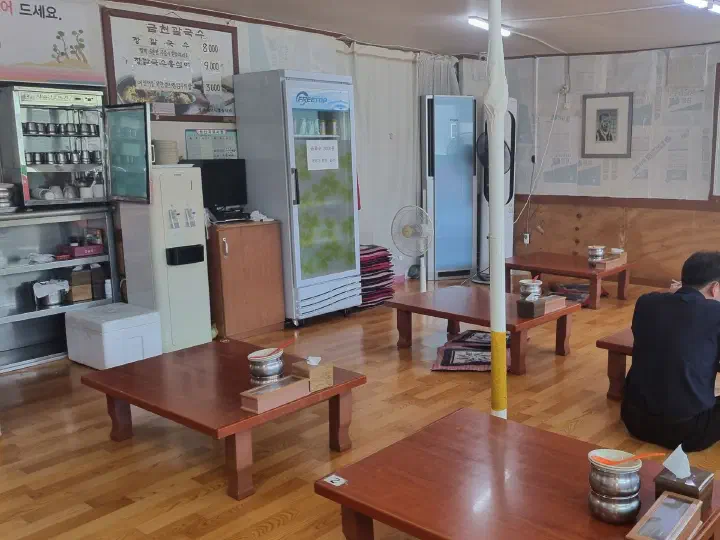
The building shows its age from the outside, and the inside matches.
There are around nine four-person tables, and all but one are floor seating, so shoes come off at the step.
Cushions and aprons sit off to one side for anyone who wants them.

Interior of Geumcheon Kalguksu with low tables and traditional Korean floor seating

The floor seating is the most common complaint about this place.
If sitting cross-legged for half an hour is hard on your back or knees, you are competing for that single raised table, and it is rarely free.
The same goes for families with babies, since the high chair only works at that one table, and some parents bring a portable booster seat instead.

In summer the room gets hot.
It is a hot noodle restaurant with fans and an air conditioner that never quite wins, so a morning visit beats a mid-afternoon one in August.
Signed boards from a YouTube shoot hang on the wall, and they still pull in the occasional pilgrim.

Where opinions split

Ratings for this place are uneven, 4.45 on Naver and 3.8 on KakaoMap, and the gap comes down to three things.

Bowl of Geumcheon Kalguksu jang kalguksu served with a side of cabbage kimchi

Salt, first: the broth is seasoned hard, and people do ask for water to cut it.
Then the ramen association, which reads as comfort to one diner and as a shortcut to the next.
Then the wait itself. An hour in July heat or January wind changes how the same bowl lands.

Close-up of jang kalguksu broth with sliced zucchini and swirled egg

Portion size deserves a mention too.
The bowls are not large, there is no extra-large option, and a hungry adult may want the 1,000-won rice on the side.
Service is brisk and impersonal. Nobody is going to check on you mid-meal.

Single bowl of jang kalguksu with a side dish of kkakdugi radish kimchi

Getting there

The restaurant sits on Gangneung-daero directly opposite Gangneung City Library, in the Ponam-dong neighborhood.
Gangneung Station is about 20 minutes away by car, and city buses stop near the library.
If you are driving, setting your navigation to the Ponam paid lot rather than the restaurant itself saves a lap around the block.

📍 View Geumcheon Kalguksu (금천칼국수) on Google Maps →

My takeaway

How much you like this place depends on how long you stood outside first.
Get in within half an hour and a 9,000-won bowl, with unlimited kimchi on the side, is a good deal by any measure.
Stand in the August sun for an hour and the same bowl has a lot more to prove.

Overhead view of a bowl of jang kalguksu ongsimi at Geumcheon Kalguksu

So treat the timing as part of the meal.
Come right at opening on a weekday or after 13:30, park at the Ponam lot, and order the standard spice level with rice on the side if you are unsure about heat.
Do that and it is a good local bowl of Gangneung noodles. Skip the planning and it turns into an errand.

Two bowls of jang kalguksu and ongsimi topped with dried seaweed, served with kimchi