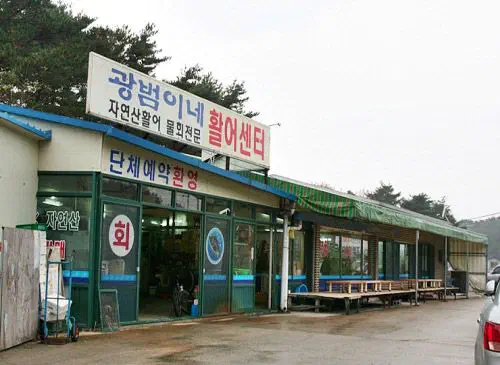
Right on the waterfront at Gajin Harbor in Goseong, there’s a small place that has been serving one dish for more than thirty years.
The sign says hoetjip (a sashimi house), but almost everyone here orders the same thing: mulhoe (물회), a cold, spicy raw fish soup.
That single focus is the whole point of Gwangbeomine Hoetjip (광범이네횟집).

Exterior and signboard of Gwangbeomine Hoetjip near Gajin Harbor in Goseong, Korea

The basics before you go

The address is 114 Gajin Haebyeon-gil, Jukwang-myeon, Goseong-gun, Gangwon-do.
It opens at 10 a.m. and closes at 8 p.m., with last order at 7 p.m., so don’t leave a late dinner to chance.
It’s closed every Monday, which is worth remembering if you’re planning a Monday trip up the coast.
The phone number is 033-682-3665, though don’t count on English over the phone.

Prices are simple. The regular mulhoe runs around 17,000 won per person, and the deluxe (특) is 29,000 won.
Both need a minimum order of two servings.
There’s also hoedeopbap (raw fish over rice), maeuntang (spicy fish stew, 40,000 to 60,000 won), and a flatfish version of the mulhoe.
A bowl of rice is an extra 1,000 won.

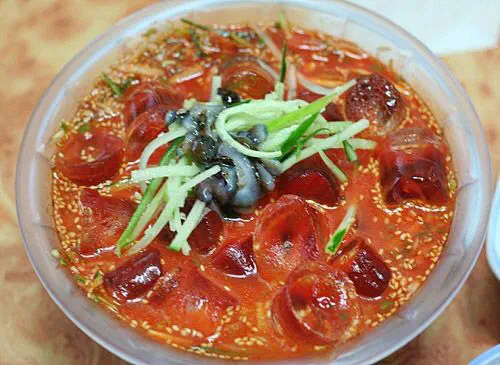
Top view of gajami sekkosi mulhoe, spicy cold raw flatfish soup, at Gwangbeomine Hoetjip

📍 View Gwangbeomine Hoetjip (광범이네횟집) on Google Maps →

Who it suits

This isn’t really a solo-diner spot.
Since mulhoe starts at two servings, coming alone puts you in an awkward spot.
It works far better for families or a group.
The room is fairly large and drinks are cheap, so it doubles nicely as a place to settle in for a long, unhurried meal.

It also fits neatly into a coastal day trip.
Gajin Beach sits right out front, so finishing a bowl and then walking out to the open East Sea feels like the natural next step.

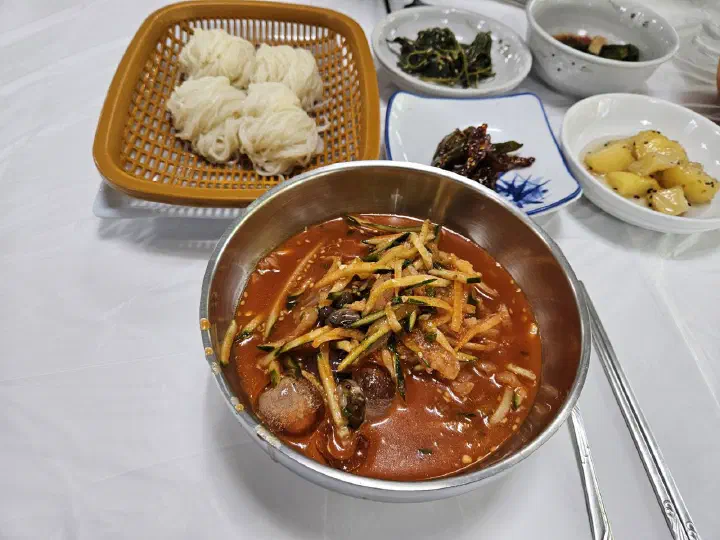
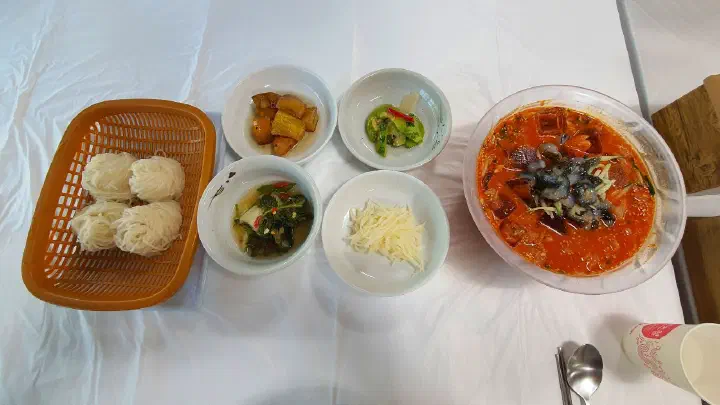
Mulhoe served with a basket of somyeon noodles and Korean side dishes at Gwangbeomine Hoetjip

Getting there, and when it’s busy

Gajin Harbor is in Jukwang-myeon, a little north of Sokcho.
Most people here arrive by car, and honestly that’s the way to do it.
Public transport to this stretch of coast is thin, so a rental car or taxi makes life much easier.
A quick note on navigation: Google Maps is unreliable for directions inside Korea, so use Naver Map or KakaoMap instead. The KakaoT app is the easiest way to call a taxi.

Busy times are exactly what you’d guess: summer, and weekend lunch.
On a hot afternoon the tables fill fast and you may end up waiting for one to turn over, sometimes close to an hour.
On a weekday or in the off-season, though, it can be so quiet you’ll wonder if it’s the same place.
If you want it relaxed, aim for just after opening or the early afternoon and skip the lunch peak.

The mulhoe itself

It all comes down to the broth.
The base is chojang (a sweet-and-sour red chili sauce), and the first thing you get is a sharp, sour lift, followed by a deep, spicy heat.
If you’re tired of mulhoe that’s just sweet, this cleaner, punchier broth is a welcome change.

A full bowl of Gwangbeomine mulhoe in a red chojang-based chilled broth

One warning: it’s genuinely spicy.
This is spicy by Korean standards, which means it can be a lot for many visitors, so brace yourself if you’re not used to Korean heat.
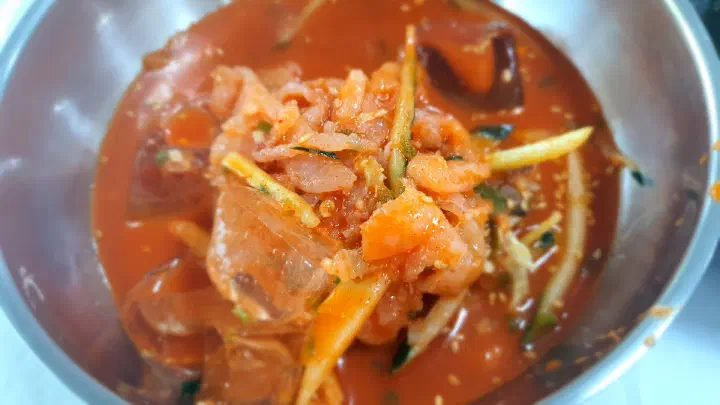
There’s ice floating in the bowl, and as it melts the broth loosens up a little, so you can use it to dial the heat down as you go.

Close-up of Gwangbeomine mulhoe stirred together with floating ice cubes

The fish is gajami sekkosi (가자미 세꼬시), thin slices of flatfish cut through the bone.
It’s chewy in a good way, and this is where opinions split.
Some love that crunch, others find the tiny bones distracting.
The bones aren’t tough, so it’s approachable even if sekkosi is new to you.
If you’d rather skip it, call ahead and they can swap in flatfish (gwangeo) sliced without the bone.

They’re not stingy with the fish, either.
Keep digging and more keeps turning up, so the value holds up well.
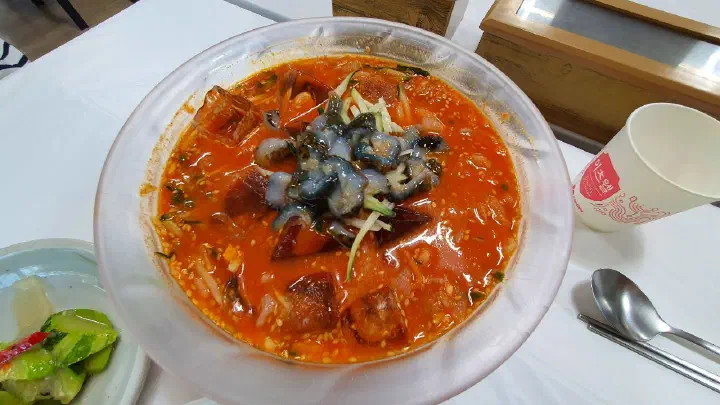
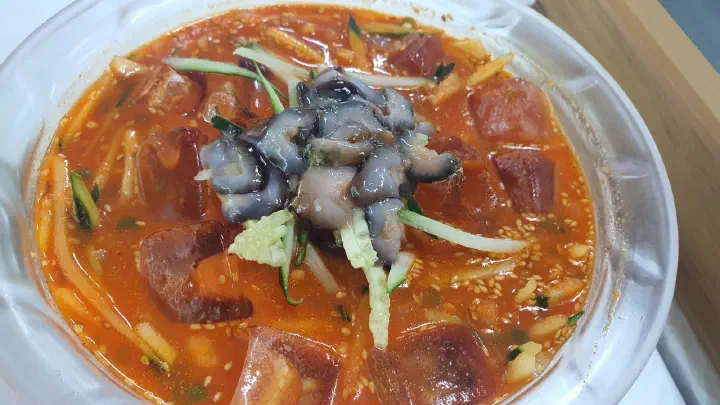
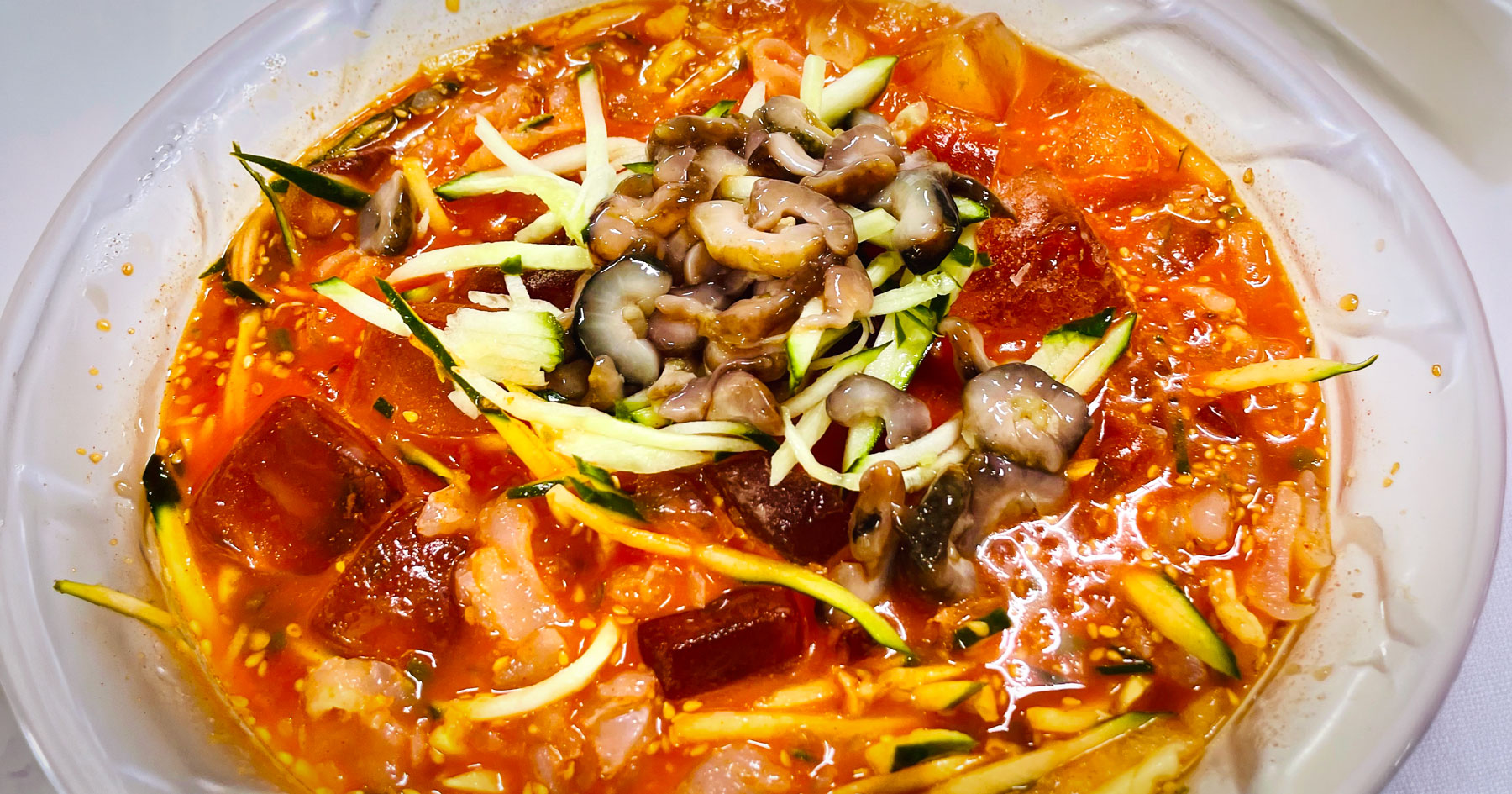
If you want it more generous still, go for the deluxe, which adds sea squirt, sea cucumber, and conch.

Close-up of the deluxe mulhoe topped with sea cucumber, sea squirt, and conch at Gwangbeomine Hoetjip

Noodles, rice, and the side dishes

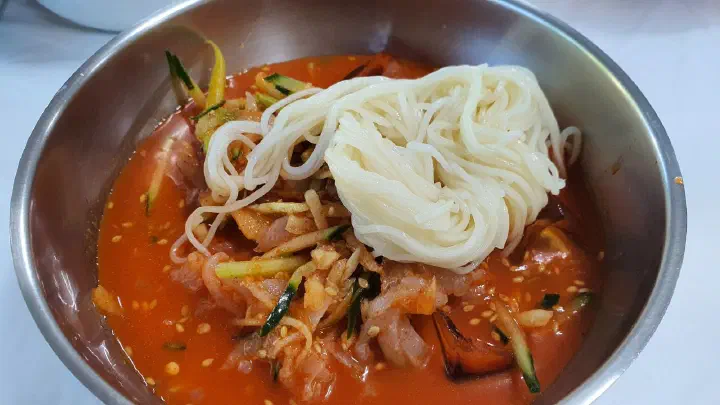
Your mulhoe comes with somyeon (thin wheat noodles), two portions per person, four for an order of two.
It looks like a little, but there’s so much fish that it usually ends up being enough.
You can ask for more noodles if you run short.

Somyeon wheat noodles added into a bowl of Gwangbeomine mulhoe

Noodles are good, but warm rice stirred into this broth is its own reward.
The spicy soup soaks into the grains and goes down easily.
If you plan to eat it with rice, order a bowl early and let it cool a bit first.

The side dishes deserve their own mention.
A warm bowl of miyeokguk (seaweed soup) comes first, along with seasoned young radish, stir-fried anchovies, seaweed stems, candied sweet potato, and a savory pancake.
They’re all well made, and they build the anticipation before the mulhoe even arrives.
If you’re with a child, the seaweed soup and rice alone can make a small meal.

Korean side dishes including candied sweet potato and seasoned greens served with mulhoe at Gwangbeomine Hoetjip

Hoedeopbap and maeuntang are worth a look

Beyond the mulhoe, two other dishes are worth ordering.
One is hoedeopbap, the raw fish rice bowl, again loaded with flatfish sekkosi and tossed with vegetables. It’s filling, and a good pick if the spicy broth sounds like too much.
The other is maeuntang, the spicy fish stew.
The interesting part is that the fish in the stew is different from the fish in the mulhoe, plumper and softer, and it suits the fiery broth well.
Start with mulhoe and finish with maeuntang and the table feels genuinely full.

Parking, payment, and small tips

Parking is easy. There’s space in front and a wide yard around back, though summer crowds fill it up, so come a bit early in peak season.
The seating used to be floor-style, but after a remodel it’s now regular tables, which makes it comfortable even in cold weather.
That’s part of why people show up for mulhoe in winter too, cold soup with a bowl of warm seaweed soup on the side is a surprisingly good match.
Takeout is possible, though on days the ingredients run out early it may not be.

Like almost everywhere in Korea, you can pay with a card, and internationally issued cards work fine here, so there’s no need to carry much cash.
There’s also no tipping culture in Korea. You don’t leave a tip, and trying to can actually confuse the staff.
The owner can come across as a bit brusque, but if that doesn’t bother you, it’s an easy place to enjoy a good bowl and head out.
Ordering isn’t hard even without shared language: point at the menu and hold up how many you want.

Final thoughts

Gwangbeomine’s mulhoe isn’t the mild, sweet kind. It’s the sharp, clear-the-sinuses kind.
It suits people who want to stir rice into a fiery bowl and finish it clean, and anyone who enjoys the chew of sekkosi.

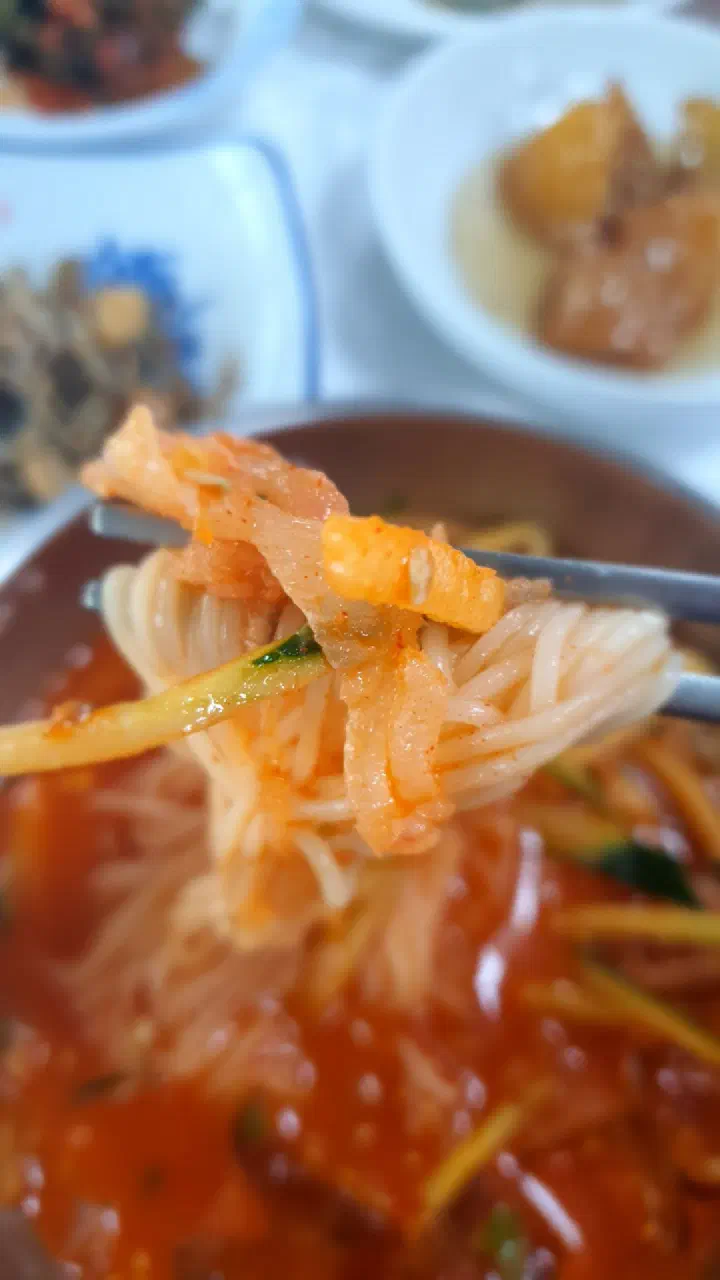
Chopsticks lifting flatfish sekkosi and somyeon noodles from a bowl of Gwangbeomine mulhoe

If you were hoping for something gentle and sweet, or you can’t handle heat, it may be too much.

So it’s a hard sell for anyone after a mild bowl, but for someone craving spicy, ice-cold mulhoe, it’s the kind of place you find yourself coming back to.
Thirty-plus years in the same spot isn’t an accident.
If you’re anywhere near Gajin Harbor in Goseong, it’s worth putting on the list.

How to find it

It’s at 114 Gajin Haebyeon-gil, Jukwang-myeon, Goseong-gun, Gangwon-do, right in front of Gajin Beach.
Check the map below before you set off.

📍 View Gwangbeomine Hoetjip (광범이네횟집) on Google Maps →