If you’re anywhere near Byeollae and the word “eel” comes up,
this is the name people land on.

Jangeoui Kkum (장어의 꿈) sits a short walk from Byeollae-Byeolgaram Station
in Namyangju, just northeast of Seoul. The short version:
it’s a Korean freshwater eel place where you pick your own eel
from a refrigerated case and grill it yourself,
for roughly half what a normal eel restaurant charges.

The catch is that everyone already knows this,
so waiting in line is basically part of the experience.
Below is the food and the price, yes,
but also how to actually dodge the queue,
and the parts that genuinely fall short.

Who it suits

This is a place for two or more people, and it shines for family meals.
You’ll see a lot of grown kids bringing their parents here
for a restorative, protein-heavy meal.
Because you grill the eel yourself, one or two people end up
on tong duty the whole time, so coming solo is awkward.

The tables are big and reasonably spaced,
which makes it easy for a larger group to sit together.
What it isn’t is quiet or intimate. It’s busy and loud
through the whole meal, so don’t come expecting a calm dinner.

The basics and getting there

The address is 492-6 Sunhwagung-ro, Namyangju-si, Gyeonggi-do.
It’s about a five-minute walk from Exit 2 of Byeollae-Byeolgaram Station (Line 4).

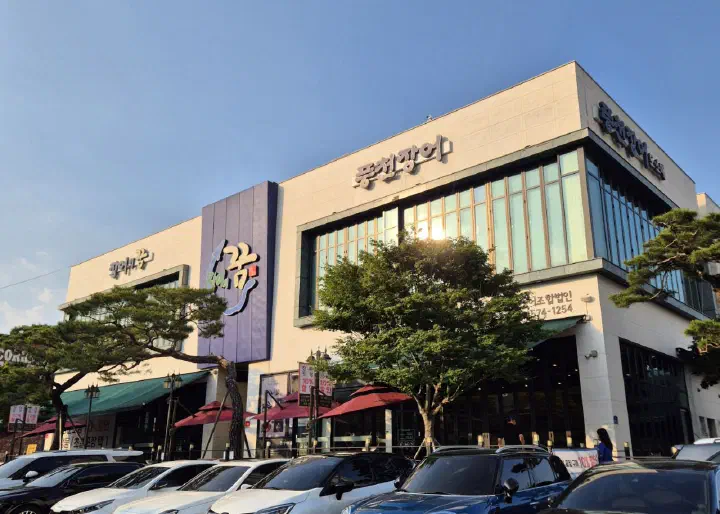
Exterior of Jangeoui Kkum eel restaurant in Byeollae, Namyangju, with parking lot in front

Hours run from 11:00 on weekdays and 10:40 on weekends,
until 21:50, with last order at 20:50. It’s open every day.
There are no reservations at all, only walk-in waiting.

Parking is generous, with three separate lots.
Coming off the main road, the first lot on your right
is closest to the entrance; keep going and you’ll reach lots two and three.
One small thing: the road up to the second lot is one-way,
so on the way out you loop back down the other side.

A note for visitors without a car: from Seoul you can take Line 4
straight to Byeollae-Byeolgaram, and the walk from Exit 2 is short.
For getting around Korea generally, Naver Map or KakaoMap
give far more accurate transit and walking directions than Google Maps,
and the Kakao T app is the easy way to grab a taxi.

📍 View Jangeoui Kkum (장어의 꿈) on Google Maps →

Pick your own eel, butcher-shop style

This is what sets the place apart.
On the first floor there’s a seafood counter where cleaned eel
is laid out by weight, like a butcher’s case.
You browse, choose the size and thickness you want,
and pay for the eel first.

Every pack is clearly tagged with weight and price,
and the day’s market rate is posted separately.
Choosing by sight makes the freshness obvious,
which honestly builds more trust than being handed a plate.

Staff suggest about 300 to 350 grams per adult,
or closer to 450 if you’re skipping rice and going all-in on eel.
Once you pay, you’re given a table number,
and your charcoal and side dishes are waiting when you sit down.

The eel is Korean-farmed jauponica (자포니카) freshwater eel,
sourced directly from clean-water farms in regions like Yeonggwang and Muan.
The farm origins are even posted on a board.
Buying and distributing at this scale is exactly
how they keep the price so low.

Hand-picked cleaned Korean-farmed jauponica freshwater eel fillets

Salt-grilled eel, eel soup, cold noodles

There’s no sweet-sauce option here, only salt grilling (소금구이).
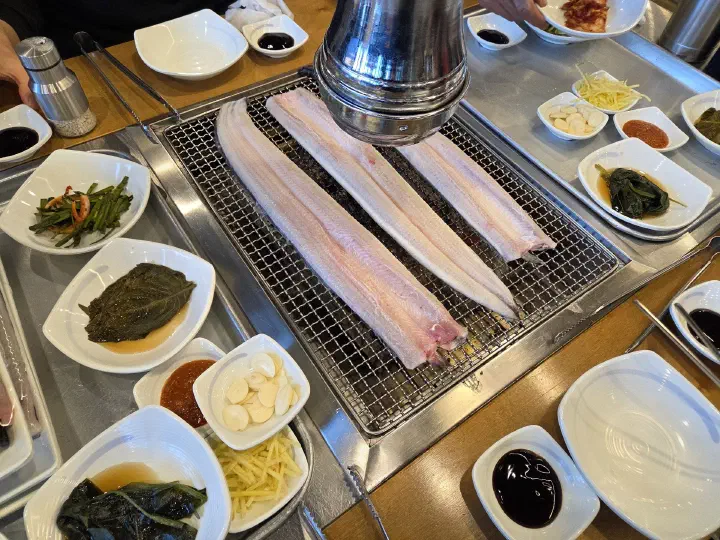
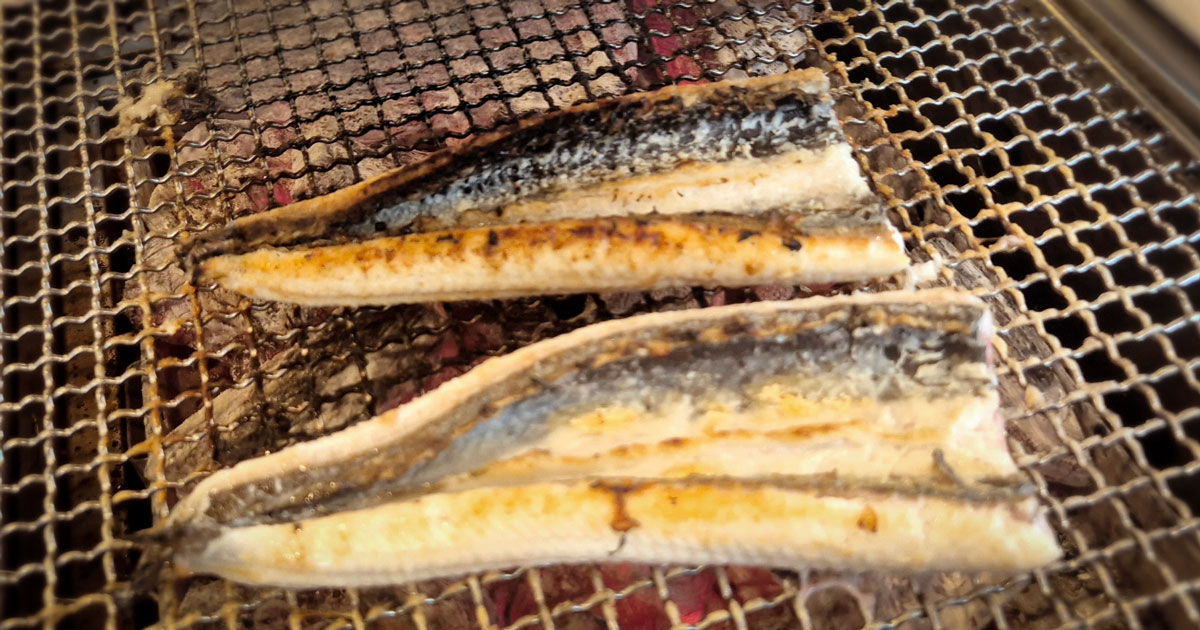
You lay the eel skin-side down on the hot grate,
sprinkle on coarse salt, grill it until golden,
then snip it with scissors. Each table has the grilling steps written out,
so first-timers manage just fine.

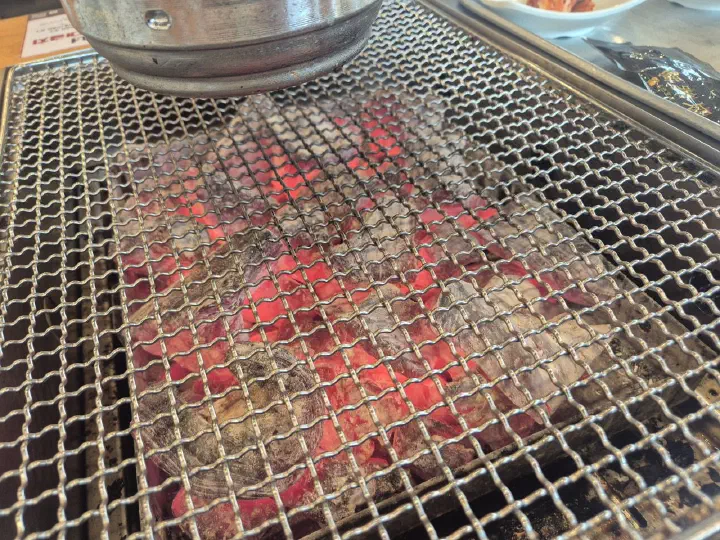
Glowing red charcoal fire under the grill grate

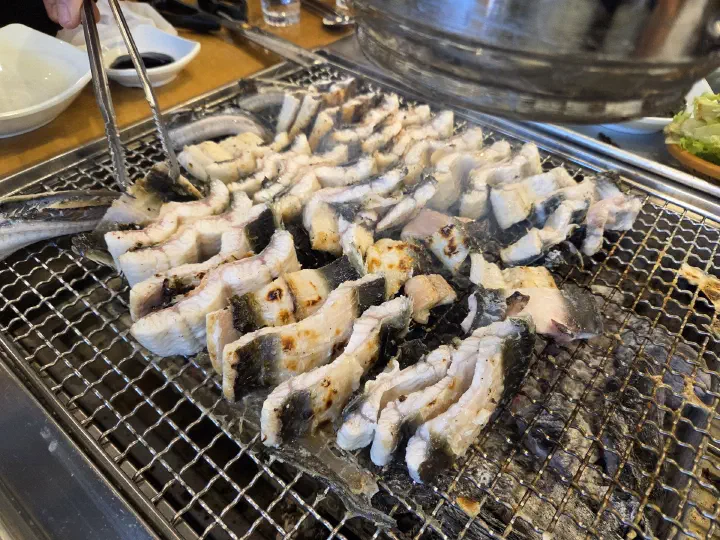
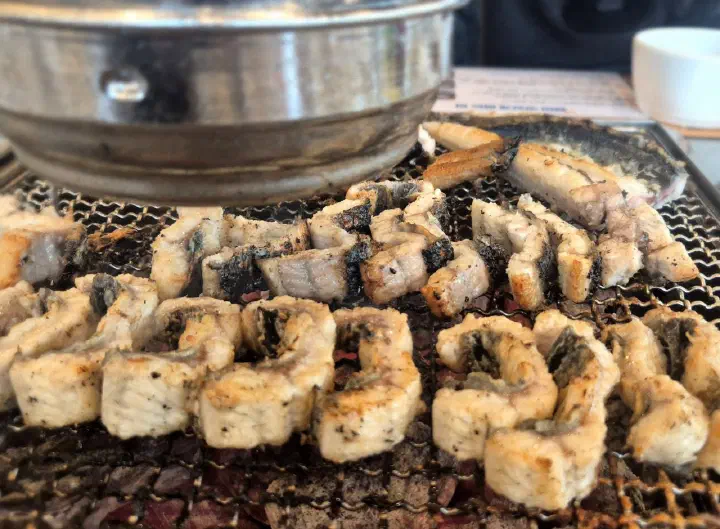
The cuts are thick and plump enough to fill your mouth in one bite.
There’s almost no muddy or fishy smell,
and the bones are cleaned well, so even people who usually
find eel off-putting tend to eat happily here.

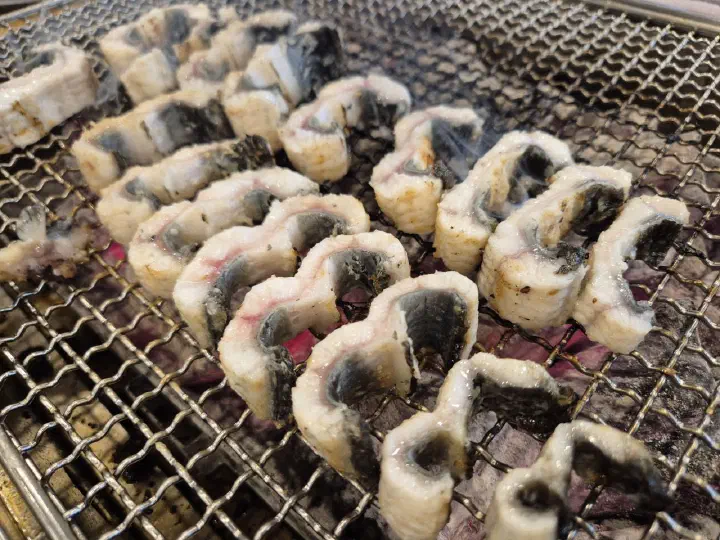
Bite-sized pieces of salt-grilled freshwater eel on the grill

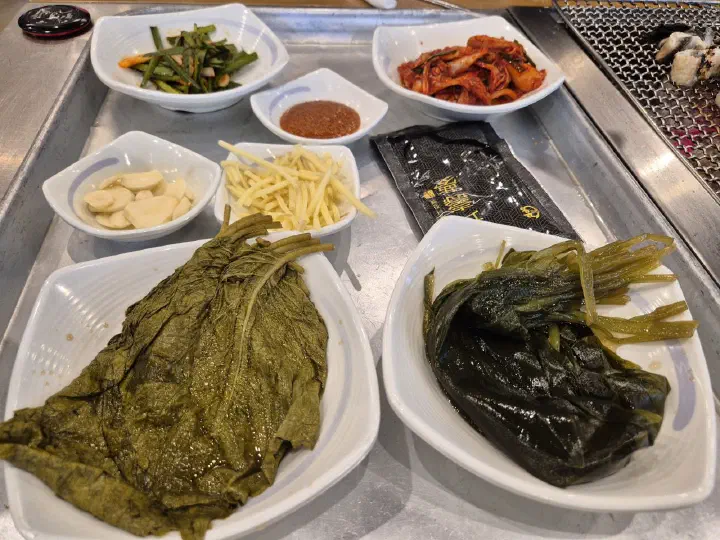
The best bite is eel wrapped in myeongi-namul (명이나물, pickled wild garlic leaves)
with shredded ginger and a dip in the sauce.
Side dishes are self-serve, so refill as much as you like.

Banchan side dishes at Jangeoui Kkum including myeongi-namul, shredded ginger, garlic, and kimchi

Of the rice-course options, get the eel soup (장어탕).
It’s 9,000 won and tastes closer to a perilla-seed loach stew,
thick and rich, the kind of thing that empties a bowl of rice fast.
After all that grilled eel, it’s a satisfying way to finish.

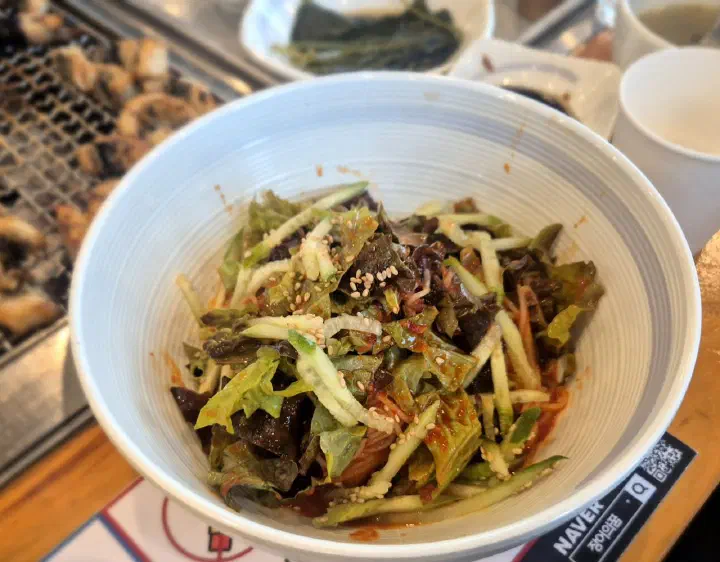
The spicy cold noodles (비빔국수) are a good call too,
pre-tossed in a sweet-tangy sauce that cuts the richness of the eel.

Spicy cold noodles (bibim-guksu) topped with cucumber and lettuce in a sweet-tangy sauce
The cold yeolmu-guksu (열무국수, young-radish kimchi noodles)
is a summer-only item; the slush of ice is refreshing,
but the radish-kimchi flavor can come out weak on some days.
If you’re not set on something cold, the eel soup is the more reliable finish.

The price really is the point

Price is the whole pitch.
One kilo of eel yields about 600 grams after cleaning,
and depending on the day’s rate it hovers in the high 20,000-won range.
When a typical eel restaurant runs well past 70,000 won per kilo,
this is close to half, which is why regulars joke
it’s cheaper than grilled pork belly.

The eel rate shifts daily, so it’s a little different each visit.
For a stretch it climbed to around 37,000 won per kilo,
but lately it has settled back into the 20,000s.
A family of four can eat their fill for around 50,000 to 60,000 won.

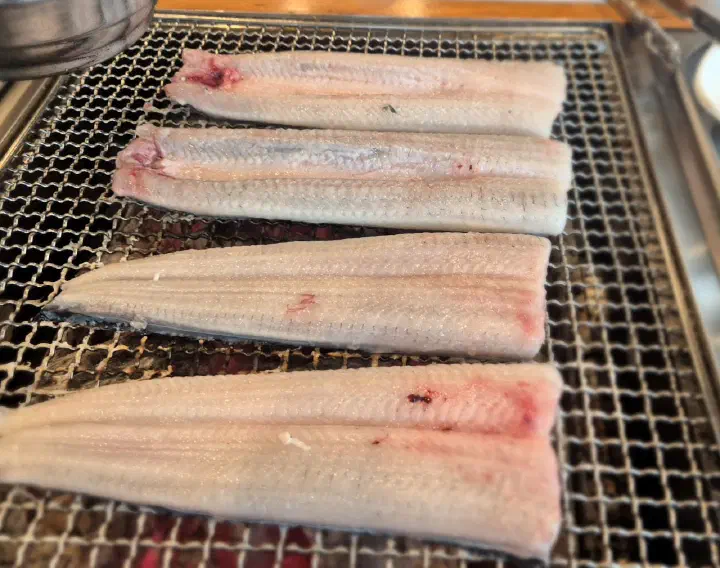
Whole freshwater eel fillets laid skin-side down on the hot charcoal grate

Separately from the eel, there’s a table-setting charge:
5,000 won per adult, 3,000 won per elementary-school child.
That covers the charcoal, the side dishes, and an eel concentrate.
This fee crept up from 4,000 to 5,000 won over time.
The eel is cheap enough that it doesn’t sting much,
but factor it in when you do the math.

Takeout gets a 10% discount, handy if you want to grill at home
or pack it for a campsite. You choose raw or pre-seared,
and they include ginger and sauce. The eel soup is sold to go
and even ships by delivery.

A practical note for foreign visitors: like almost every
Korean restaurant, this place takes credit cards without fuss,
so an internationally accepted card is fine. There’s no tipping culture here,
so you don’t need to tip, and trying to can actually cause confusion.
English isn’t really spoken, but ordering is simple, since you’re
literally pointing at the eel you want and saying how many.

The wait is the real variable

Honestly, the biggest downside is the line.
On weekends and on traditional stamina-food days,
an hour is the floor, with two or even three hours not unusual.
It’s common for the queue to top 100 groups.
The room is large so it turns over quickly, but come prepared.

Grilling eel and flipping it with tongs until golden

A few ways to cut the wait. One, go on a weekday if you can;
early evenings or right at opening, you’ll often be seated immediately.
Two, on a weekend, get there for opening. Weekend doors open at 10:40,
so arriving around 10:00 gives you a real shot at the first seating.
Three, if you’re in a group, have one person register at the kiosk
while the others park.

To wait, you enter your phone number and party size at the
entrance kiosk, and you get a KakaoTalk or text alert.
There’s no paper ticket, so watch your phone.
Plenty of cafes nearby make it easy to grab a coffee while you wait.
The one frustration is that remote-booking apps like
Tablering or CatchTable aren’t supported, so you have to show up to register.

The honest downsides

Beyond the wait, a couple of things.
Charcoal heat means that even with the AC running,
some seats get genuinely hot. When the crowd clusters on one side,
that section feels like a sauna and the smoke builds up fast.
If you’re bringing older parents, keep that in mind.

Close-up of golden salt-grilled eel, crisp outside and plump inside

And because it’s so busy, the floor staff are stretched thin,
so a press of the call button can take a while to answer.
The busier it is, the slower the response,
so it helps to ask for everything you need at once.

The bottom line

Jangeoui Kkum is the first place that comes to mind
when you just want to eat a lot of eel without overthinking the bill.
Few places let you eat this much Korean freshwater eel for this price.
Picking your own, the rich eel soup, the big parking lots,
it all adds up to a solid family outing.

In return, you do accept the wait, the heat,
and the work of grilling it yourself.
If you want a quiet meal or full table service, it may not be your spot.
Take those as given, and on price and eel quality alone,
it’s the kind of place you end up coming back to.

📍 View Jangeoui Kkum (장어의 꿈) on Google Maps →