There’s a pork soup place in Daerim that has been open since 1959.
It’s called Samgeori Meonjimak Sundaeguk (삼거리먼지막순대국), and it has shown up on Korean TV more than a few times.
But the funny thing is, the food isn’t what throws off first-timers.
The system is.
Shared tables, a back-alley location, an early closing time.
So instead of just calling it “a famous spot,” it makes more sense to talk about how you eat here and how you actually get here.

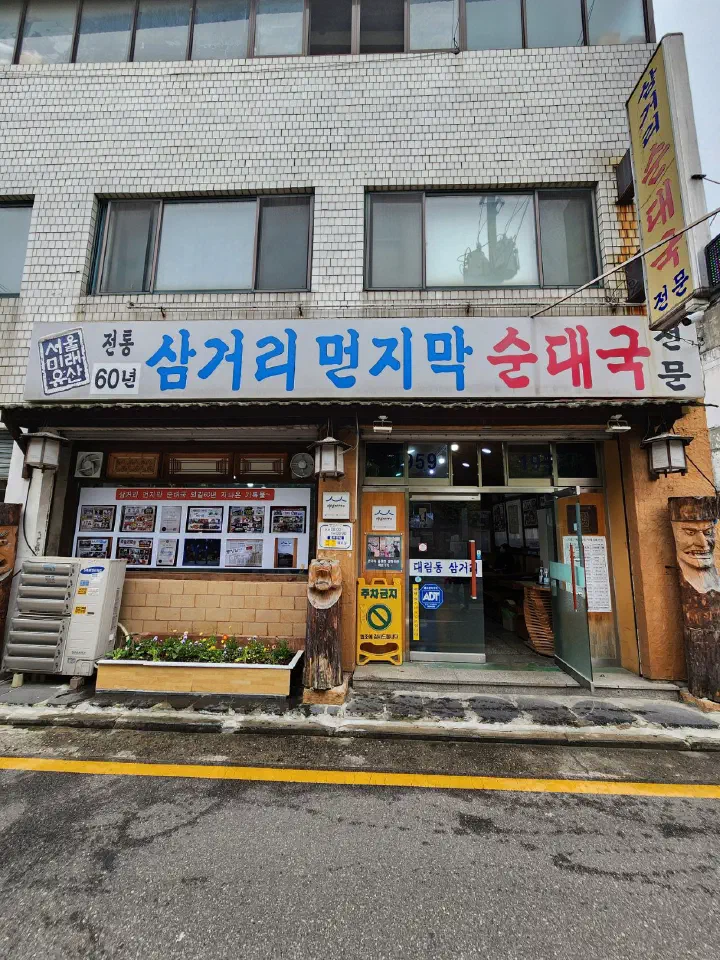
Storefront of Samgeori Meonjimak Sundaeguk in Daerim-dong, Seoul, with its 60-year-old sign

The basics

The address is 11 Siheung-daero 185-gil, Yeongdeungpo-gu, Seoul.
It opens at 8 a.m. and closes at 7 p.m., which is early for dinner, so keep that in mind.
Tuesdays are closed. There’s no afternoon break, so the odd hours between lunch and dinner are open too.

The menu is short.
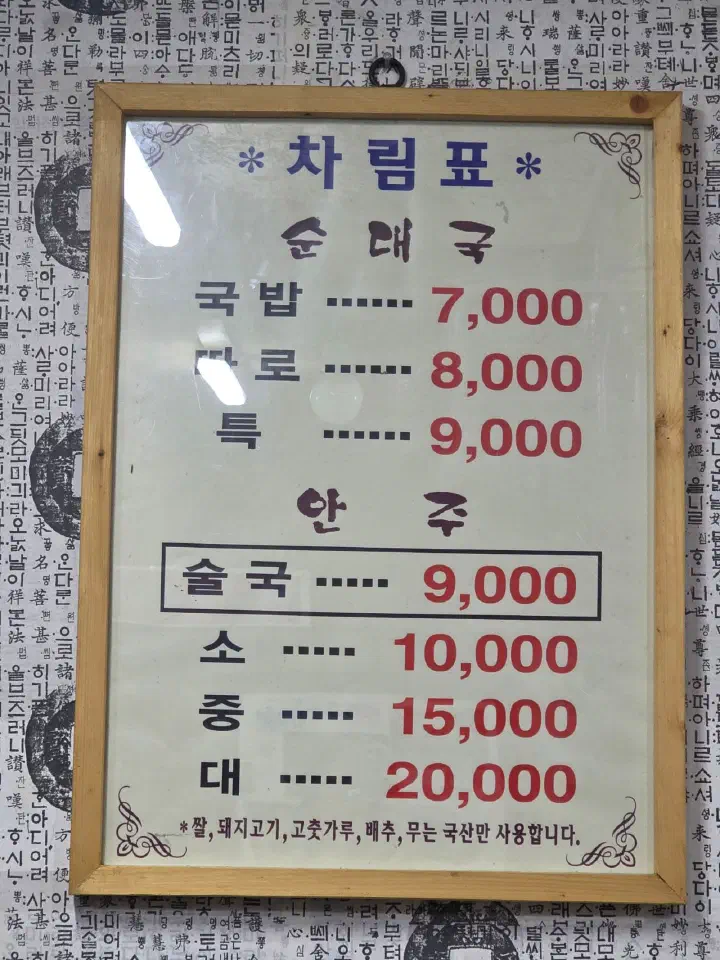
Sundaeguk (순대국) is 8,000 won for the regular, 9,000 for ttaro, and 10,000 for teuk.
Sulguk (술국), a soup meant for drinking, is 10,000 won, and the shared platters run 12,000 to 22,000 won by size.
An 8,000-won bowl of gukbap is getting rare in Seoul, so the price still feels honest.

One quick note for visitors from abroad: almost every restaurant in Korea takes credit cards, and an international card works fine here.
There’s no tipping culture, so don’t leave a tip. It usually just confuses the staff.
English isn’t really spoken, but ordering is easy. You can point at the menu and hold up fingers, and you’ll be fine.

Framed Korean menu board at Samgeori Meonjimak Sundaeguk listing sundaeguk, ttaro and teuk prices

📍 View Samgeori Meonjimak Sundaeguk (삼거리먼지막순대국) on Google Maps →

Getting there through the alley

The place isn’t right next to a subway station.
Most people walk over from Exit 6 of Guro Digital Complex Station, though Sindaebang or Sinpung stations work too.
Either way, you turn off the main road and head into the alley.

An easy landmark is Daerim Middle School’s front gate.
It sits in the alley behind Hallym University Kangnam Sacred Heart Hospital, and it’s close to Daerim Sungmo Hospital, so a lot of regulars stop by on their way home from a checkup.
The sign is low-key, so save the address before you go.
One more thing: Google Maps walking directions can be unreliable in Korea, so Naver Map or KakaoMap will get you there more accurately.

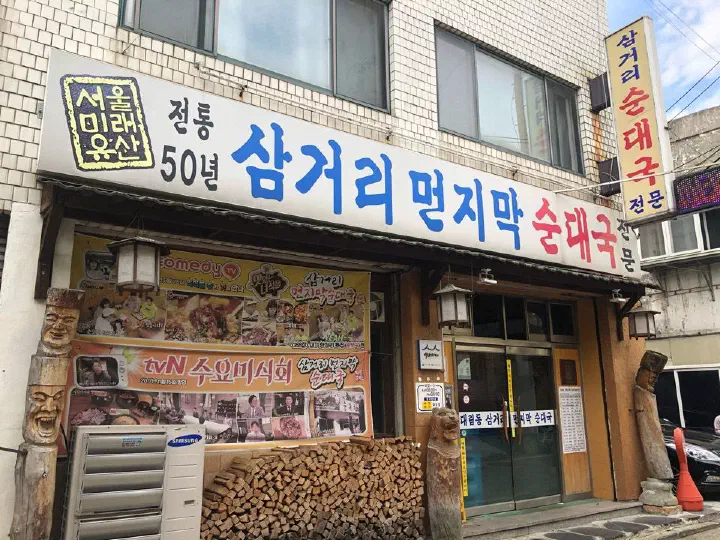
Exterior of Samgeori Meonjimak Sundaeguk tucked in a back alley, with TV show banners on the wall

Shared tables and timing

The most unfamiliar part is the shared seating.
The room is small and turns over fast, so if you come alone or as a pair, you’ll likely share a table.
The tables are wide and the sets are separated by the utensil holder, so it’s less awkward than it sounds.

There’s even a loose logic to the seating.
Solo diners get the small room near the entrance, and groups of two or more get sent to the back.

Waiting comes down to timing more than anything.
Lunch brings a line, and it overlaps with takeout orders, so that’s the busiest stretch.
Still, the turnover is quick, so even a line moves along.
If you’d rather take it slow, aim for 8 to 10 a.m. or after 1 p.m. once the lunch peak fades.
And remember the 7 p.m. close. Show up late in the evening and you’ll find the door shut.

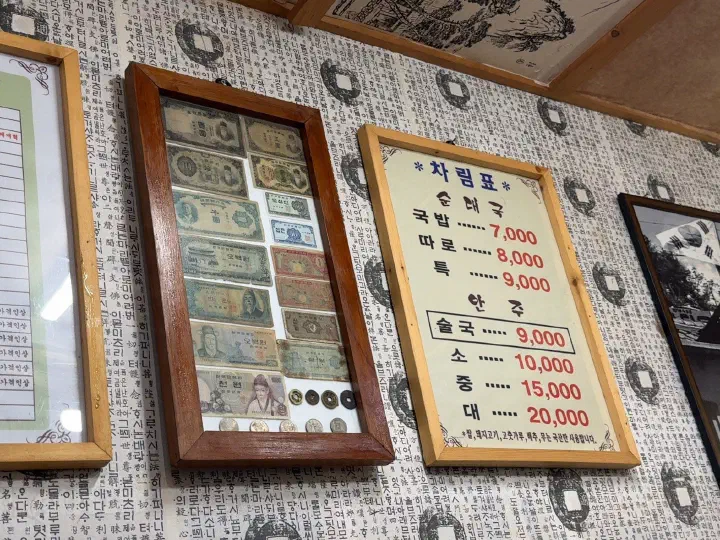
Interior wall of Samgeori Meonjimak Sundaeguk hung with framed vintage Korean currency and the menu board

Botong, ttaro, teuk: what’s the difference

The soup comes three ways.
Botong (보통) arrives with the rice already dropped into the broth, the toryeom style.
Ttaro (따로) keeps the rice on the side and gives you a bit more.
Teuk (특) is the same thing with extra offal piled on.

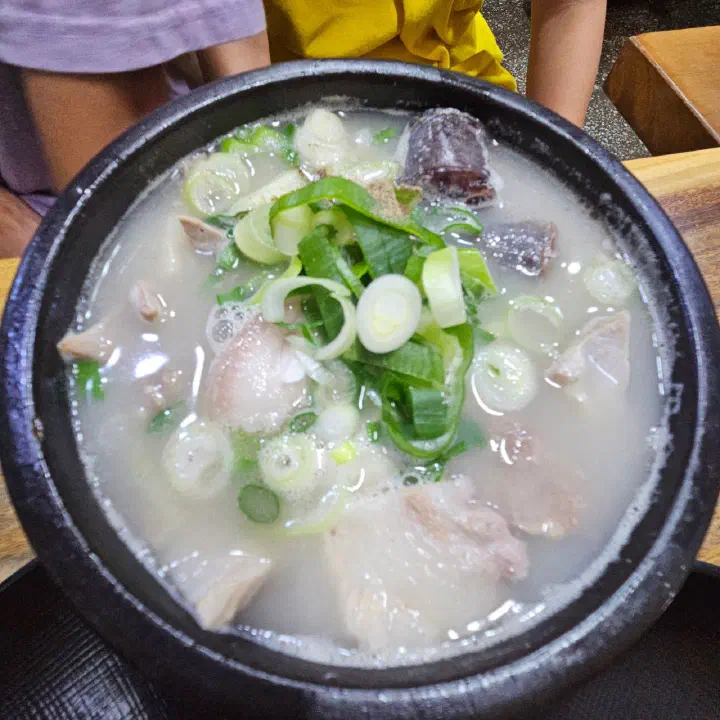
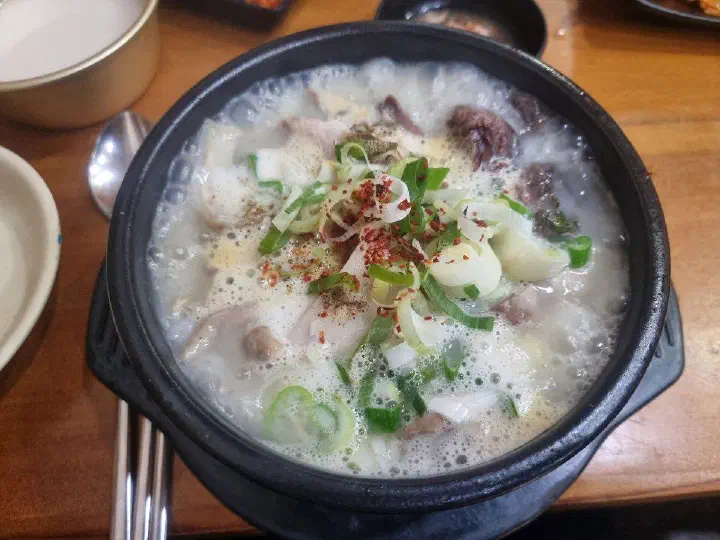
Teuk sundaeguk at Samgeori Meonjimak Sundaeguk, an earthen bowl loaded with extra pork offal

If it’s your first time, get the botong and read the broth first.
Go ttaro if you don’t like rice sitting in the soup, and teuk if you’re a big eater.
Just know that teuk includes cuts like ampong (pork uterus) that push the smell a little further.
If you’re sensitive to that funk, factor it in.

You can also customize the bowl, which is worth knowing.
Ask for it without the innards, or with only the head meat, and they’ll sort it out.

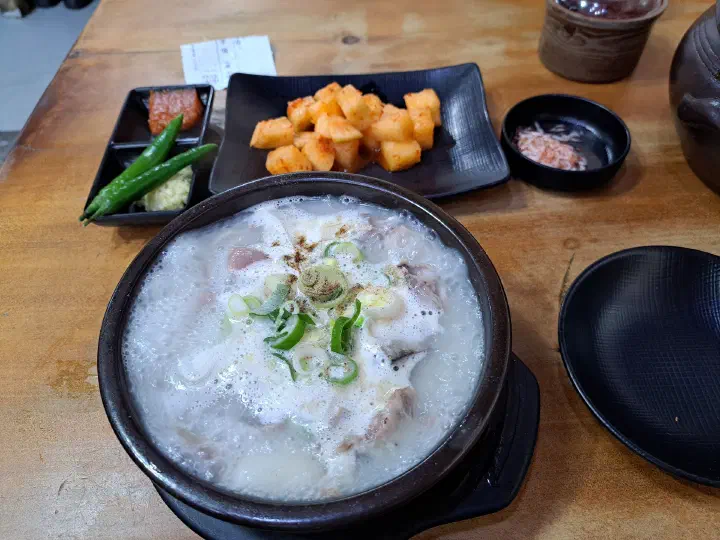
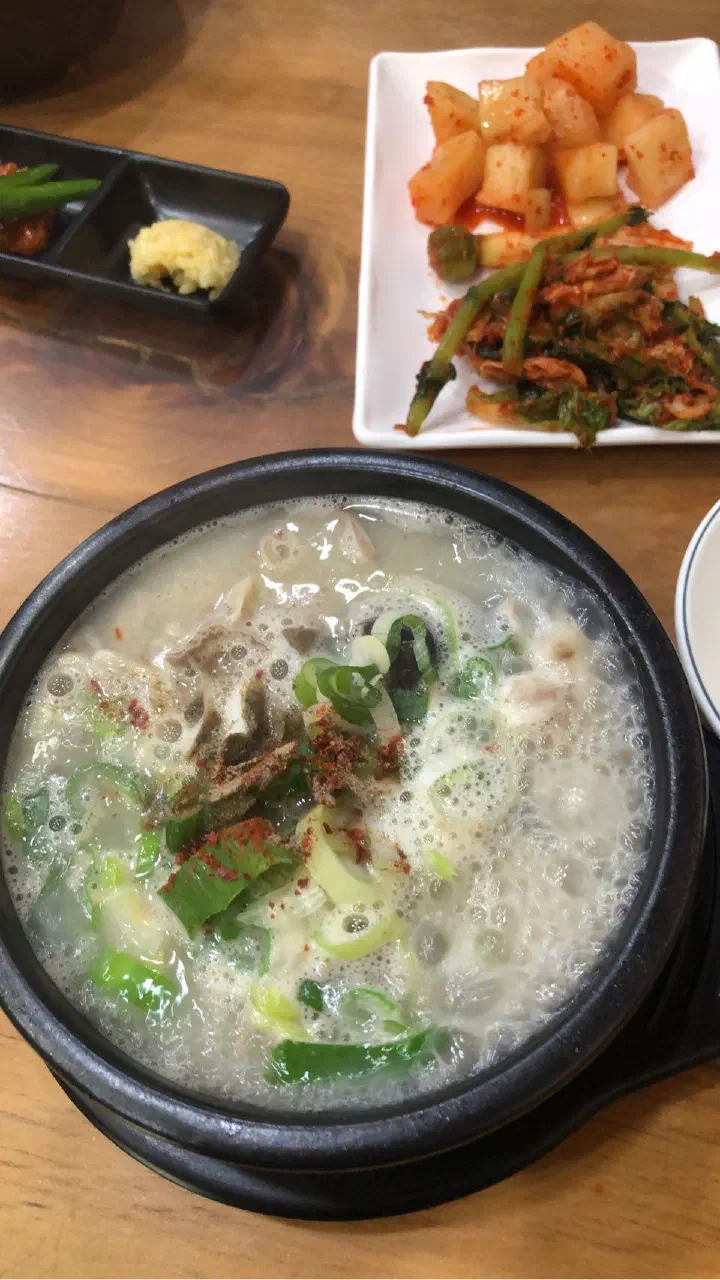
Sundaeguk table setting at Samgeori Meonjimak Sundaeguk with kkakdugi, salted shrimp and minced garlic

The broth, the offal, and the garlic

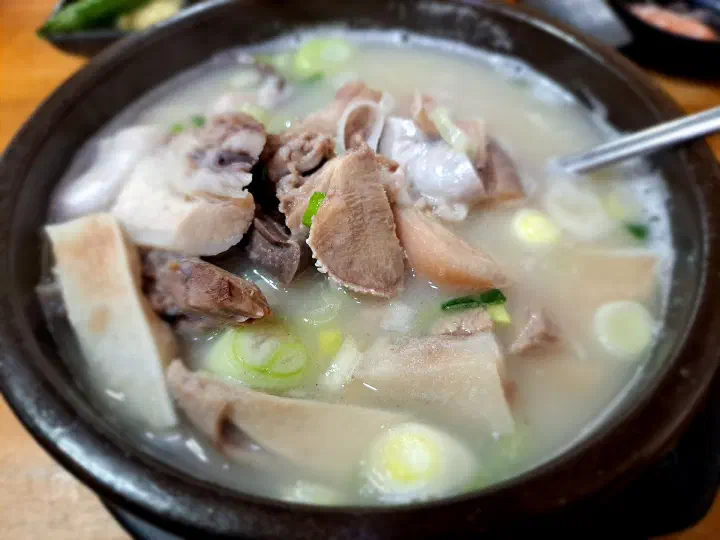
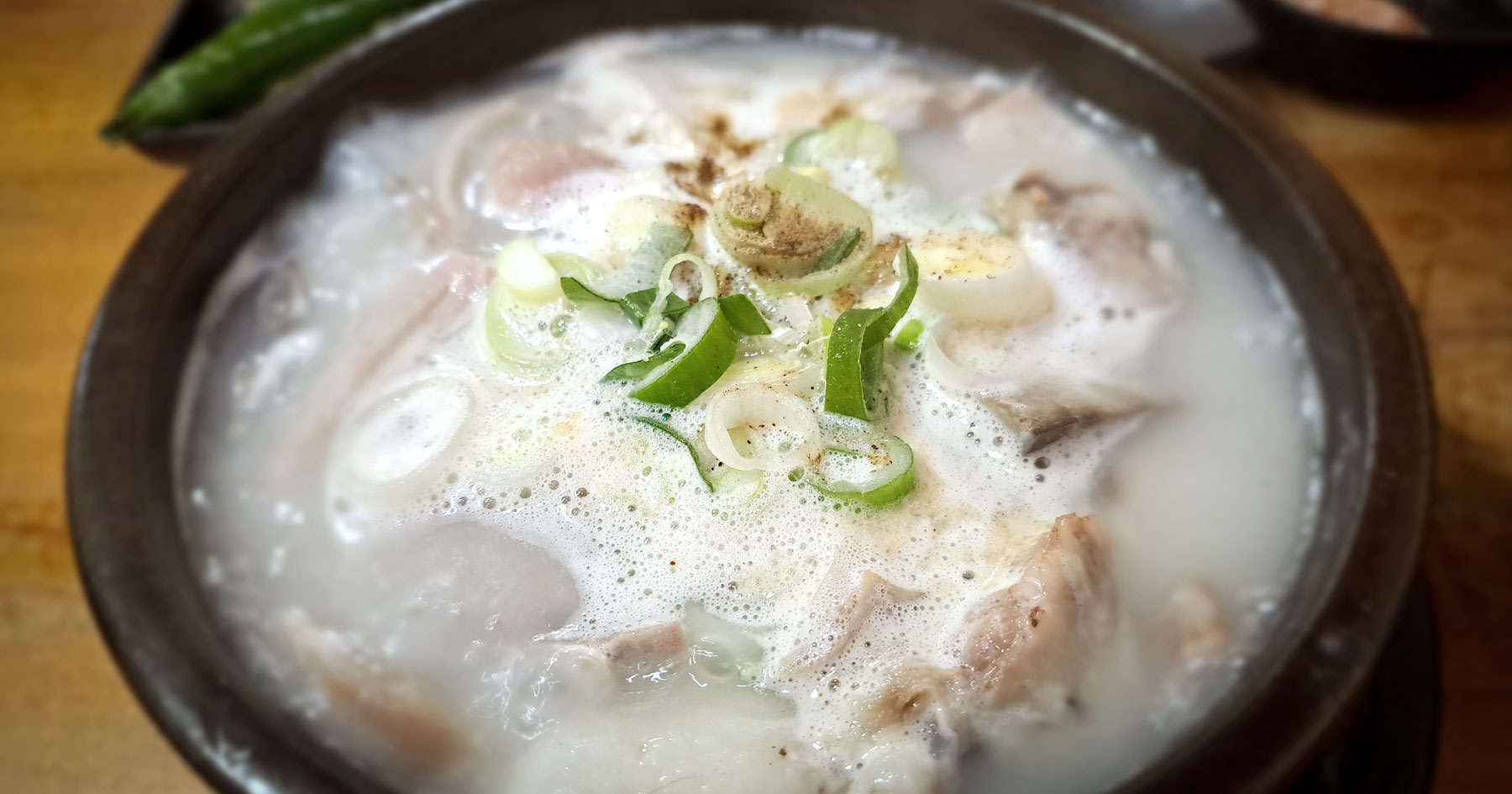
The broth is clear but not thin.
It leans toward the milky, long-simmered side, built from pork meat, bone and head.
The first spoonful is mild, and the offal aroma catches up around the second.

Close-up of the milky, long-simmered pork broth at Samgeori Meonjimak Sundaeguk

This is a place that wins on volume.
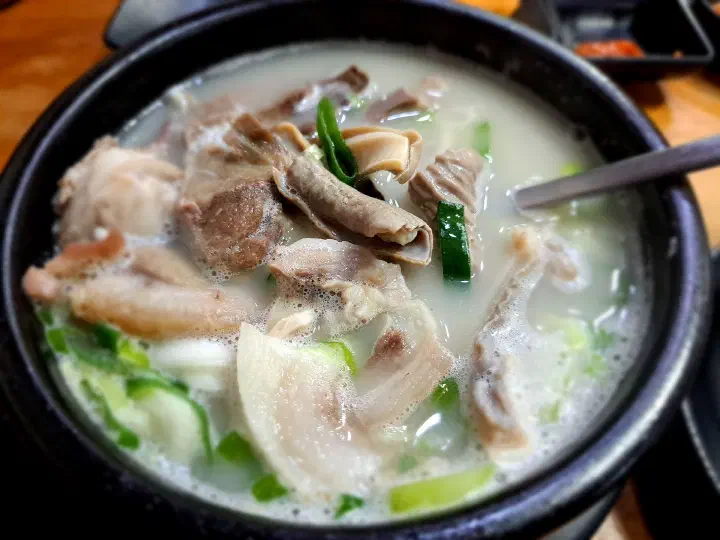
There’s head meat in several cuts, plus osori-gamtu (pig stomach), ampong, liver, lung, tongue and heart.
Basically all the pork bits you’d find tucked next to street-stall sundae, gathered into one bowl.
Great if you love offal, a wall if the smell isn’t your thing.

Close-up of pork offal in the soup: pig stomach, ampong, liver and lung

The real trick here is the minced garlic.
Taste the broth plain first, then stir the garlic in around the halfway mark.
The whole thing shifts. The quiet pork note steps forward and the garlic sharpens the back end.
Add the garlic, a little salted shrimp, and just a touch of perilla powder. Too much perilla too early and it flattens the broth.
If you want it red, stir in the dadaegi (spicy paste).
This isn’t a bowl you eat as served. It’s one you tune as you go.

Sundaeguk with dadaegi spicy paste stirred in, turning the broth reddish

Sundae and side dishes

The sundae is the dangmyeon (glass-noodle) kind.
If you’re hoping for the chewy blood-sausage type, it may feel a little plain.
It soaks up the broth’s seasoning instead, and honestly, real hand-made sundae would have pushed the price up.

The side dish is really just kkakdugi (radish kimchi).
It sits in a big jar, and you scoop what you want into a bowl, so take a little at a time to keep it from drying out.
It’s crunchy most of the time, occasionally a bit soft.
Cabbage kimchi doesn’t show up much these days, so it’s mostly kkakdugi.
Each person gets a dish of salted shrimp, and a dab on top of the meat rounds out the savoriness.

Side dishes served with sundaeguk: kkakdugi radish kimchi, young cabbage kimchi and minced garlic

TV fame, heritage, and the price

The fame isn’t for nothing.
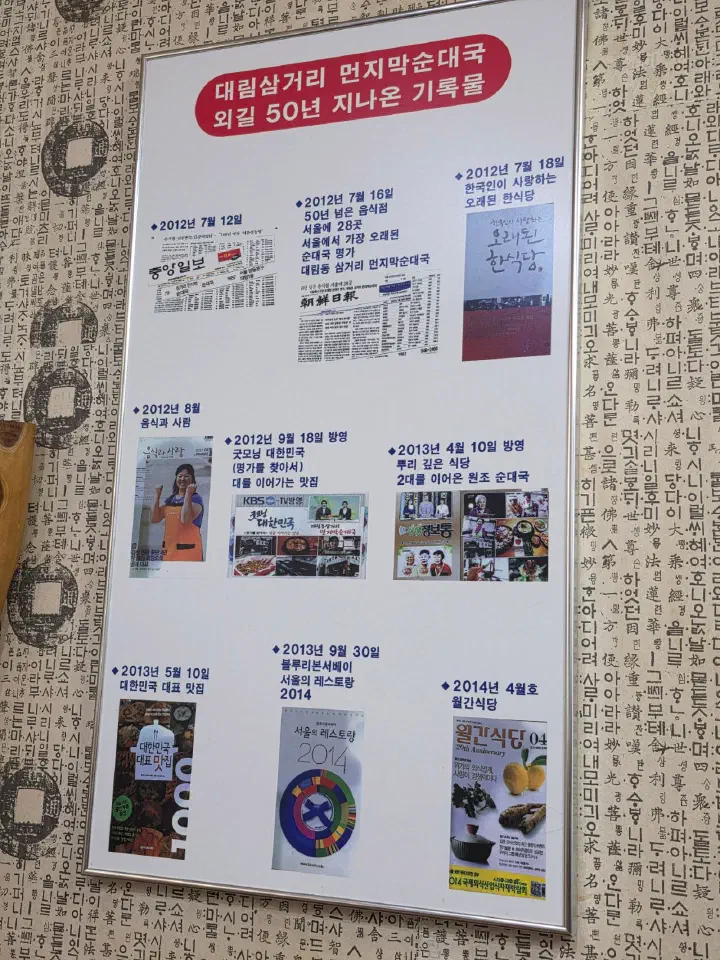
The sundaeguk was featured on Wednesday Food Talk (수요미식회) back in 2017, and it has appeared on shows like Korean Cuisine (한국인의밥상) and Tasty Guys (맛있는녀석들).
The walls are packed with plaques, certificates and a Blue Ribbon sticker.
It’s also a government-designated Baengnyeon Gage (a “100-year shop”) and a Seoul Future Heritage site.

Framed record of Samgeori Meonjimak Sundaeguk’s TV appearances and newspaper features

The price has its own story.
Back in 1959 a bowl went for 150 hwan, an old currency unit.
It held at 5,000 won for a long time, moved up to 6,000, sat around 7,000 for teuk in 2022, and the regular is 8,000 now.
Next to other places that have blown past 10,000 won, it still feels reasonable.

The flavor has drifted a little over the years, too.
The alley used to hit you with a strong boiled-pork smell from the corner.
As TV widened the crowd, it softened, and some longtime fans actually miss the old funk.

Parking and payment

Parking is the weak spot.
There’s no lot, and the alley is narrow, so pulling up out front isn’t easy.
It may be a no-parking zone, so if you drive, a nearby public lot is the calmer choice.

Cards are accepted.
Local-currency payment can be hit or miss, though, so keeping a card or some cash on hand makes checkout smoother.
The service is old-school. During the rush the staff can come across as brusque, so if warm service matters to you, adjust your expectations a bit.
The soup here, by the way, isn’t spicy on its own, so heat isn’t a concern unless you stir in a lot of the dadaegi.

Final thoughts

The verdict is pretty clear.
Come on a weekday morning or after 1 p.m., without a car, and you’ll get an 8,000-won bowl with almost no hassle.
Do the opposite, a weekend lunch, driving, late in the evening, and you’ll hit the shared tables, the line, the parking and the early close all at once.

On taste, it’s a place that plays to preference.
If you want a clean, refined pork soup, this isn’t it.
If you like the old-style bowl finished with offal and garlic, it’s one of the better ones in Seoul.
Once you’re okay with the rough edges, it’s the kind of gukbap spot you end up coming back to.

How to find it

Most people walk from Exit 6 of Guro Digital Complex Station, and Sindaebang or Sinpung stations are options too.
Look for Daerim Middle School’s gate, in the alley behind Hallym University Kangnam Sacred Heart Hospital.

📍 View Samgeori Meonjimak Sundaeguk (삼거리먼지막순대국) on Google Maps →