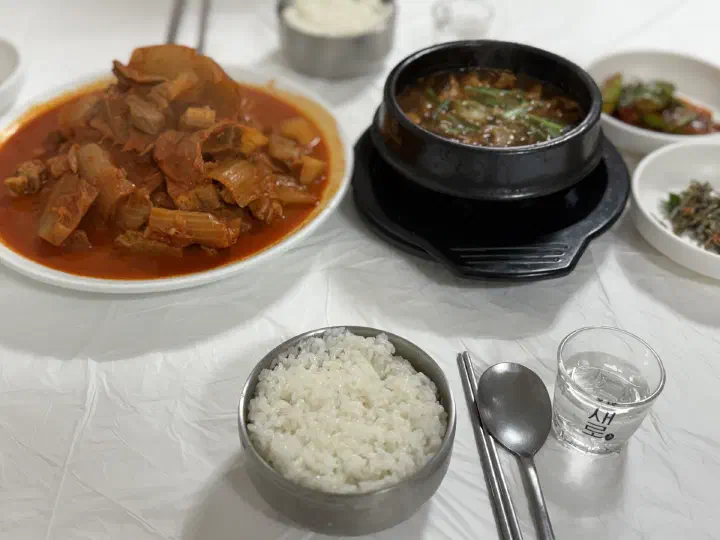
This place serves exactly one thing, and people start lining up for it at seven in the morning.
That sentence covers most of what makes Jeonwon Sikdang (전원식당) complicated for a traveler.
It is not a restaurant you can wander into at lunchtime.
It runs on a same-day paper ticket system, the tickets are usually gone before nine, and by the time most visitors have finished breakfast the kitchen has already stopped seating people.
Whether that is worth planning your morning around depends on what you expect.
Some leave having eaten two bowls of rice.
Others walk out wondering what the fuss was about.
Both reactions make sense once you know what the dish actually is.

The basics
The address is 15 Yeonggeumjeong-ro, Sokcho-si, in the Dongmyeong-dong area, right beside the Yeonggeumjeong pavilion.
The phone number is 033-633-0282, though calling won’t get you a reservation.
Hours are 9 AM to 7 PM, with a break from 2:30 to 5 PM and last orders at 6 PM.
The restaurant closes every Wednesday and Thursday, and holiday closures shift around, so it is worth checking Naver Map before building a day around it.
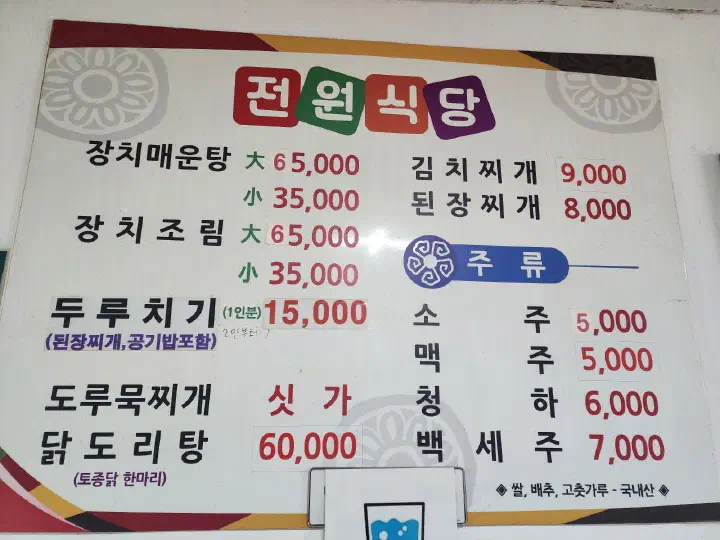
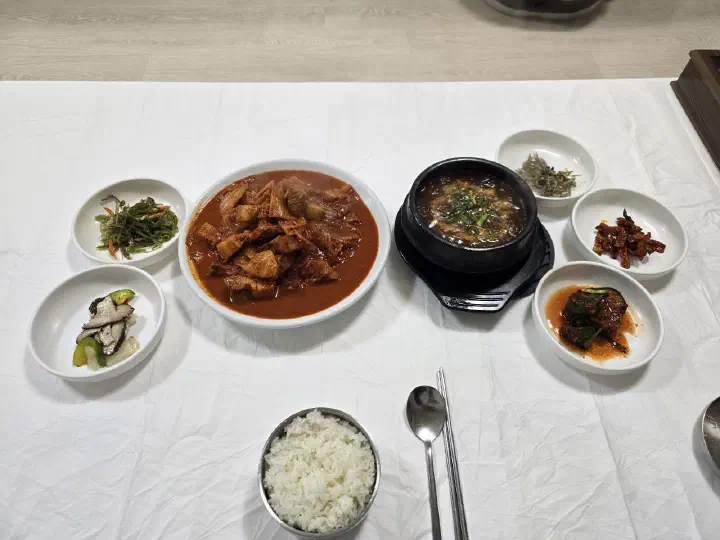
One dish: duruchigi (두루치기), 15,000 won per person, minimum two orders.
That price includes a soybean paste stew and a bowl of rice.
Takeout runs 13,000 won per person, also with a two-order minimum.
Cards work here, including foreign-issued ones, which is true of nearly every restaurant in Korea.
No tipping — leaving money on the table will just confuse the staff.

📍 View Jeonwon Sikdang (전원식당) on Google Maps →
How the ticket system works
There is no app, no phone booking, no international reservation platform.
You show up in person in the morning and take a slip of paper with a time written on it.
Tickets usually go out from around 7 AM, though it depends on when the owner opens up.
The restaurant itself opens at 9, and from then on seven parties enter each hour.
That number comes from the table count, not from policy.
When you take a ticket, you pick from the time slots still open.
Arrive at 7 and you can usually claim the 9 or 10 AM slot.
Arrive at 7:30 on a summer weekend and the lunch hours will already be spoken for.
During peak season, twenty people can be waiting before 6:30 AM.
Show up about ten minutes before your slot.
Miss it and you lose the table.
The useful part is that you don’t have to wait around.
Once you have your ticket you can go back to your hotel, shower, and come back.
Yeonggeumjeong is a two-minute walk and a good sunrise spot.
Dongmyeong Port and Sokcho Tourist and Fishery Market both fill an hour easily.

When it sells out
Once the day’s tickets are gone, dine-in is finished for the day.
On weekends and holidays that often happens around 8 AM.
On a quiet weekday in the off-season, slots can still be open at 10.
Arriving at 11 and finding a “sold out” sign taped to the door is a common experience.
The flip side is that off-peak weekdays sometimes work without any planning at all.
A single table opens up around mid-morning and you simply walk in.
Weekday evenings outside of high season are the loosest.

Takeout is the practical option
Takeout is handled separately from the ticket line and moves much faster.
Portions go out between the hourly dine-in services, and it is not unusual to be back on the street a minute or two after joining the line.
What you get is only the duruchigi.
No rice, no side dishes, no stew.
If you plan to eat it at your accommodation, buy instant rice at a convenience store first — convenience stores are everywhere in Sokcho and the rice heats in about ninety seconds.
The dish itself reheats well in a microwave, which is why so many people take it back for breakfast the next morning.
Takeout also ends when the food runs out, so aim to arrive well before 6 PM.
Single portions are not sold; two is the minimum.

What duruchigi actually is
The name suggests stir-fried pork.
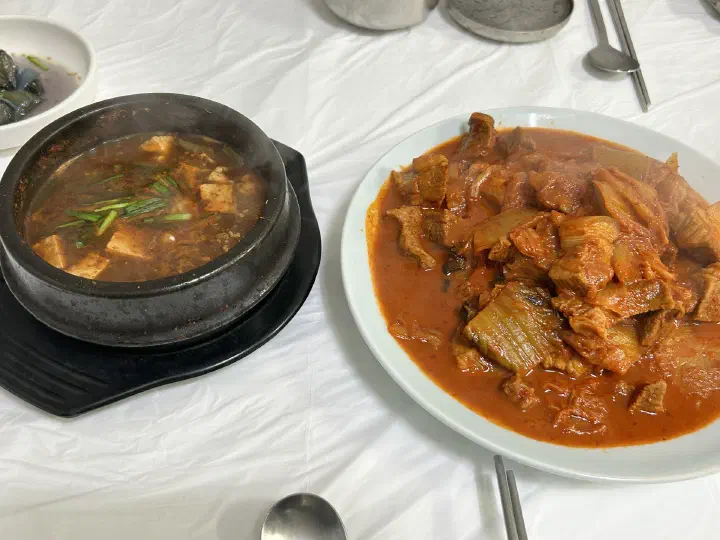
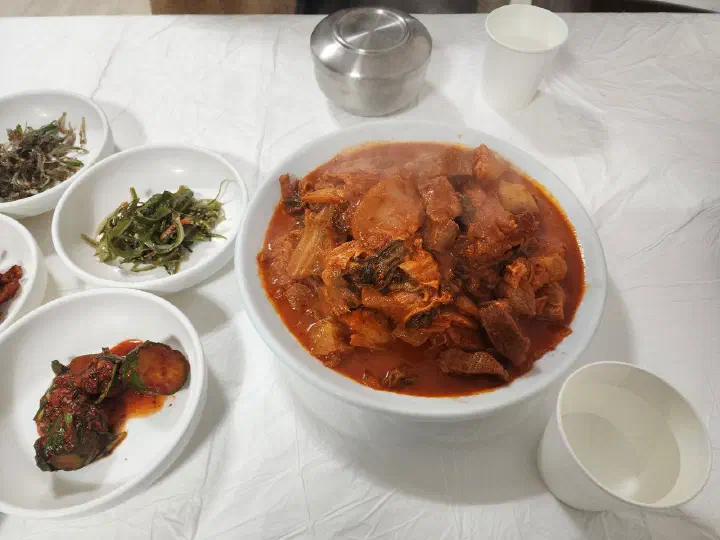
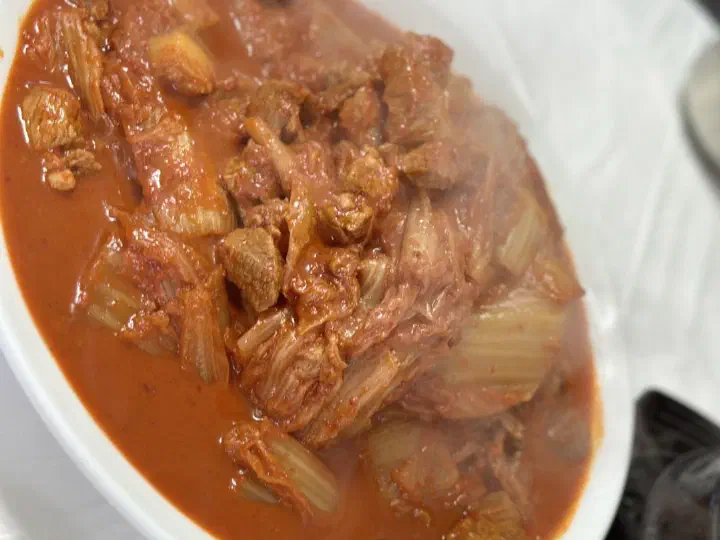
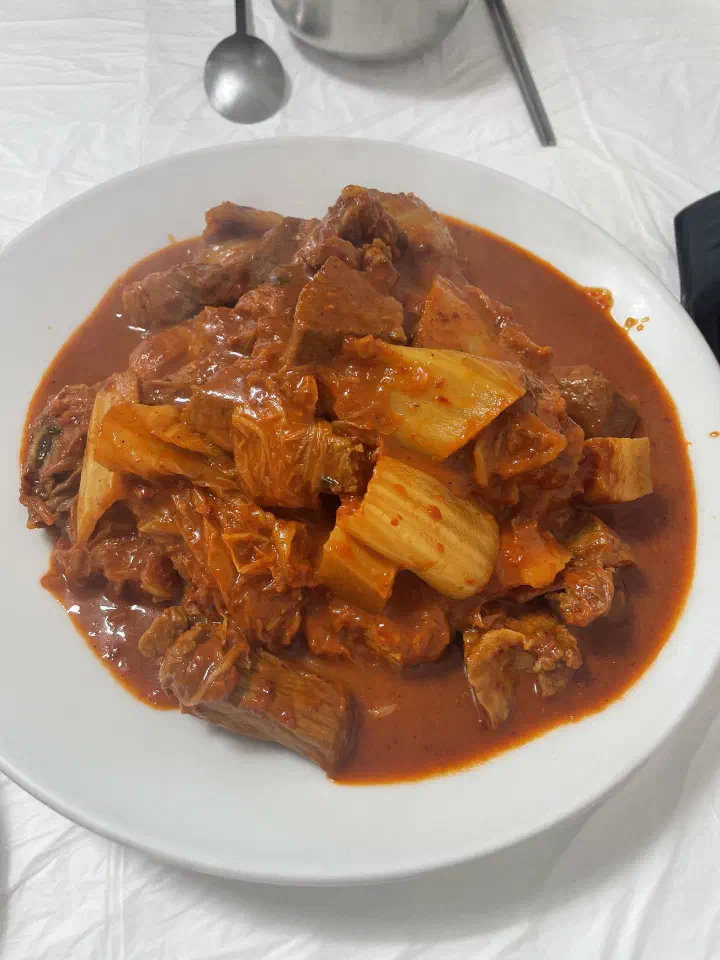
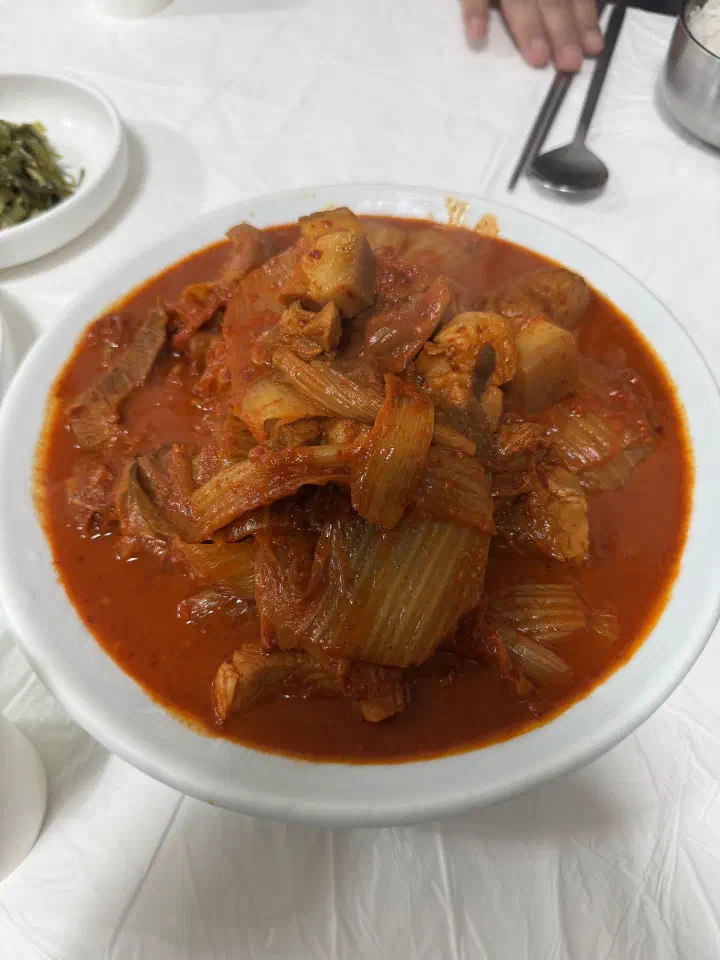
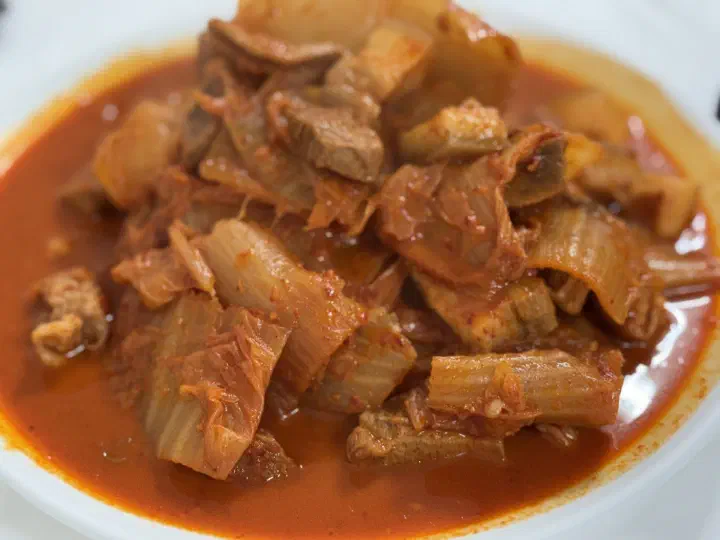
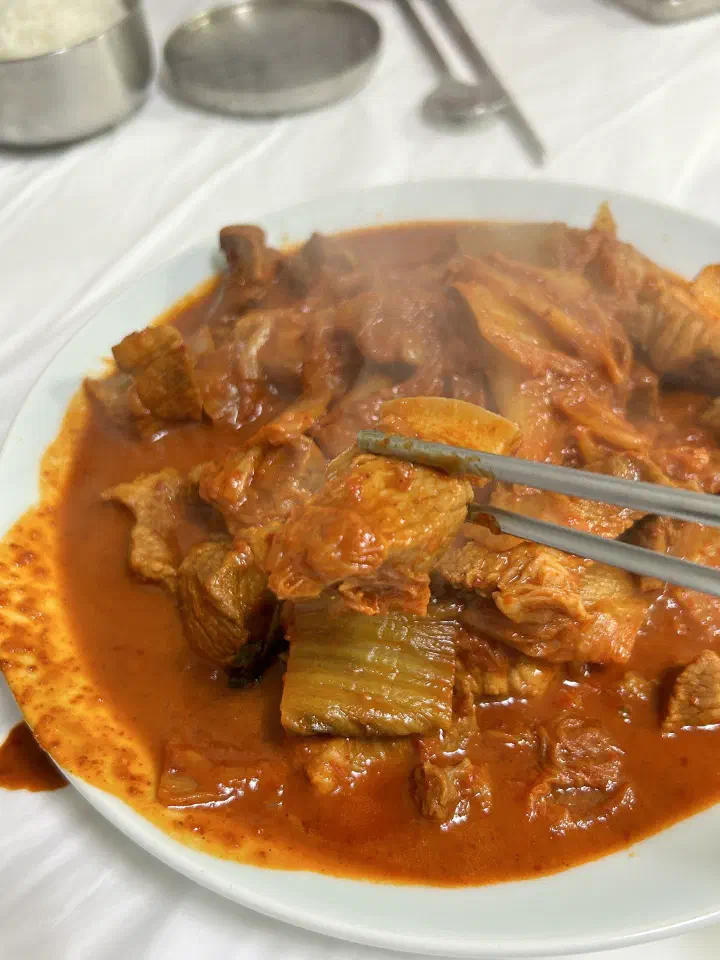
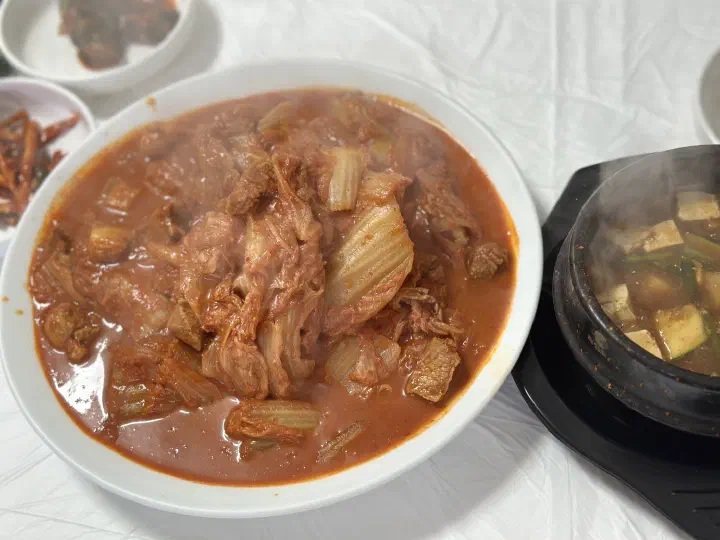
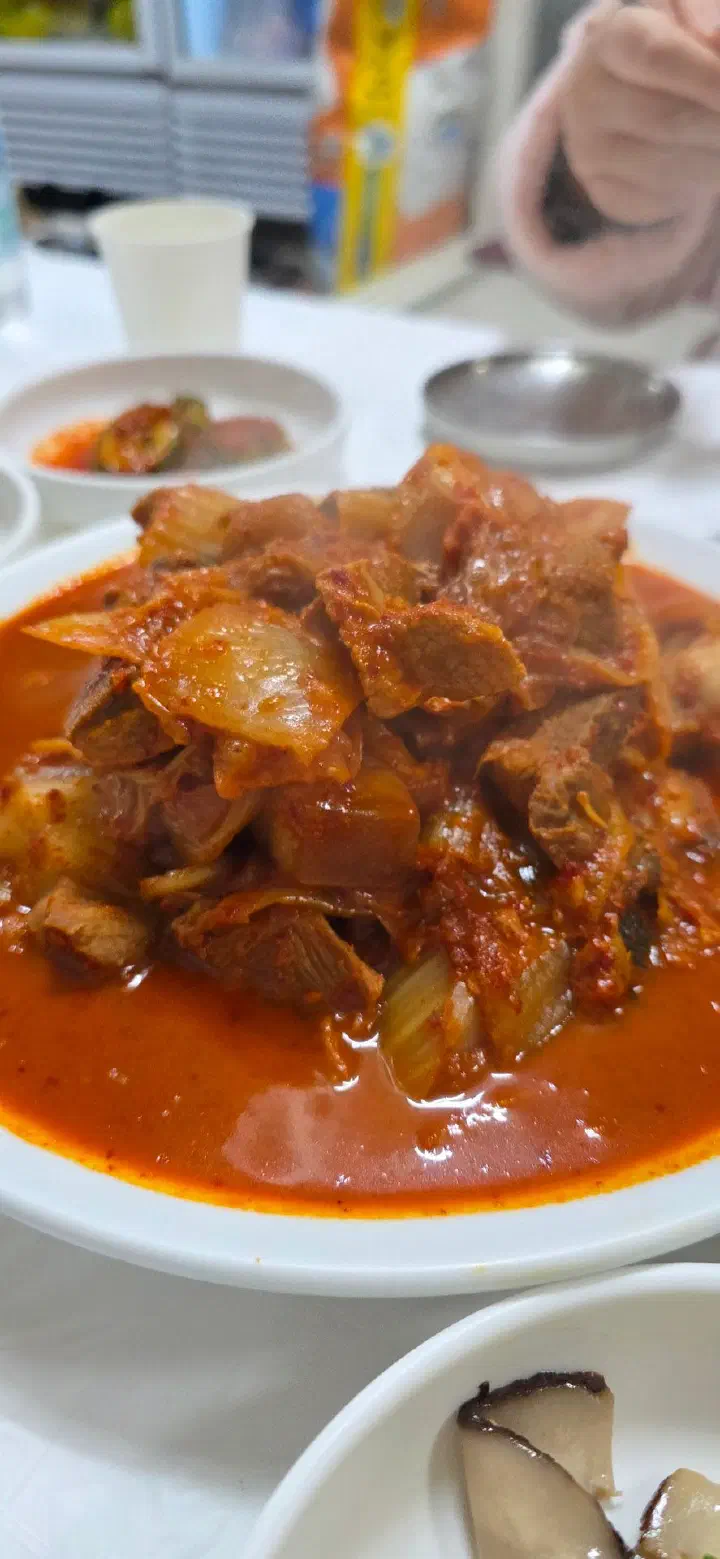
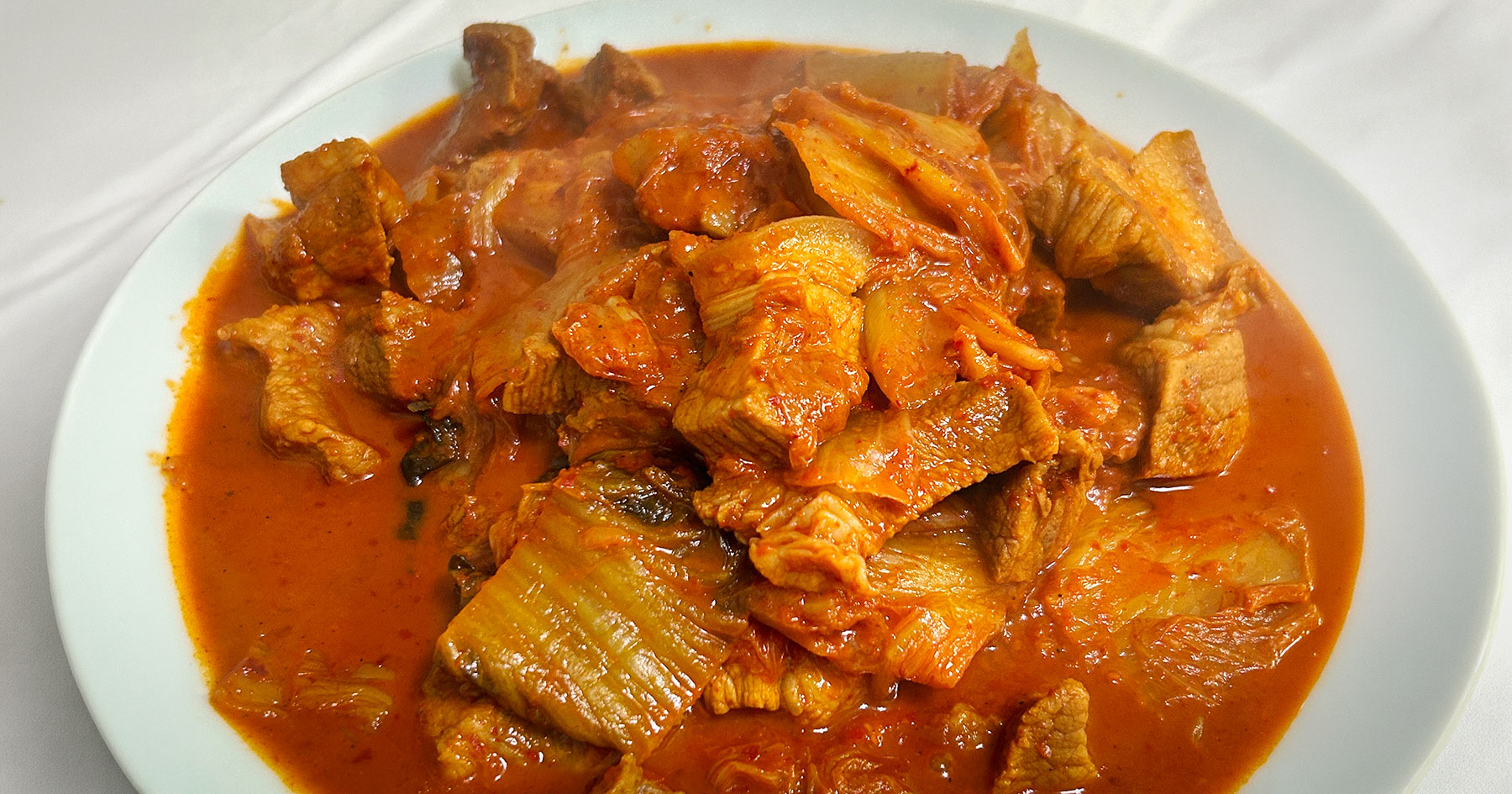
What arrives looks and tastes closer to a kimchi braise — a mounded plate of pork and aged kimchi sitting in a shallow, deep-red sauce.
Plenty of Koreans say it should just be called kimchi-jjim, and looking at the plate, they have a point.

Underneath all of it, the kimchi is doing the heavy lifting.
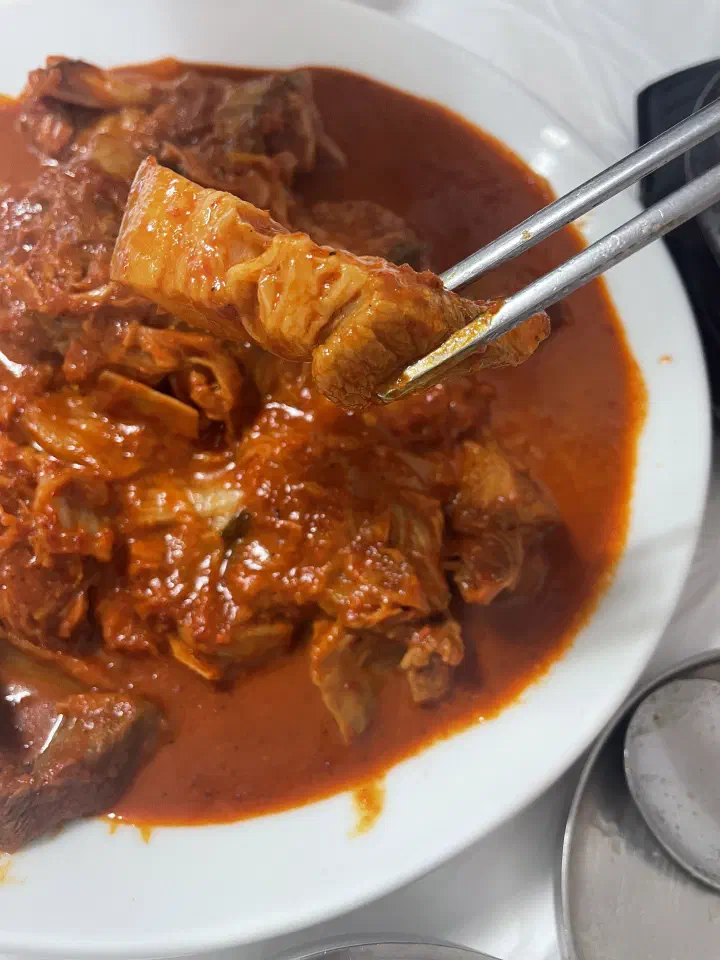
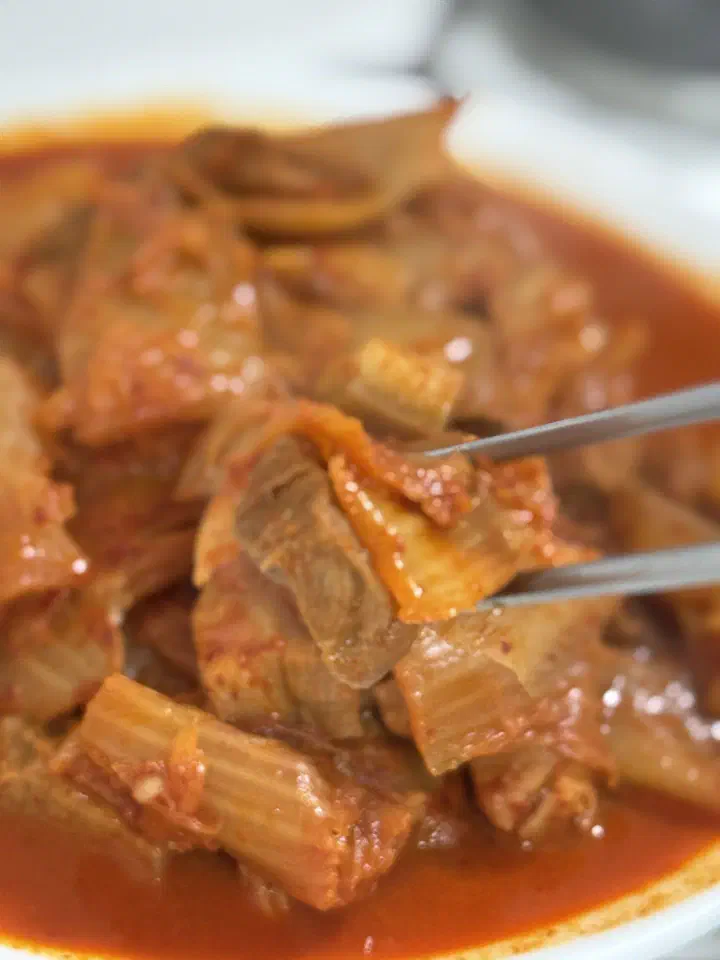
It has been cooked long enough to go soft and sour, and the sourness has seeped into the pork fat and through the whole sauce.
This is not kimchi tossed in at the end.

Cut into generous chunks, the pork is mostly shoulder or front leg.
The fattier pieces are tender and slightly chewy in a good way.
The leaner ones can come out dry.
There is generally no off smell to the meat.

The sauce is the strange part.
Along with the heat there is real sweetness and a sour finish, and the texture is thick enough that people keep guessing dairy — milk, cream, something.
The kitchen says nothing like that goes in, and the sweetness comes down to sugar plus their own kimchi.
Some taste ketchup, some taste tomato.
It genuinely does not taste like standard Korean pork and kimchi.
On the spice: this is moderately spicy by Korean standards, which means most non-Korean visitors will find it hot.
The sugar takes some of the edge off, but not all of it.
The stew and the rice give you somewhere to retreat.
The seasoning is built to be eaten with rice, not on its own.
Put a piece of pork and some kimchi on top of a spoonful of rice, or push rice into the sauce.
Extra rice is 1,000 won and most tables end up ordering it.

Why reactions split
Four things, mostly.
Sweetness comes first.
They use a fair amount of sugar and if you don’t like sweet, savory food, you’ll notice immediately.
Sourness is second.
The kimchi is genuinely sour, and that lands differently depending on your palate.

Third is the meat.
Some plates come out loaded, others noticeably light.
Everything is cooked in huge batches in two or three woks and portioned out fast, which seems to be where the inconsistency creeps in.

Fourth, and probably the biggest, is expectation.
When you have waited in line at dawn after watching a celebrity rave about a place, the bar is already high before the first bite.
A lot of people conclude it tastes like a good neighborhood kimchi-jjim.
That is not the same as saying it’s bad — it’s saying it isn’t a revelation.
Put plainly: this is a familiar dish cooked well, not an unfamiliar one.
Go expecting a very good braise and it delivers.
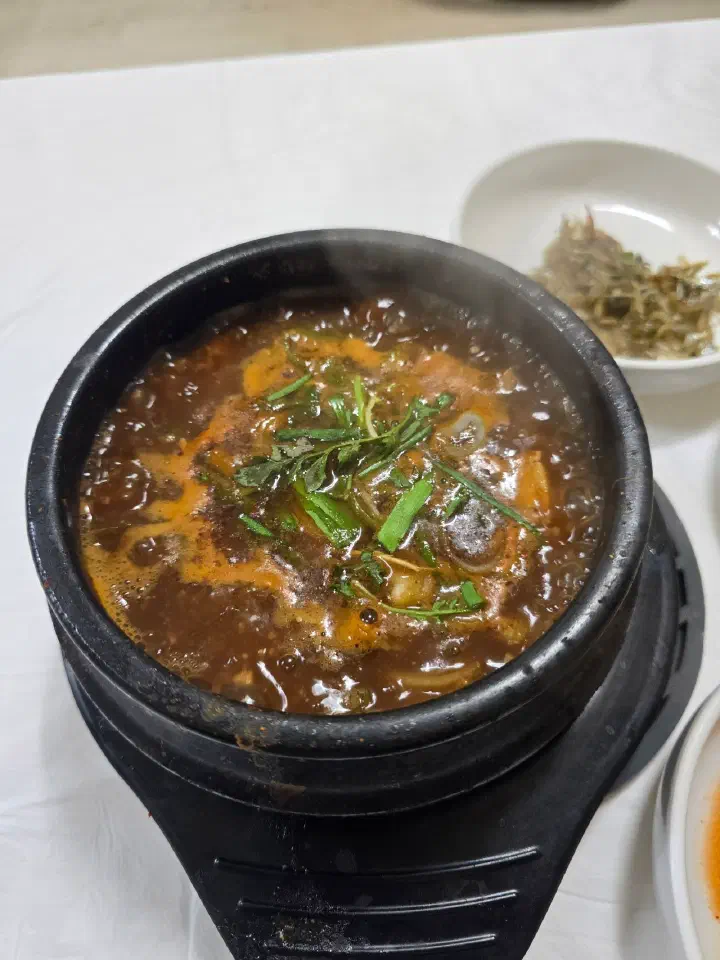
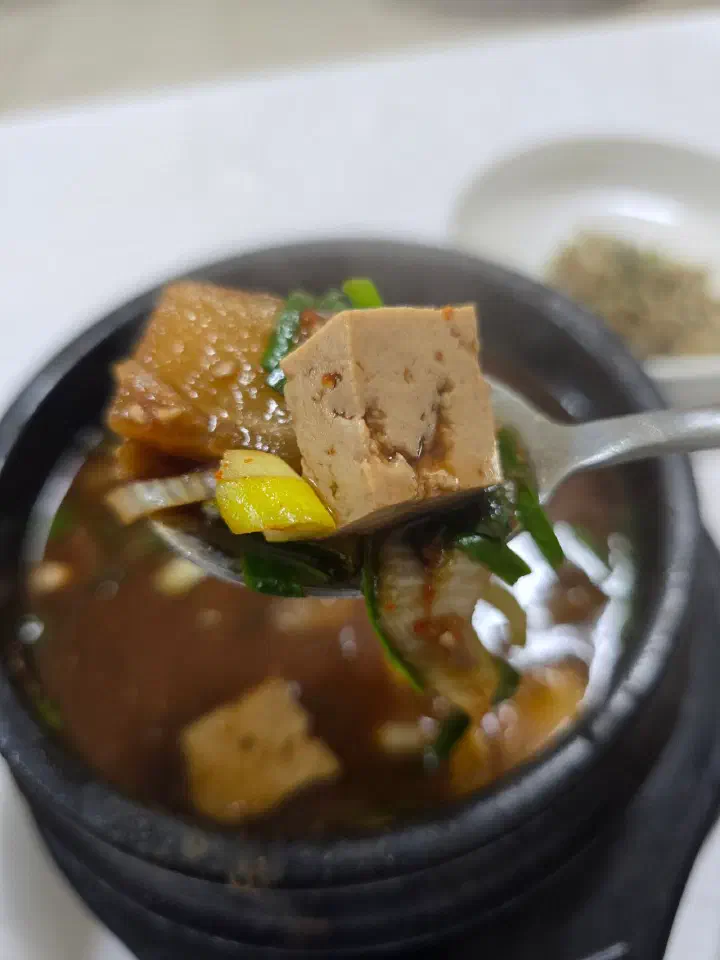
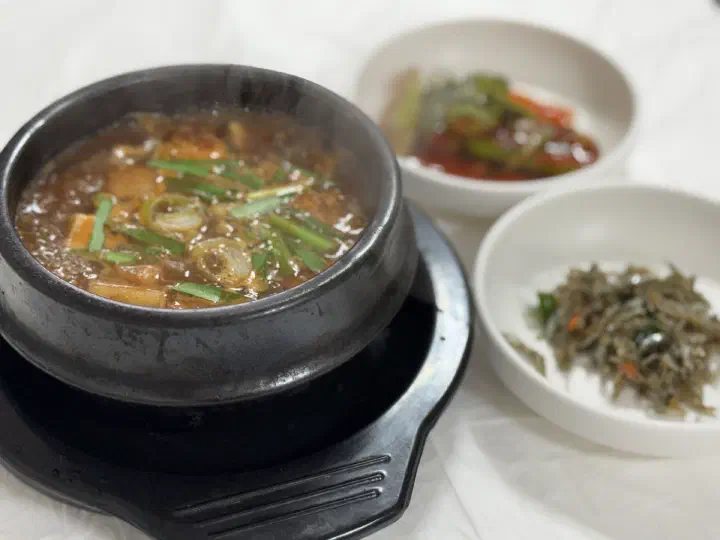
The stew might be the best thing on the table
A lot of diners rate the doenjang-jjigae above the main dish.
It’s made with house-fermented soybean paste, so it is darker and earthier than the version most restaurants serve.
Tofu and squash go in, sometimes wild greens depending on the season.
It leans salty.

After a few bites of the duruchigi, which is intense, a spoonful of the stew resets your mouth.
If you order takeout, this is the thing you’re giving up.

Side dishes number four or five: stir-fried anchovies, seasoned bean sprouts, cucumber, fish cake, and something seasonal like eggplant or spinach.
They are lightly seasoned and genuinely good with rice.
There were seven when the restaurant was filmed for television; the count has come down since the crowds arrived.
The rice is well cooked too — separate grains, still steaming.

What changed after the broadcast
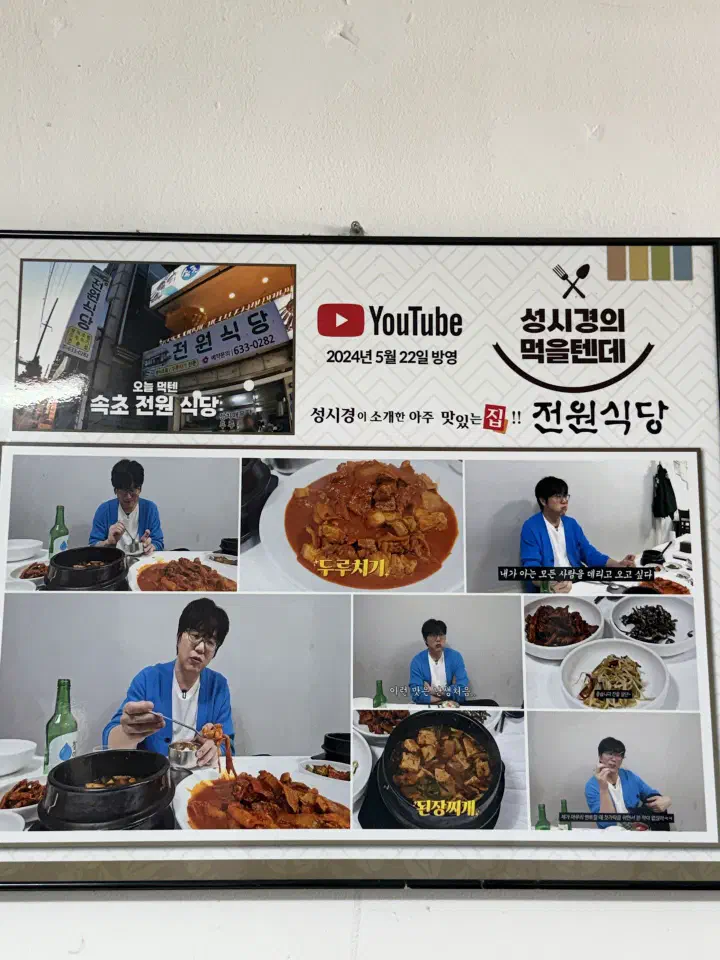
Jeonwon Sikdang appeared on Sung Si-kyung’s YouTube channel Meogeultende on May 22, 2024.
The singer’s reaction was over-the-top, and the framed photos on the wall date from that visit.
His table is still there, and the staff will happily point it out if you ask.

Before that it was a local place.
Afterward the pre-dawn lines started, and a few things shifted.
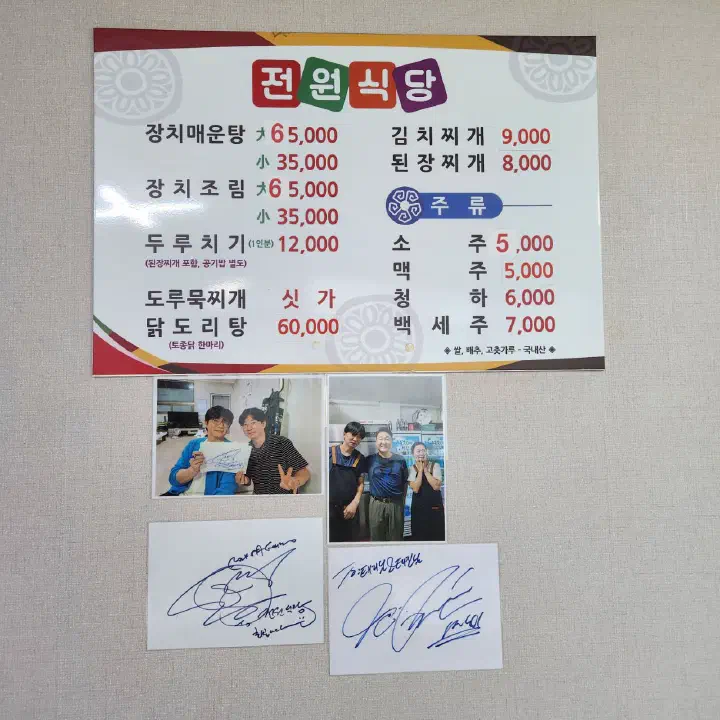
The price went from 12,000 to 15,000 won per person.
Rice used to be a separate 1,000 won charge and is now included.
Side dishes dropped from seven to around five.

The menu board still lists braised jangchi fish, spicy jangchi stew, braised chicken and sandfish stew.
Those are seasonal and simply don’t get made when the restaurant is this busy.
In practice there is one dish, year-round, and no ordering decision to make — which removes the usual language barrier entirely.
Two people, hold up two fingers, done.
The room
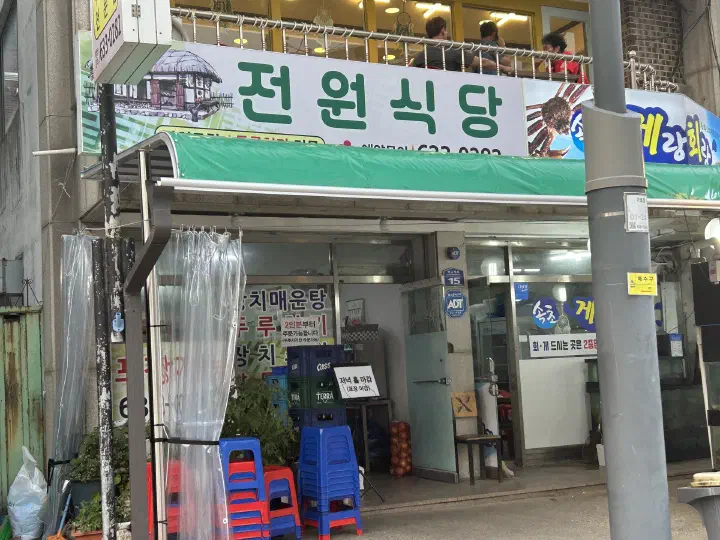
The building is an old neighborhood restaurant and looks it: a green awning, one sign, and nothing else.
The sign lists only two things.
Inside there’s a floor-seating room with five or six low tables and two or three regular tables.
You take your shoes off at the entrance for the floor section.
Nothing is decorated, and somehow that’s easier to settle into than most places that try.

The kitchen is open to the room.
Two or three big woks stay in motion the whole service, kimchi and pork going in constantly.
Watching your food get cooked in front of you is reassuring in a way a closed kitchen never is.
Running seven parties an hour keeps everyone moving.
The staff is friendly — several of them will fuss over children or anyone who’s pregnant, finding a better seat or bringing something extra.
During the busiest slots you may wait a bit for attention, but that’s short-staffing under pressure, not rudeness.
English is limited, though the single-dish menu makes that mostly irrelevant.
This is not a place to settle in for two hours.
The next group is outside.
In summer the restaurant runs with the doors open rather than air conditioning, so it gets warm.

Parking and getting there
There’s no dedicated parking lot.
Cars line up along the alley across the street, and if you find a space there it’s under a minute’s walk.
Weekends and peak season make that competitive.
For something less stressful, the Yeonggeumjeong public parking lot and Dongmyeong Port public parking lot are both about a four to five minute walk.
Both charge.
Without a car, Sokcho Express Bus Terminal is roughly a 15-minute taxi ride, and Sokcho Intercity Bus Terminal is closer to 10 minutes.
Fares run somewhere in the 6,000 to 10,000 won range.
Kakao T is the taxi app that actually works in Korea, and it accepts foreign cards.
For walking directions, use Naver Map or KakaoMap rather than Google Maps — Google’s walking and transit routing in Korea is unreliable.
The location itself sits right in front of Yeonggeumjeong, surrounded by seafood halls and fish markets, so it lands naturally on most Sokcho itineraries.
If you’ve got dead time between taking a ticket and eating, the Yeonggeumjeong observation deck over the East Sea is right there.
Coastal wind here is stronger than most people expect, especially in winter and early morning — bring a layer even in summer.
📍 View Jeonwon Sikdang (전원식당) on Google Maps →
Who it suits
After a few days of raw fish and cold soups in Sokcho, a hot, heavily seasoned rice meal starts to sound very good.
That’s the gap this fills.

It works if you’re already an early riser.
Grab a ticket at seven and the rest of the day stays intact.
It doesn’t work if you sleep in, hate waiting, or want a quiet room.
Takeout solves the first two.
If you want a drink with it, come in the evening.
The seasoning is strong enough to hold up to soju.
Wrapping up
Is it worth getting up at dawn?
That depends entirely on you.
What’s harder to argue with is the value.
Fifteen thousand won gets you that much pork and kimchi, a good stew, rice, and side dishes — a fair deal by any standard.

Traveling to Sokcho for this restaurant alone would be a stretch.
Being in Sokcho already, with a morning you can start early, makes it an easy yes.
And going in with slightly lower expectations tends to produce the happier meal.