Sokcho is a beach town, so most food lists here start with squid or raw fish.
This place is neither of those.
It’s a tiny neighborhood mill on a side street near the Cheonghak intersection, and it sells one thing: chapssal mochi (찹쌀모찌), a soft rice cake filled with red bean paste.

The tricky part isn’t finding it.
Buying it is the hard part.
Maps list the shop as opening at 9:30 in the morning, and people who show up right then often go home with nothing.
That’s when selling starts, not when you should arrive.
The numbered tickets that let you buy are handed out well before that, and they run out.

Shop details

Address: 13 Cheonghak-ro, 1F, Sokcho-si, Gangwon-do
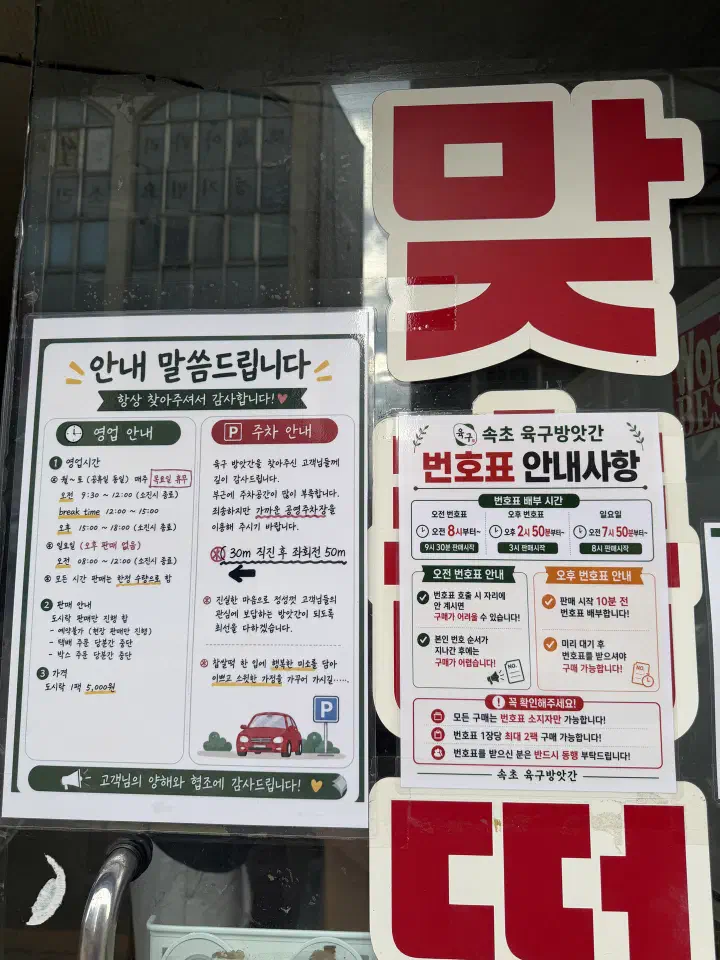
Hours: Mon-Wed and Fri-Sat, 09:30-12:00 and 15:00-18:00 (closed 12:00-15:00)
Sunday: 08:00-12:00, no afternoon session
Closed: every Thursday
Tickets issued: 08:00 and 14:50 on weekdays and Saturday, 07:50 on Sunday
Price: 5,000 won for a box of eight
Limit: two boxes per ticket
Payment: cash or Korean bank transfer
Parking: no lot of its own, use the Rodeo 1 or Rodeo 2 public lot
No reservations, no delivery, no shipping

📍 View Yukgu Bangatgan (육구방앗간) on Google Maps →

One warning about those hours.
The sign on the shop door and the hours on Naver Map do not match, and the door sign is the accurate one.
Either way the closing time barely matters.
When the day’s batch is gone, the shop stops selling, whatever the clock says.

Notice signs on the door of Yukgu Bangatgan in Sokcho listing business hours and numbered ticket handout times

How the ticket system works

There are two lines here, not one.
You stand once to get a numbered ticket, then you come back and stand again in number order to actually buy.

On weekdays and Saturdays, morning tickets go out at 08:00 and selling starts at 09:30.
The afternoon round issues tickets at 14:50 and sells from 15:00.
Sunday runs earlier, 07:50 for tickets and 08:00 for selling, with nothing in the afternoon.

Each round releases roughly 200 tickets.
Show up well after the handout time and you may still get a number, along with a frank warning that it only works if rice cakes are left.
Even at 08:00 on an ordinary weekday, the count is often close to 100.

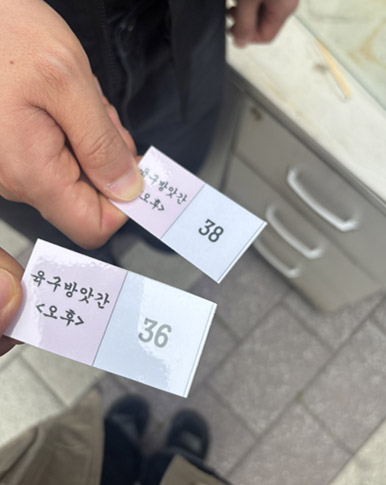
Two numbered afternoon tickets, 36 and 38, handed out at Yukgu Bangatgan in Sokcho

When you take a ticket, a staff member tells you when to come back.
Low numbers get called around 09:20, ten minutes before selling, and anyone past 100 is told to come back at 09:50 or later.
Miss your slot and the line moves on without you.
The staff call out numbers in a normal speaking voice, not over a loudspeaker, so stay within earshot.

If you missed the tickets

A missed ticket is not the end of it.
Once every ticket holder has bought, leftovers are sold one box per person.
In the morning round, you’ll know by about 10:30 whether there are any left.

It can be done in half an hour.
It can also come to nothing.
If the morning batch is finished, you get told to come back for the afternoon round.
Still, if a dawn start does not fit your day, this is the version worth trying.

The pregnancy lane

Pregnant customers do not wait in line at all.
Bring a doctor’s note confirming the pregnancy, a maternity health booklet, or a pregnancy courtesy badge; a photo on your phone is accepted.
Show it to the staff member out front and they’ll show you where to stand, even when no lane is visible.

As you face the shop, the line on the left is for ticket holders; the one on the right is the priority lane.
Come at the selling time and you buy and leave without waiting.
The shop counts two boxes for the mother and two for the baby, so four in total.
For anyone who can’t stand in the sun, this is the surest way to walk out with a box.

Waiting in summer

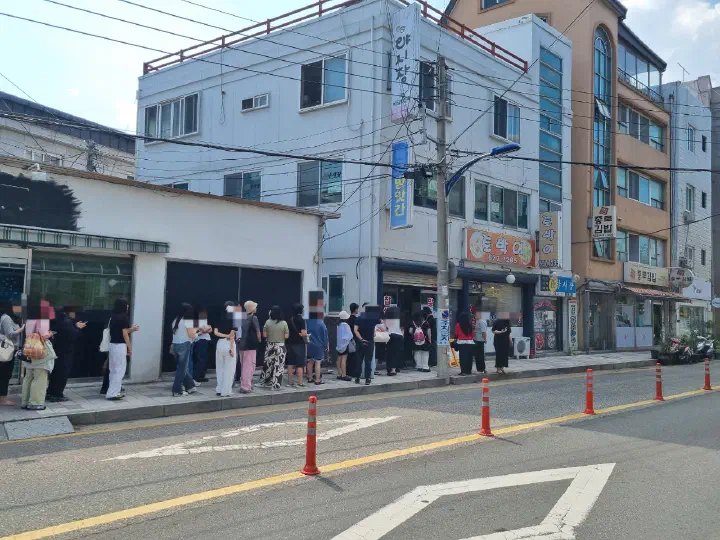
The morning waiting spot has no shade.
That is part of why the shop hands out tickets early, so people are not standing in the heat for an hour and a half.
You still need to be there before tickets are issued, so in summer bring a hat or a parasol, and a handheld fan if you have one.
Some people show up with folding stools.

Customers lined up on the shadeless sidewalk outside Yukgu Bangatgan during the morning round in Sokcho

The afternoon spot gets some shade, which makes that round easier.
And since about 90 minutes pass between ticket and purchase, most people go wander somewhere.
Cheongcho Lake is a short stroll away and quiet in the morning, and there are cafes within a couple of minutes.
There is no reason to stand outside the shop the whole time.

What the rice cake is like

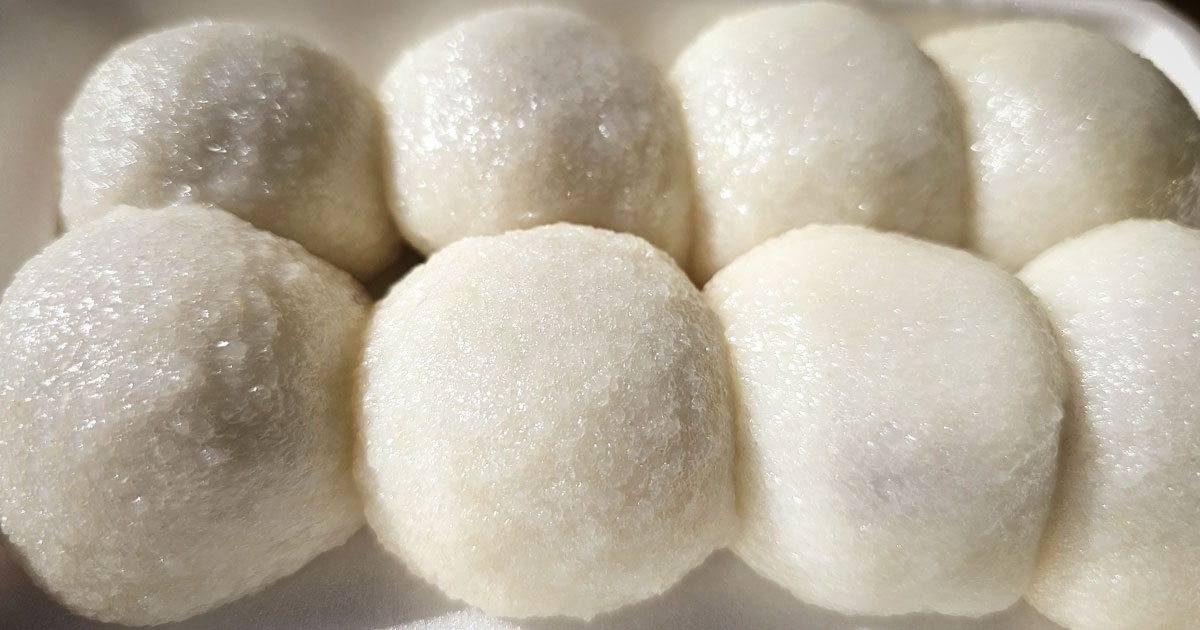
This is not the smooth, glossy kind of Korean rice cake.
The glutinous rice is coarsely milled, so individual grains stay whole and you feel them as you chew.
The texture is what people come for.

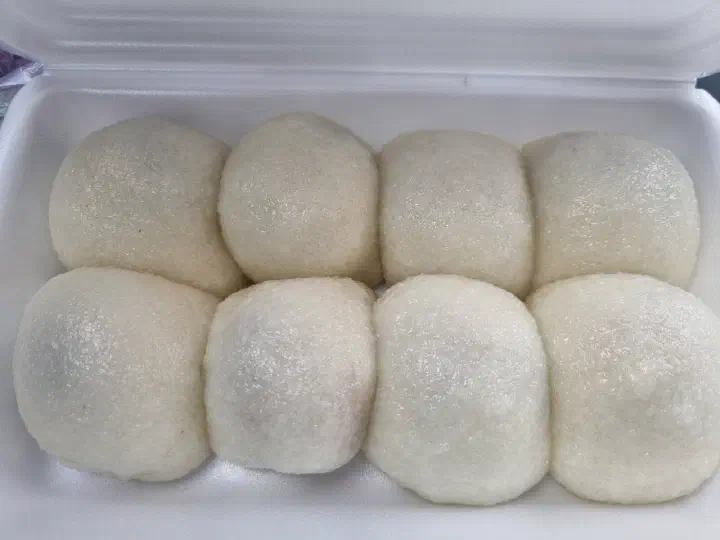
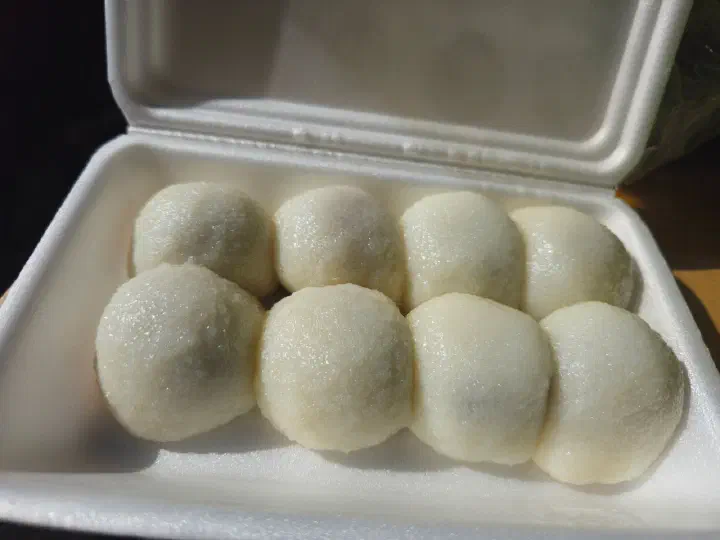
Close-up of eight chapssal mochi in a Yukgu Bangatgan box, with coarsely milled rice grains visible in the skin

It is chewy without being rubbery, and it stretches a long way before it breaks.
There is almost no starch dusting on the outside, which means clean fingers.
Some people compare it to steamed rice bread because of the air in the skin; others say it tastes like rice cake pounded in a stone mortar the old way.
Both descriptions land in the same place.

The red bean filling is not very sweet.
It’s cooked in-house, so you get whole beans here and there, and you can eat several without needing coffee to cut the sugar.
Eight pieces for 5,000 won works out to a little over 600 won each, which is cheap for a dessert in Korea right now.

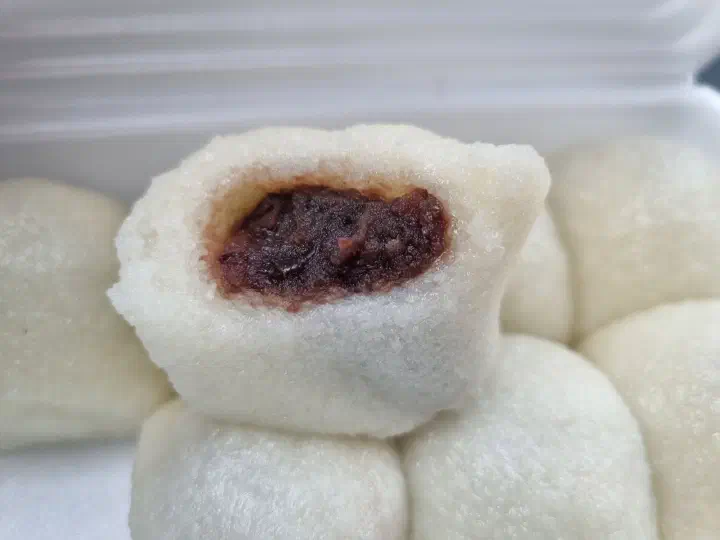
A bitten piece of Yukgu Bangatgan chapssal mochi showing the red bean filling and grainy rice cake skin

It’s softest warm, straight from the counter.
Plenty of people prefer it once it has cooled a bit and firmed up, so this part comes down to taste.

Storing it

Nothing is added to make it keep, and it is made fresh that morning.
Keep out what you plan to eat that day and freeze the rest.
The refrigerator is the wrong answer here; it goes hard within a day.

A takeout box of eight Yukgu Bangatgan chapssal mochi before being split up for the freezer

Don’t freeze the box as is, or the pieces fuse together.
Wrap them one or two at a time in plastic wrap or a zip bag.
Take them out 30 minutes to an hour before eating and let them thaw at room temperature, and the texture comes back almost exactly.
Thaw a piece and brown it in a dry pan and the outside crisps up, a different snack altogether.

If you are driving in summer, pack a cooler bag and an ice pack before you go, especially if you are carrying them a long way.

A family mill, 35 years in

The shop opened in 1991, which makes 2026 its thirty-fifth year.
The grandmother started it, and her son, daughter-in-law, and granddaughter now work alongside her, three generations in one small workspace.
Nothing is stamped out by machine; the cakes are shaped by hand.

Close-up of the house-cooked red bean paste inside a Yukgu Bangatgan chapssal mochi

It began as an ordinary neighborhood mill that took custom orders and supplied rice cakes to the Cheoksan hot spring resort nearby.
Social media changed that completely.
The hot spring contract ended, and so did everything that wasn’t a walk-up sale.

Since May 1, 2026, the operation has been stripped down.
Shipping and the old 96-piece box orders are gone, and the only thing left is the single boxed pack, sold in person.
Phone orders are not possible either.
The family is working while the shop is open, so calls mostly go unanswered; Instagram DM is the better way to reach them.

The line got longer again on July 27, when SBS featured the shop on Saenghwarui Dalin (Masters of Living).
The segment showed the 88-year-old master still making rice cakes herself.
People were already lining up before the broadcast, and since then, weekends and the summer vacation season have brought dawn arrivals.

Getting there and parking

You cannot park in front, and you cannot stop briefly either.
The street is narrow enough that a stopped car blocks it.
Sokcho Rodeo Parking Lot 1 is a one to two minute walk, and Rodeo Lot 2 is five or six minutes away.
Both are open around the clock and run about 400 won per 30 minutes, 1,000 won per hour, or 2,200 won for two hours.

Car navigation apps sometimes route you into the narrow alley behind the shop, which is a bad place to end up in a car.
Come in from the Cheonghak intersection on the main road and turn into the public lot instead.

If you are not driving, Sokcho Express Bus Terminal is a short taxi ride away, and the Kakao T app is the easiest way to call one since street hailing is hit or miss here.
For walking directions in Korea, use Naver Map or KakaoMap rather than Google Maps, which handles Korean pedestrian and bus routing poorly.

A lot of first-timers try the back door and get confused.
The rear is the workroom, and there is a note telling you to go around to the front.
The side with people lined up is the entrance, so follow the line.

One thing worth knowing before you get in line: most restaurants and shops in Korea take international credit cards without any trouble, but this one is an exception.
Cash or a Korean bank transfer is how it works, and a single 10,000 won note covers two boxes.
There is no tipping in Korea, and offering a tip here would only confuse the staff.
Nobody at the counter is going to speak much English, but ordering is easy anyway: hold up one or two fingers for the number of boxes, and that is the whole transaction.

📍 View Yukgu Bangatgan (육구방앗간) on Google Maps →

My take

Opinions on this place are split, and honestly they should be.
Some people find the grainy texture genuinely unusual.
Others walk away thinking it was just fine.
There are people who don’t even like rice cake and end up liking this one. An hour on your feet is a different question.

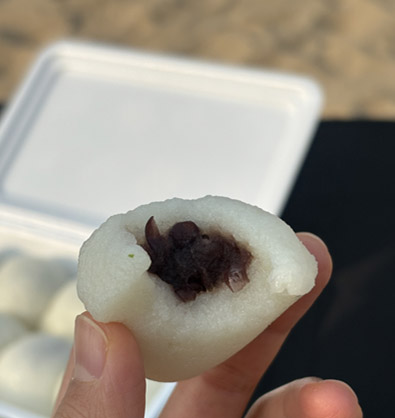
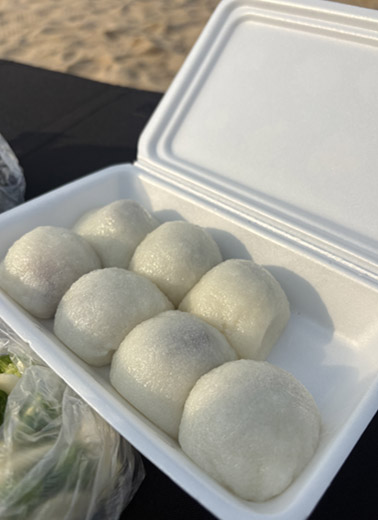
A box of Yukgu Bangatgan chapssal mochi opened on the beach in Sokcho

The useful threshold is 30 minutes.
Under 30 minutes, this is an easy yes at 5,000 won a box, and knowing the ticket times makes that realistic on a weekday morning.
Over an hour, or if it means a dawn start, it is not worth bending a trip around, especially since there is not much to do in the immediate blocks while you wait.

Where it does make sense is as an add-on.
Sokcho’s Rodeo Street and the tourist fish market are both walkable from here.
Grab a ticket, go do something else, and come back when you are called.
That version of this shop costs you almost nothing.