Almost every itinerary for Gangwon-do ends up with one bowl of cold buckwheat noodles somewhere in it.
In Yangyang, the name that keeps coming up is Yeonggwangjeong Memil Guksu (영광정메밀국수).

Nothing else is out here.
The restaurant sits up a winding road in Ganghyeon-myeon, surrounded by rice fields and low mountains, and people drive out specifically for it.
On a weekend afternoon the parking lot across the road fills anyway.

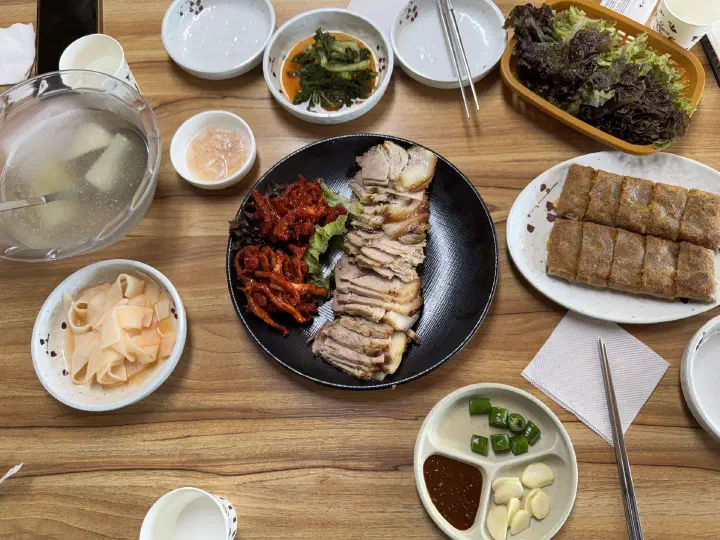
Full table spread at Yeonggwangjeong Memil Guksu in Yangyang with suyuk pork, buckwheat rolls and dongchimi broth

The basics

Address: 446 Jinmi-ro, Ganghyeon-myeon, Yangyang-gun
Phone: 033-673-5254
Hours: 10:00 - 19:00 daily, last order 18:30
Closed: every Tuesday
Parking: large free lot directly across the road

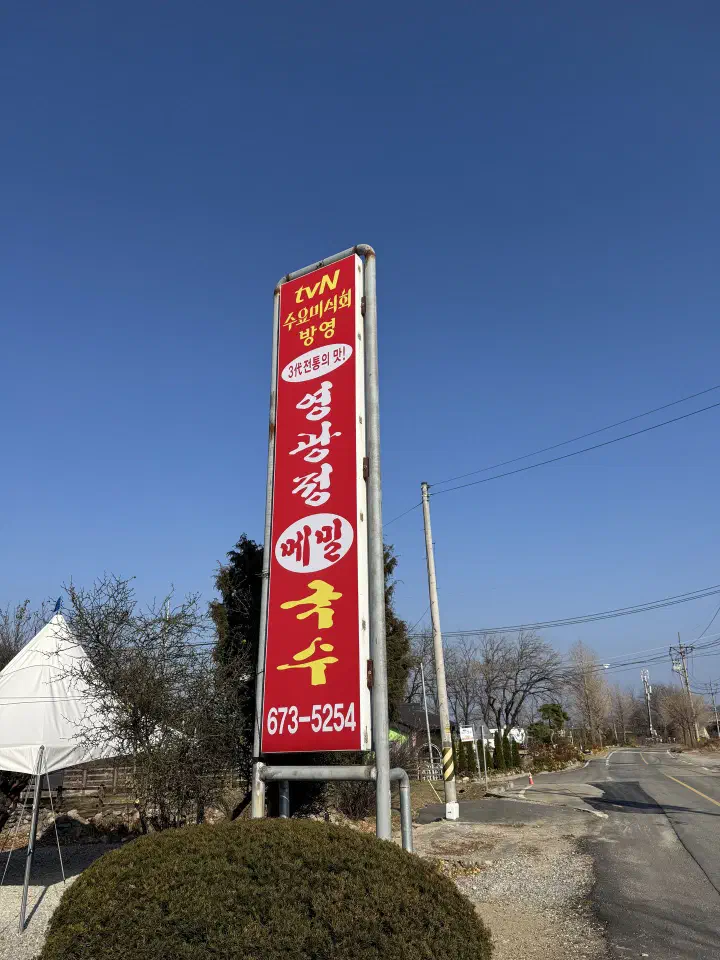
Tall red roadside sign for Yeonggwangjeong Memil Guksu on Jinmi-ro in Ganghyeon-myeon, Yangyang

📍 View Yeonggwangjeong Memil Guksu (영광정메밀국수) on Google Maps →

The Tuesday closure trips up more visitors than anything else here.
Some map listings still show the place as open seven days a week, but it shuts every Tuesday without exception.
Worth double-checking before you build a day around it.

Getting there without a car

This is not an easy place to reach on public transport.
There is no station nearby, local buses are infrequent, and the last stretch is a narrow road climbing away from the coast.
A rental car is the realistic option.

If you are staying in Sokcho or near Naksan Beach, a taxi is the next best thing.
Naksan Beach is about ten minutes away by car, downtown Sokcho roughly twenty.
Kakao T handles the hailing and quotes you a fare, though the ride back can take a while — no drivers idle out here.
Ask the staff to call one for you if the app gets you nowhere.

One practical note about navigation.
Google Maps is unreliable for walking and transit directions in Korea, and it sometimes misses the turn-off for this road entirely.
Naver Map or KakaoMap will get you there properly, and both have enough English to be usable.

When the line forms

Weekend and holiday lunch is the crowded window.
Five groups ahead of you means roughly thirty minutes, but the turnover here is fast enough that lines move quicker than they look.
Weekdays you will usually walk straight in.

Arriving before noon is the simplest fix.
Around 11:30 there is normally no wait at all, and after twelve the entrance starts filling up.

A waiting kiosk sits just inside the door.
The restaurant uses Tabling, a Korean remote waitlist app, so you register your number and wait in your car instead of standing outside.
The screen is in Korean, but the staff will punch in your party size if you hold up the number on your fingers.

The menu and what things cost

The menu is short, which is a good sign in a noodle house.

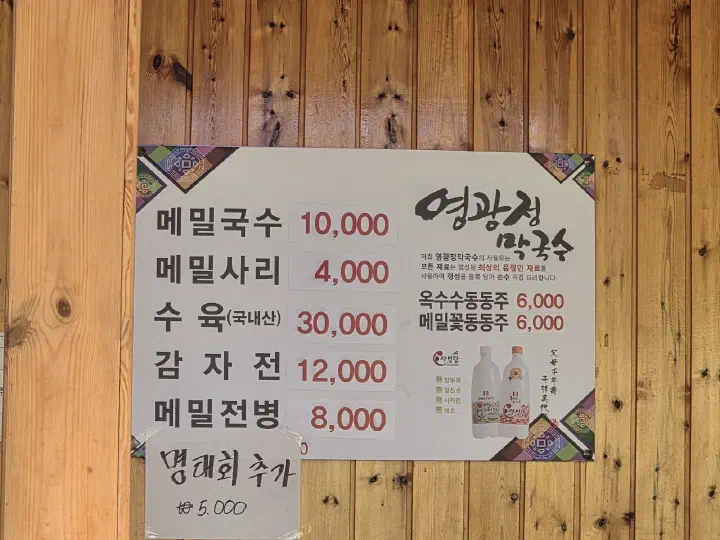
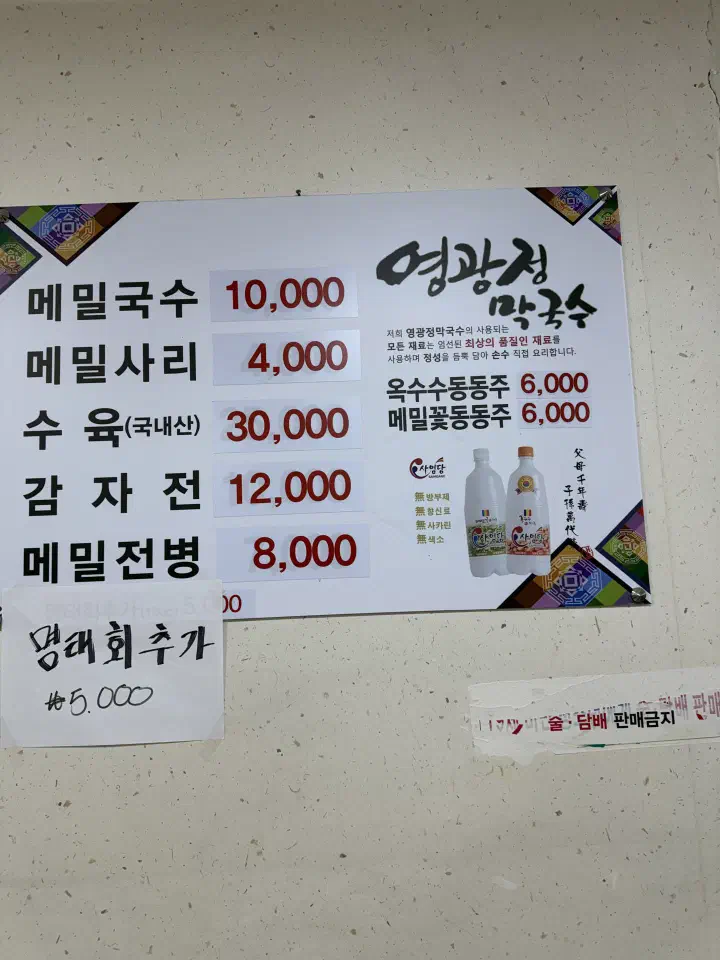
Memil guksu (메밀국수), cold buckwheat noodles, 10,000 won
Memil sari (메밀사리), extra noodle portion, 4,000 won
Suyuk (수육), sliced boiled pork, 30,000 won
Gamjajeon (감자전), potato pancake, 12,000 won
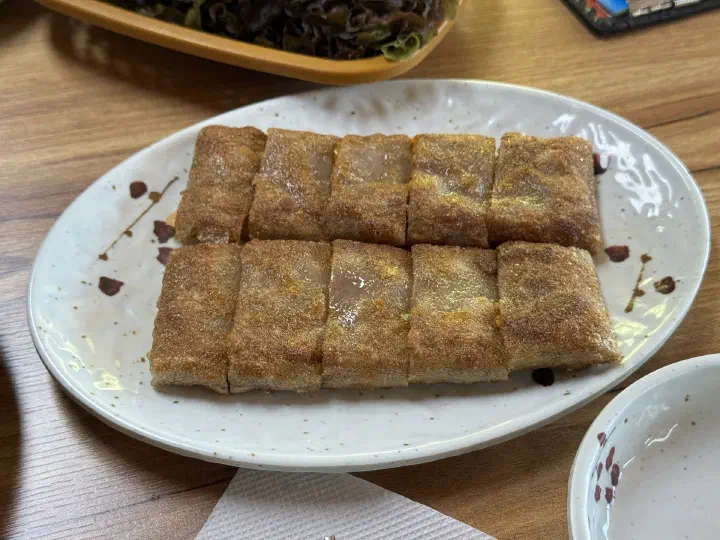
Memil jeonbyeong (메밀전병), buckwheat crepe rolls, 8,000 won
Myeongtaehoe (명태회) pollock salad, extra 100g for 5,000 won

There’s also corn dongdongju and buckwheat-flower dongdongju — a cloudy rice wine — if someone in the group isn’t driving.

Korean menu board on the wooden wall at Yeonggwangjeong listing memil guksu, suyuk, gamjajeon and jeonbyeong prices

Cards are fine here, including foreign-issued ones, and you pay at the counter on the way out.
No tipping in Korea, and leaving money on the table will genuinely confuse the staff.
Still, carrying a little cash is a sensible habit in rural Gangwon-do, where the odd small shop or market stall is cash only.

For two people, two bowls of noodles plus a potato pancake works well.
Or one large bowl of noodles with the pork, which is the combination most tables seem to land on.
Three or more, get the pork. It is the dish people remember.

Gangwon-style potato pancake beside a bowl of icy dongchimi broth and young radish kimchi at Yeonggwangjeong

How you are supposed to eat it

At most makguksu places you pick soup or mixed. Not here.
The noodles arrive already lightly dressed, with a separate bowl of dongchimi (동치미) on the side, the icy brine from radish-water kimchi.
How much of that broth you pour determines whether you end up with a soupy bowl or a mixed one.

A sign on the wall explains the order.
Broth first, then vinegar, sugar, perilla oil, and mustard to taste, all of which sit on the table.
Add them a little at a time and taste as you go, because the balance moves fast.

Pouring icy dongchimi radish-water broth over cold buckwheat noodles at Yeonggwangjeong

The sugar is the counterintuitive one.
It does not make the bowl sweet so much as push the buckwheat aroma forward.
A quick drizzle of perilla oil rounds the broth out.
If it tastes too sour, oil plus a pinch of sugar fixes it; if it tastes flat, a spoonful of the red sauce brings it back.

The noodles and the broth

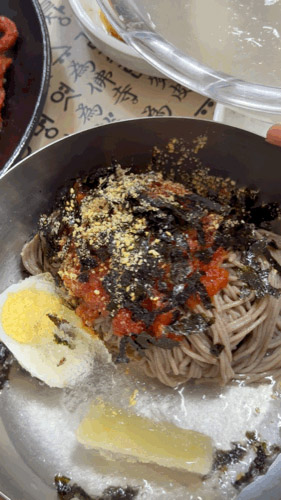
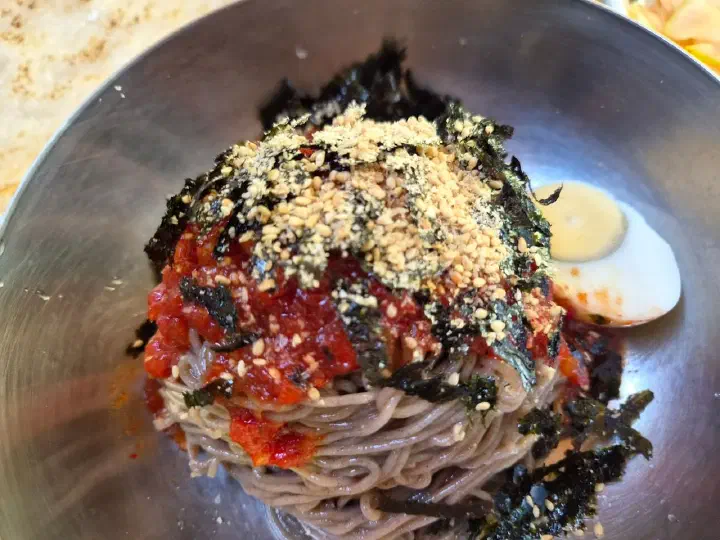
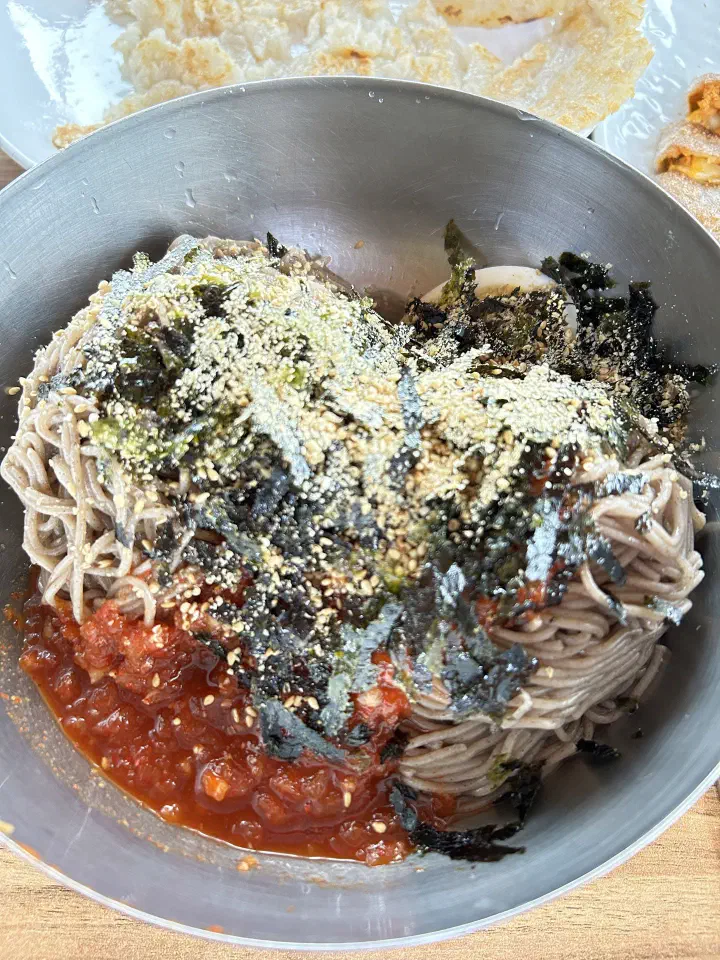
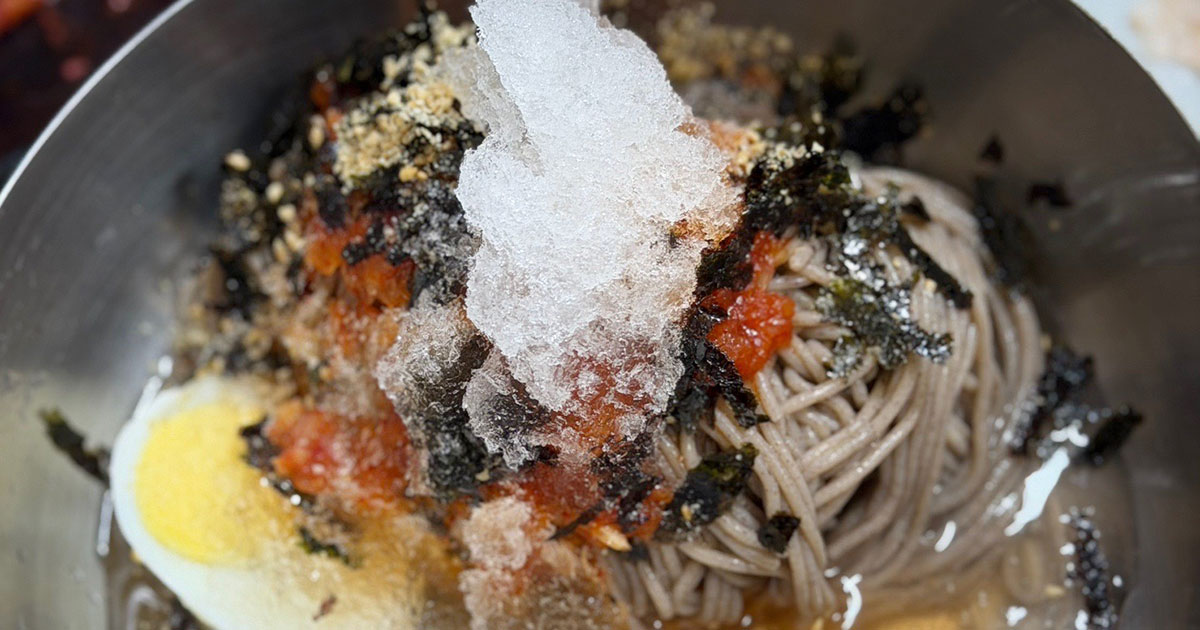
Grey buckwheat noodles come in a big stainless bowl, topped with seaweed flakes, sesame, a dab of red sauce, and half a boiled egg.
It looks plain, and that plainness is the point.

Cold buckwheat noodles in a stainless bowl topped with seaweed flakes, red sauce and half a boiled egg

The noodles have a rough, nutty chew that builds the more you eat.
They are not rubbery, they hold some spring, and they go down easily.
Stirring the egg yolk into the broth softens everything toward the end of the bowl.

The dongchimi broth is the real draw.
It arrives with a skin of ice still floating on it, clean rather than funky, with a natural sweetness from the radish itself.
On a good day there is even a faint fizz to it.

Close-up of grey buckwheat noodles with sesame, seaweed and red chili sauce at Yeonggwangjeong Memil Guksu

That broth changes with the season, though.
Depending on when the radishes were pickled and which crock the batch came from, some days it lands noticeably sweeter than others.
If it reads too sweet, more vinegar evens it out.

The overall seasoning is tangy and lightly sweet rather than spicy, which makes this an easy meal even if you are wary of Korean heat.
The pollock salad on the side is the only thing with real chili in it, and even that is mild by local standards.
The flip side is that people who want a boldly seasoned noodle bowl sometimes find this one thin, and the buckwheat aroma is gentler than at places that use pure buckwheat flour.

The pork is the sleeper hit

Plenty of people come for the noodles and leave talking about the suyuk.
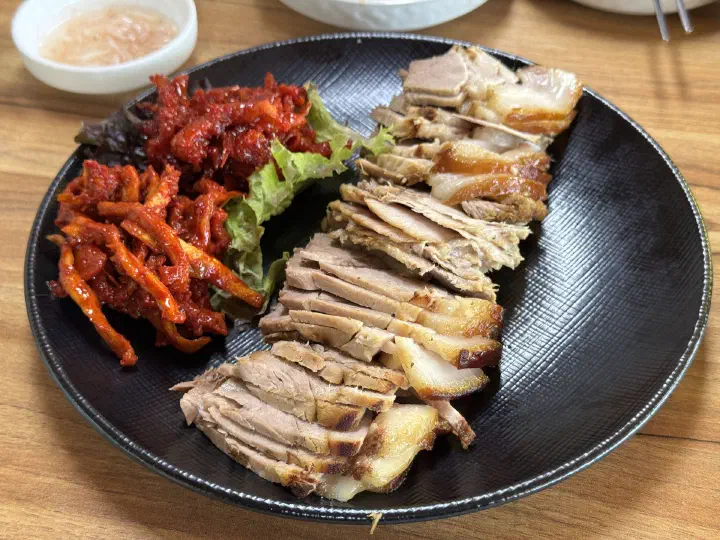
Domestic pork, sliced thin, with the fat and lean in good proportion so it stays tender instead of drying out.
It reaches the table almost immediately after ordering.

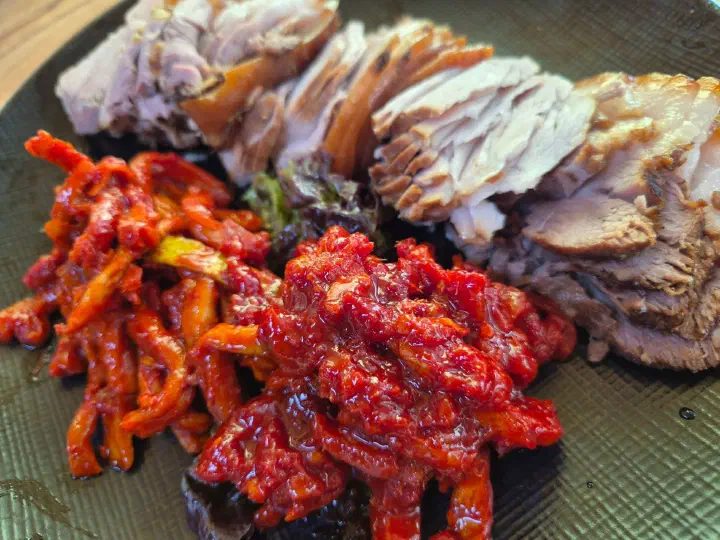
Plate of sliced boiled pork suyuk with spicy pollock salad at Yeonggwangjeong Memil Guksu

It comes with the spicy-sweet pollock salad and a pile of dried radish strips.
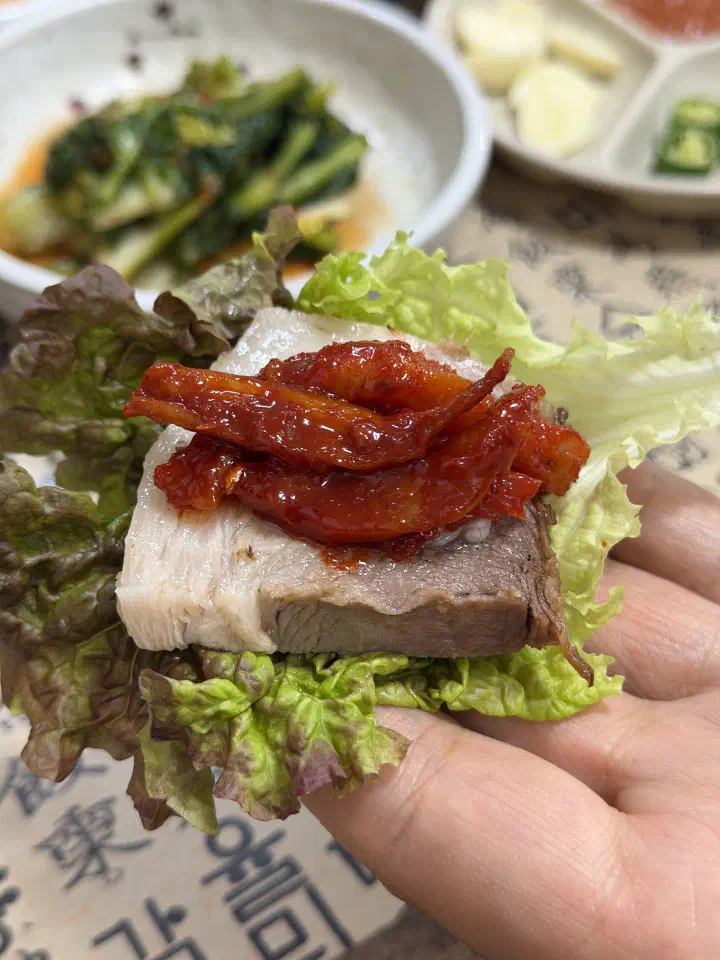
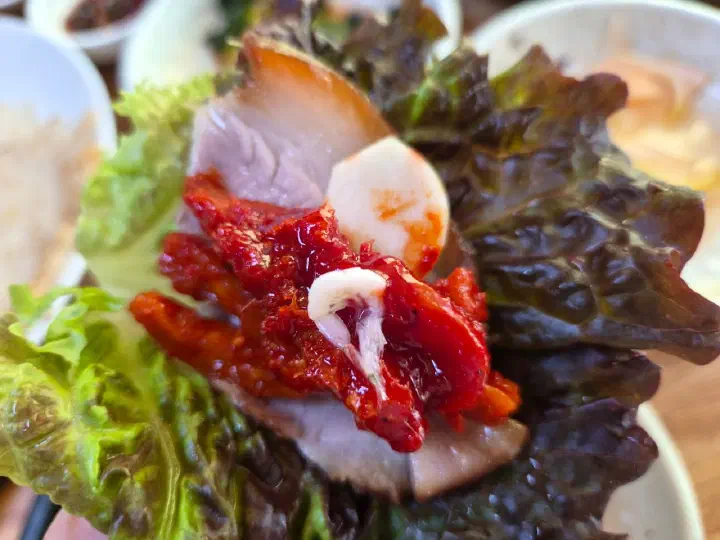
Build a lettuce wrap with a slice of pork, some pollock, garlic, and chili, and that one bite justifies the drive.

Lettuce wrap holding a slice of suyuk pork topped with spicy pollock salad
The pollock comes free with the pork, so skip the extra portion unless you want some with your noodles as well.
Taste it first either way, because it is salty.

Close-up of tender suyuk pork slices and sweet-spicy myeongtaehoe pollock salad

The pork is not perfectly consistent, to be fair.
Most days it is tender and clean-tasting, but the lean sections can come out dry, and now and then a slice comes through faintly gamy.
And it only comes as a full 30,000-won plate, no half orders, which makes it an awkward call for two people.

Potato pancake and buckwheat rolls

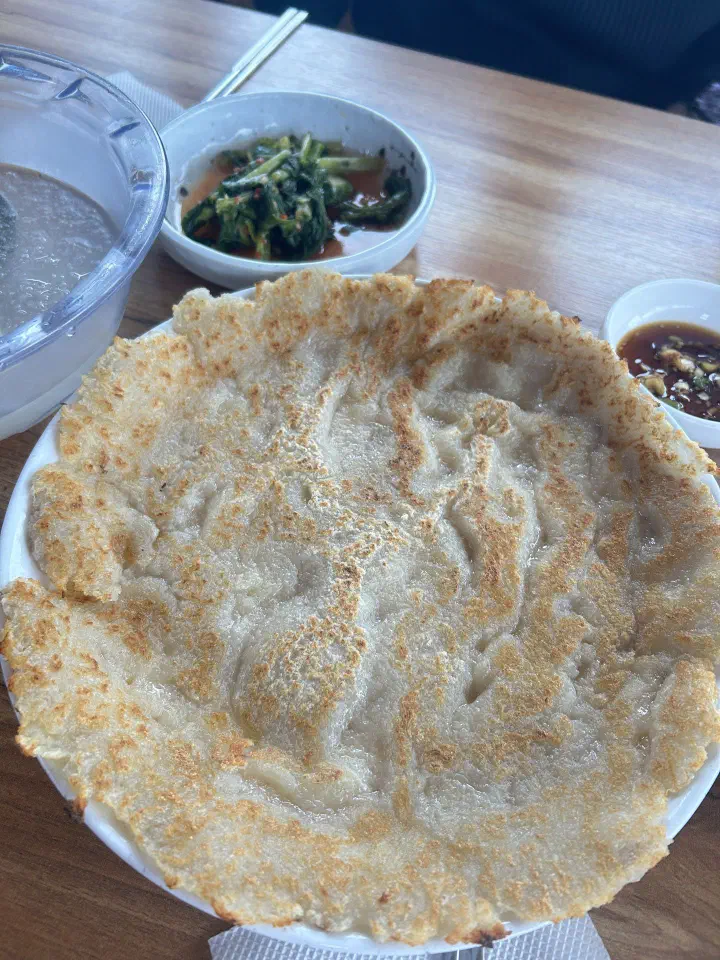
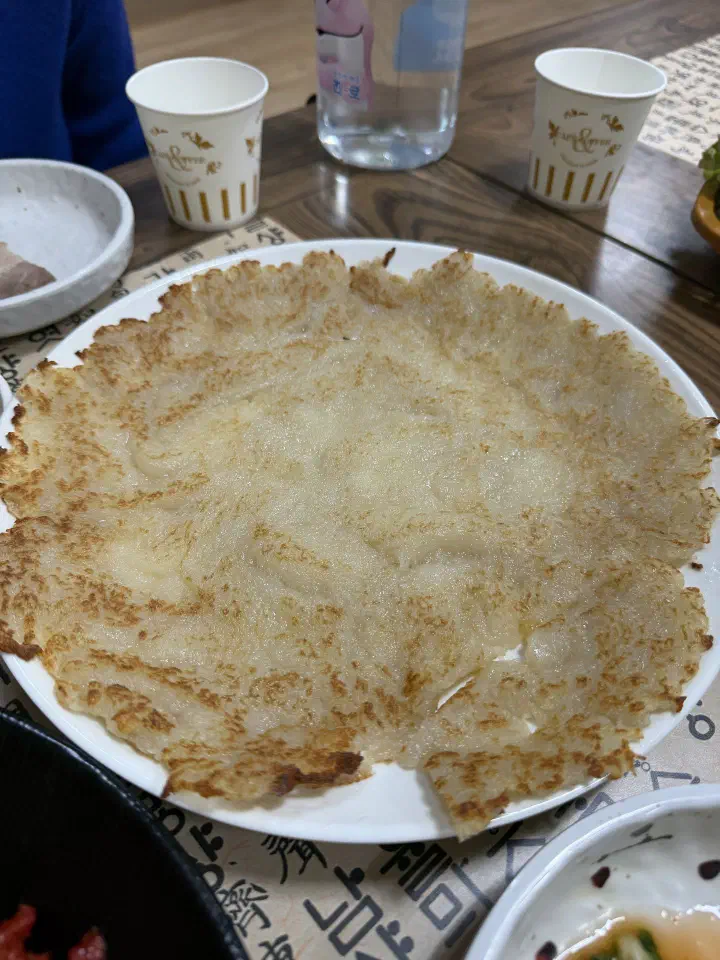
The gamjajeon is the Gangwon-do style: raw potato grated on a box grater and fried thin.
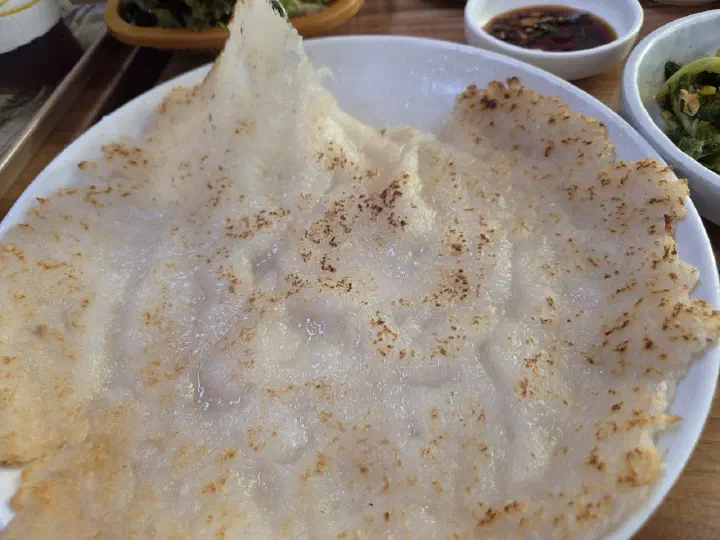
It covers most of the plate, crisp and lacy at the edges, thicker and chewy in the middle, served with a soy dipping sauce loaded with scallion and chili.

Whole Gangwon-style gamjajeon potato pancake filling the plate

Hot and oily against cold noodles is a good pairing, and the oil never feels heavy.
That said, 12,000 won is steep for what it is, and more than a few people walk away thinking it was just a potato pancake.

Close-up of the lacy crisp edge and chewy centre of the potato pancake

The memil jeonbyeong is the underrated order.
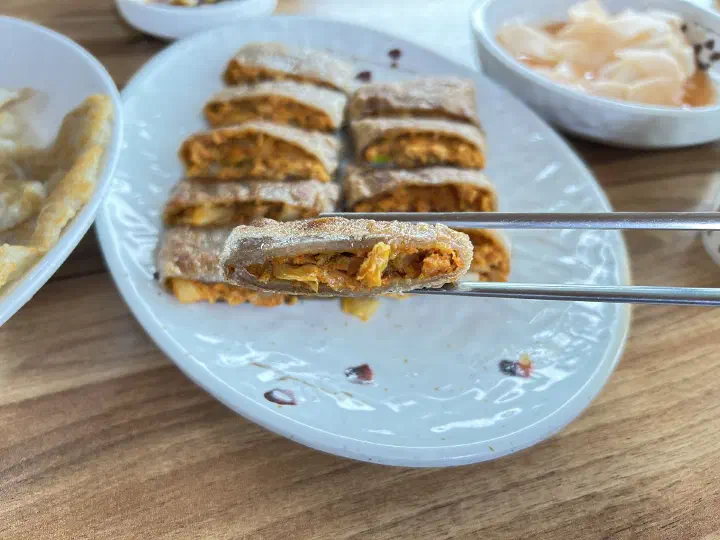
Crisp outside, chewy inside, with a slightly spicy filling that plays well against the cold noodles.

Plate of sliced memil jeonbyeong buckwheat crepe rolls at Yeonggwangjeong

If you can only pick one side, this is the one people regret skipping.

Cut buckwheat crepe roll showing the spicy kimchi filling inside

The room

You will spot the red roof and sign from a distance.
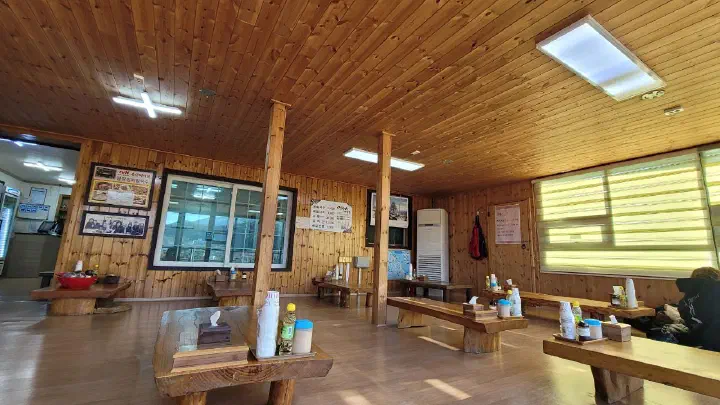
The exterior is unfussy, an old country restaurant that has not been prettied up, but inside it opens into a wide hall finished almost entirely in wood.

Wide wood-panelled dining hall with log tables inside Yeonggwangjeong Memil Guksu

Floor seating up front in the traditional style, regular tables further in.
The back wall is glass, looking down over the village with the Seoraksan ridgeline behind it, and those window seats are worth asking for.
The view does a fair amount of the work here.

Families make up most of the room, and it is loud enough that a restless kid will not draw attention.
No high chairs or kids’ utensils, though, so the floor seating tends to be easier with small children.
Air conditioning is minimal, which is worth knowing in August.

Meals here are quick.
Food lands within about five minutes of ordering, and thirty to forty minutes is a full unhurried visit.
Some people find that speed slightly off-putting, as though the food had been sitting rather than made to order.

Television and ribbons

The place appeared on tvN’s Wednesday Food Talk in March 2016, and earlier on MBC and KBS morning programs.
The Wednesday Food Talk banner is painted right on the sign outside, so you cannot miss it on arrival.

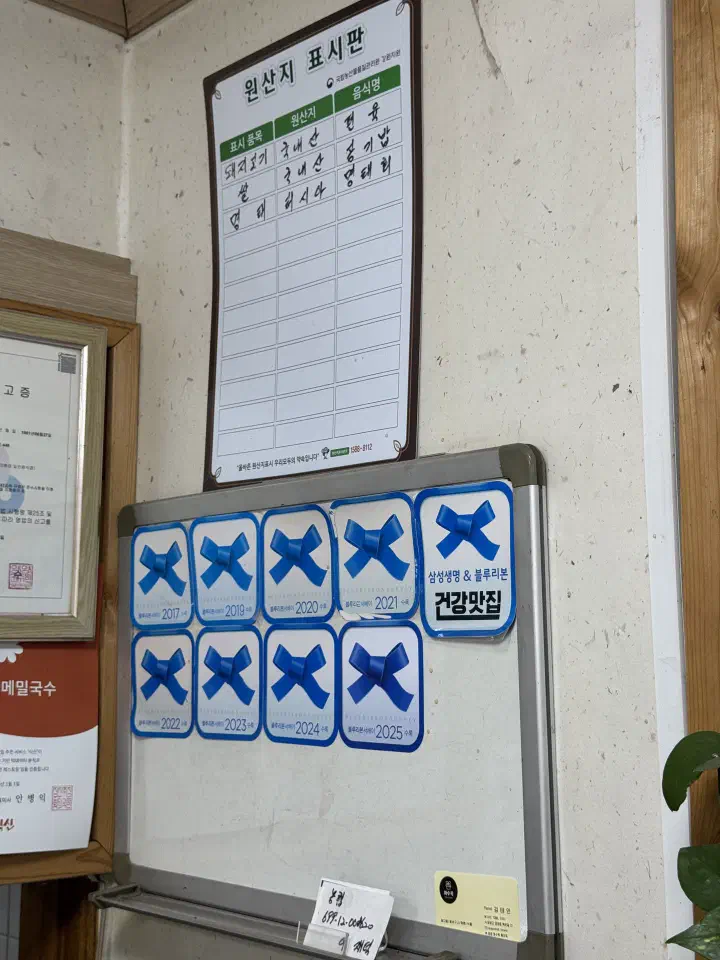
Near the register there are nine Blue Ribbon Survey stickers on the wall, alongside signed photos from Korean celebrities and the mandatory ingredient-origin board.

Blue Ribbon Survey stickers from 2017 to 2025 and the ingredient-origin board on the wall
The sign outside claims three generations of family cooking, and the restaurant has been running for close to fifty years.

One thing to watch: there is a branch in Sokcho with the same name.
The Yangyang location in Ganghyeon-myeon is the original, and regulars are fairly firm that the broth is better here.

Ordering when you do not speak Korean

Nobody on staff is likely to speak much English, and the menu on the wall is Korean only.
None of that matters much in practice.
Five things on the menu, and pointing at the wall while holding up your fingers gets the job done every time.

Korean-only price list on the wall showing memil guksu at 10,000 won and suyuk at 30,000 won

If you want a shortcut, the transliterations above are close enough to the Korean that saying them out loud will work.
Memil guksu, suyuk, gamjajeon. That covers most tables.

Wrapping up

If you are looking for one bowl of makguksu in Yangyang, this is still the name that comes up first, and it earns that for reasons you can taste.
The pour-your-own dongchimi broth is genuinely distinctive, and the pork with pollock salad is what most people end up describing afterward.

One-bite lettuce wrap of suyuk pork, pollock salad and raw garlic at Yeonggwangjeong Memil Guksu

It is not the place for anyone chasing bold flavors or a heavy buckwheat aroma.
If clean and cold and slightly restrained sounds right to you, it will land well.
Just check the Tuesday closure and the 18:30 last order before you set off.

Finding it

446 Jinmi-ro, Ganghyeon-myeon, Yangyang-gun, Gangwon-do.
Turn off the coastal highway, follow the village road inland, and the red roof appears as the road climbs.
Parking is directly across from the building, and the restrooms are over there too, separate from the dining room.

📍 View Yeonggwangjeong Memil Guksu (영광정메밀국수) on Google Maps →