Perilla oil makguksu is on half the noodle menus in Korea now.
It didn’t exist as a dish before 2012, and it started here, in a wooded valley in Yongin.
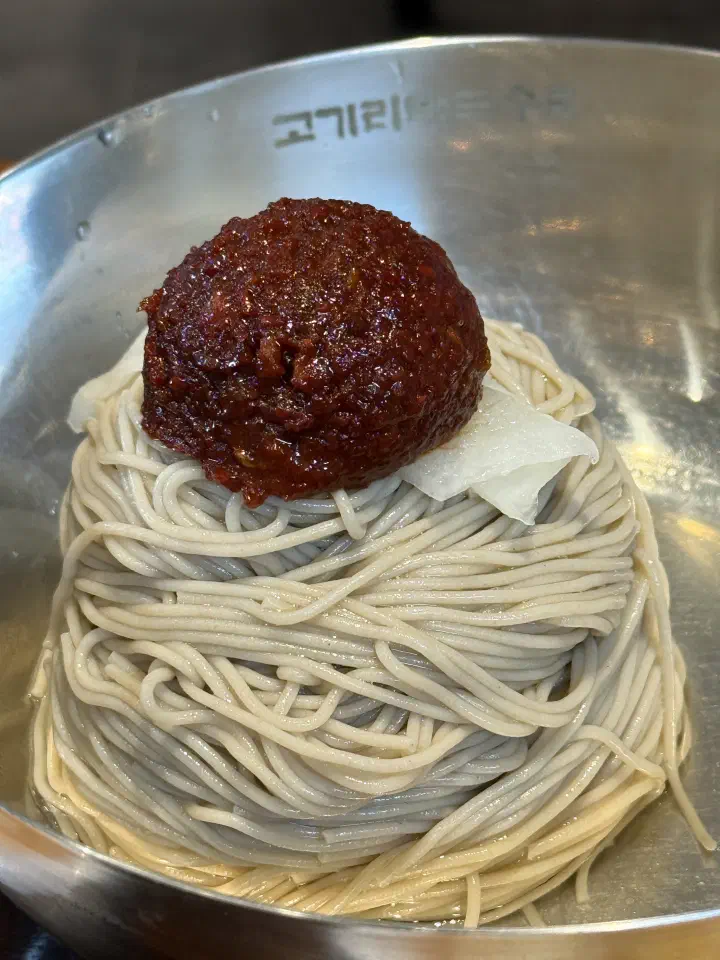
Gogiri Makguksu (고기리막국수) put it on the menu first. Everything since is downstream of that one bowl.
Which is why the place is now better known for its line than for its noodles.
A weekend evening can put more than a hundred parties ahead of you.
The good news is that the line runs on rules, and the rules are knowable.
Learn them and you can cut the wait in half.
So: logistics first, food second.

The basics
The address is 157 Ijongmu-ro, Suji-gu, Yongin-si, Gyeonggi-do.
Phone is 031-263-1107.
Hours run 11:00-21:00 Monday through Friday, and 10:40-21:00 on Saturday and Sunday.
Last order is 20:20 every day. Closed Tuesdays.
The kitchen never shuts down mid-afternoon, the way a lot of Korean restaurants do.
But somewhere between 4 and 5 p.m. they change the water in the noodle pots, and that takes about half an hour.
Land in that window and you’re adding half an hour to whatever you were already facing.
Three parking lots, with attendants on duty.
No reservations — the only way in is the waitlist.
Cards are fine here, including foreign ones, so you don’t need cash.
And nobody tips in Korea. Leaving money on the table will just confuse the staff.

📍 View Gogiri Makguksu (고기리막국수) on Google Maps →
Two ways to get on the list
This is where first-timers lose the most time.
There are two ways to sign up, and they open at different hours.
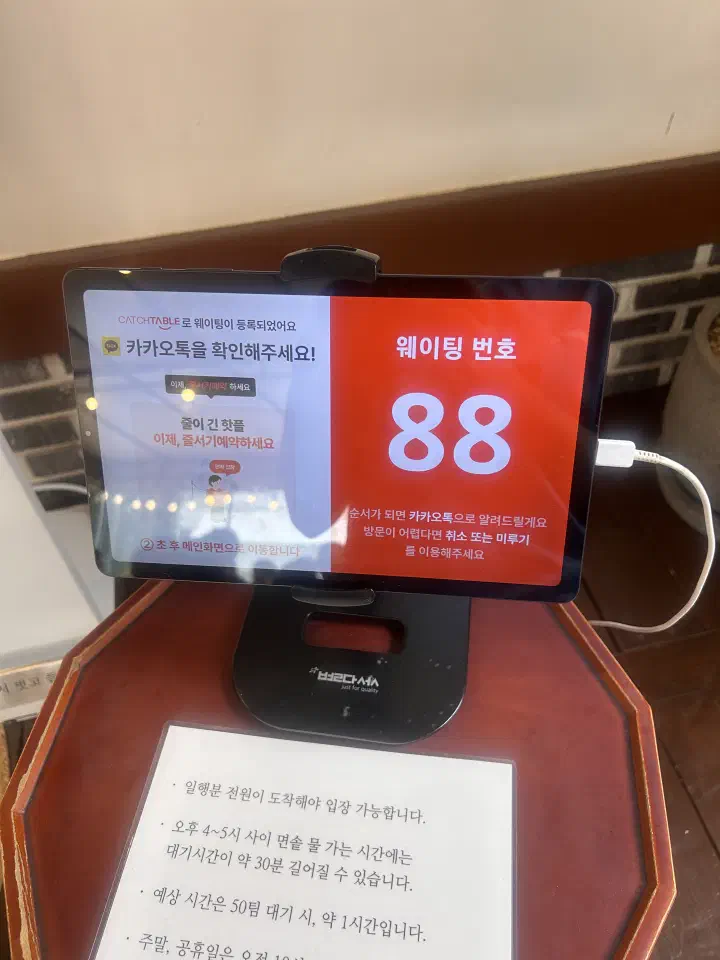
The kiosk at the entrance opens at 10 a.m. You punch in a phone number and get position updates over KakaoTalk, the messaging app everyone in Korea uses.
The CatchTable app, which lets you sign up remotely, doesn’t open until 11:30 a.m.

So if you’re aiming for the opening slot on a weekend, the app is useless.
Doors open at 10:40 on Saturday and Sunday, and by 11:30 there are already dozens of parties ahead.
For an early arrival you have to use the kiosk on site.
If you’re coming after the lunch rush, though, put your name in on the app before you leave home. That one habit saves an hour.
Don’t miss the check-in
Once your remote spot moves up, the app asks you to confirm you’ve arrived.
When you hit the top 50, the app gives you 30 minutes to check in — and it verifies you’re actually near the restaurant when you do.
Miss it and your spot is canceled, and you start over.
People do lose two hours this way, waiting in a cafe and letting the timer run out.
Better to be within walking distance once your number gets close.
Sending one person ahead to handle the check-in is a common workaround.

Getting seated is a separate rule: they need your whole party present.
If one person is still circling for parking, you lose the slot.
Worth sorting out in advance.
What the wait actually looks like
Weekend lunch, roughly 11:30 to 2:30, is the worst of it.
Plan on 90 minutes to two hours.
Sign up around 5 p.m. on a Saturday and a three-digit number is not unusual.
But tables turn over fast.
Noodles come out almost immediately and people don’t linger.
The sign out front says 50 parties works out to about an hour, which matches what happens.
A big number is less alarming than it looks.

Weekdays are a different animal.
Early lunch on a weekday can mean ten minutes. Off-peak, you might be seated in fifteen.
The quietest stretch is after 3 p.m.
Just steer around that 4-to-5 p.m. water change, since it adds a solid half hour on top of whatever you’re already waiting.
Parking
Three lots.
Lot 1 sits directly behind the building and fills first.
Lots 2 and 3 are farther down on either side — a minute by car, three on foot, about 200 meters.
You’ll drive past both on the way up.
If cars are already turning around and coming back down, the lot behind the building is full.
At that point just take a spot below and walk.
Fair warning about that walk: narrow sidewalk, wide road, and no real buffer between the two.
It isn’t a comfortable stretch with small children.
At peak hours the lot entrances themselves back up.

Waiting and getting seated
They’ve put real thought into the waiting area.
Two indoor rooms with air conditioning, plus a restroom inside the waiting area itself, which matters in a Korean summer.
There’s outdoor seating too, but in July and August you want to be inside.
Shoes come off at the entrance.
You’re given a shoe locker number and walk to your table in socks.
It catches people off guard on a first visit.
You don’t sit on the floor, though — the place used to have floor seating and switched to tables during a renovation, so you’re on a stool at a normal table. The stools have no backs, which is fine for a bowl of noodles and less fine if you like to linger.
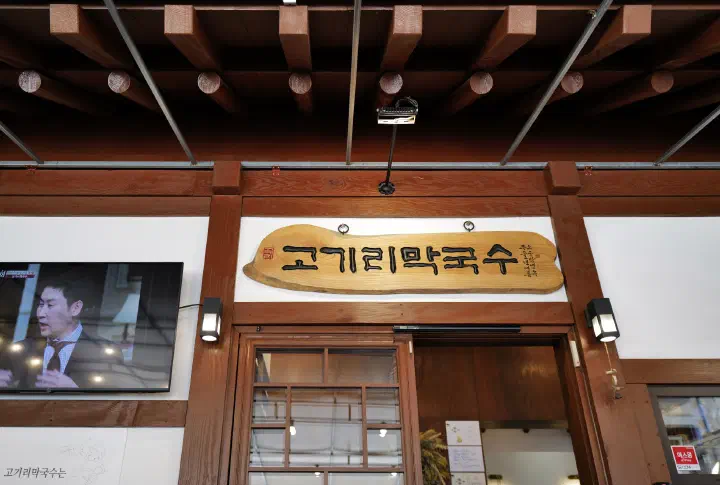
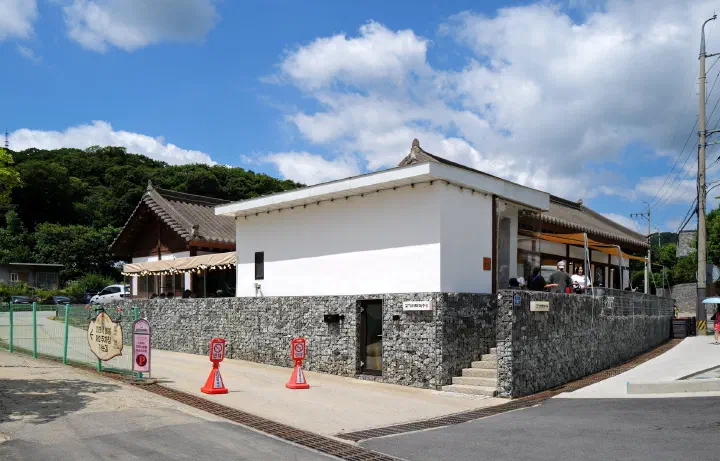
The building borrows from hanok architecture, the traditional Korean style with tile roofs and exposed wood beams, but it comes off clean and modern rather than rustic.
High ceilings keep it from feeling cramped even at full capacity, and big windows open onto the garden.
The room is broken up enough that a full house never gets loud.
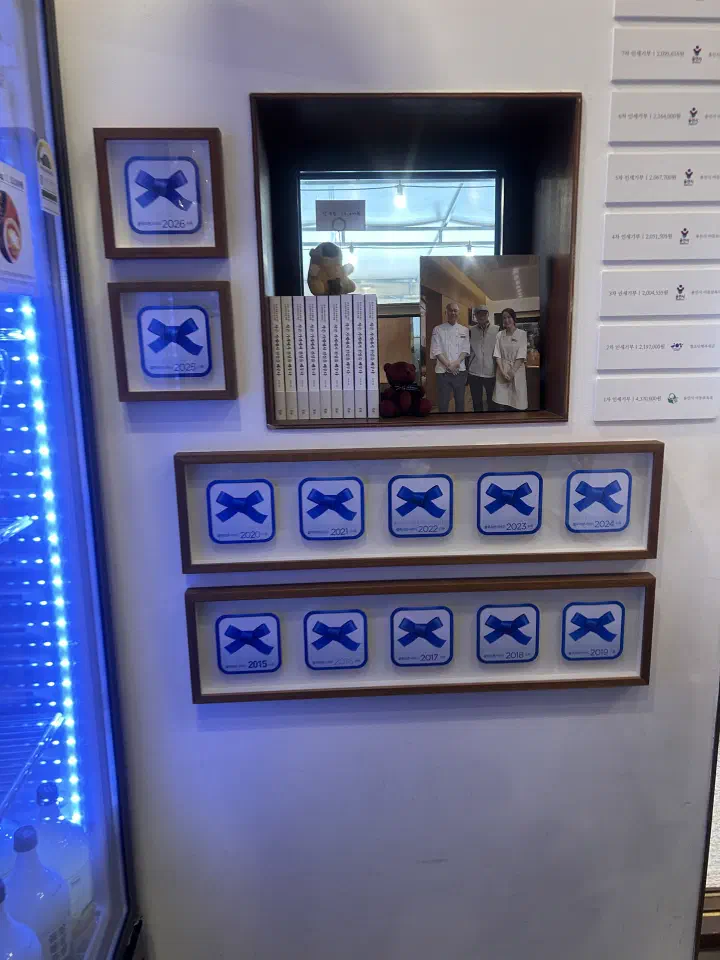
Near the entrance there’s an open kitchen, and one wall is given over to Blue Ribbon plaques and framed stills from TV appearances.

The menu and how to order
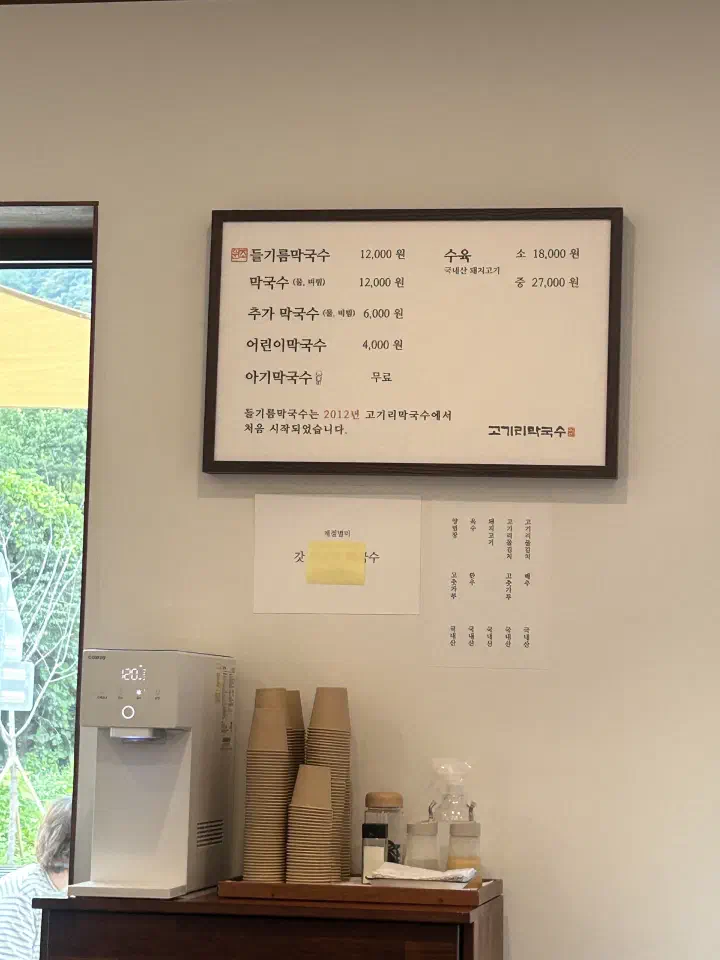
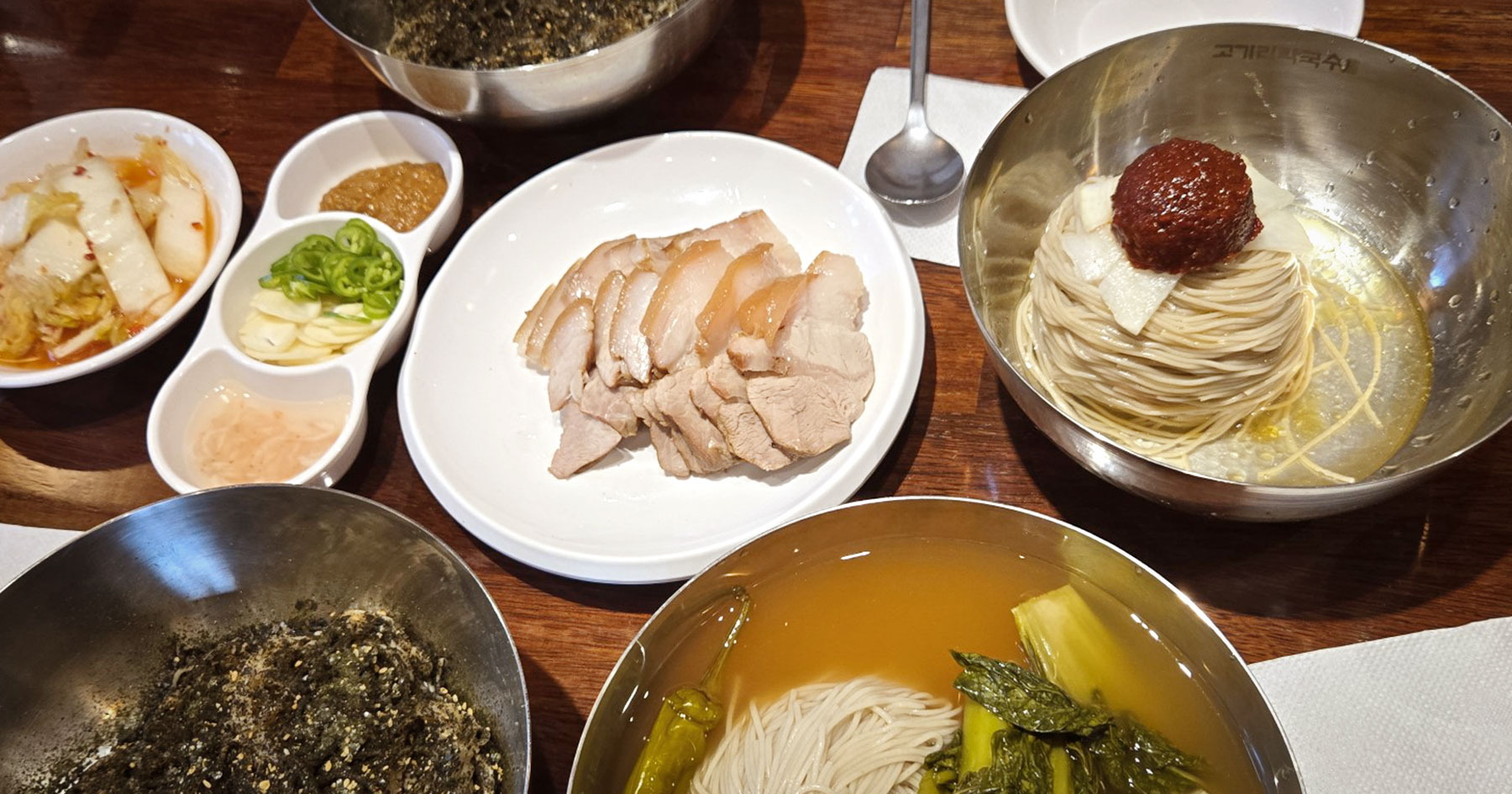
Perilla oil makguksu (원조 들기름막국수) is 12,000 won.
Mul makguksu, the same noodles served in cold broth, and the spicy mixed version are also 12,000 won each.
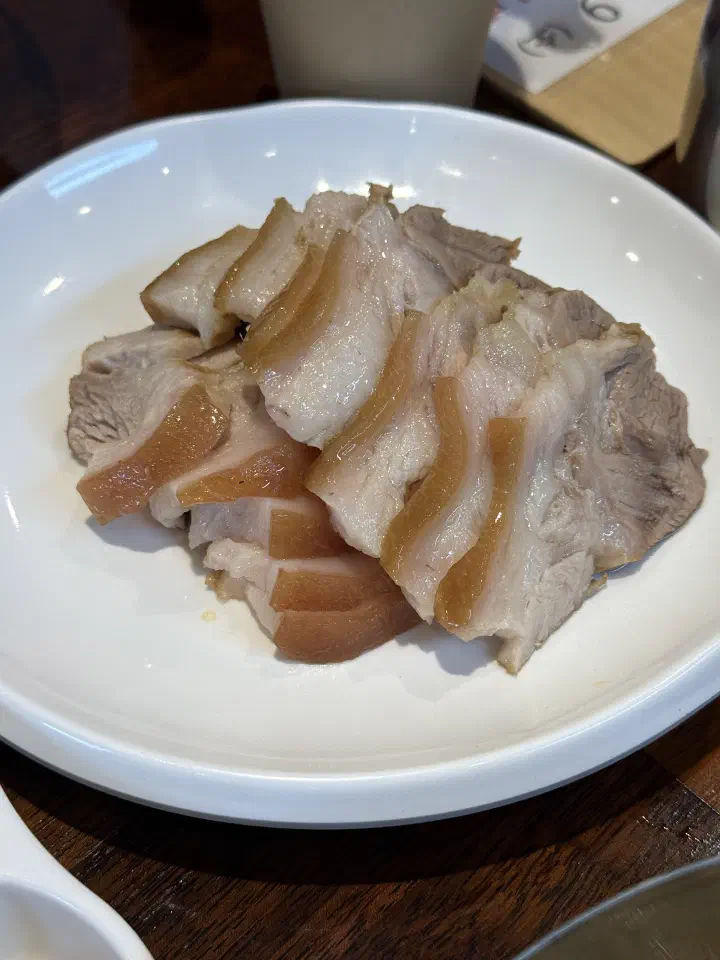
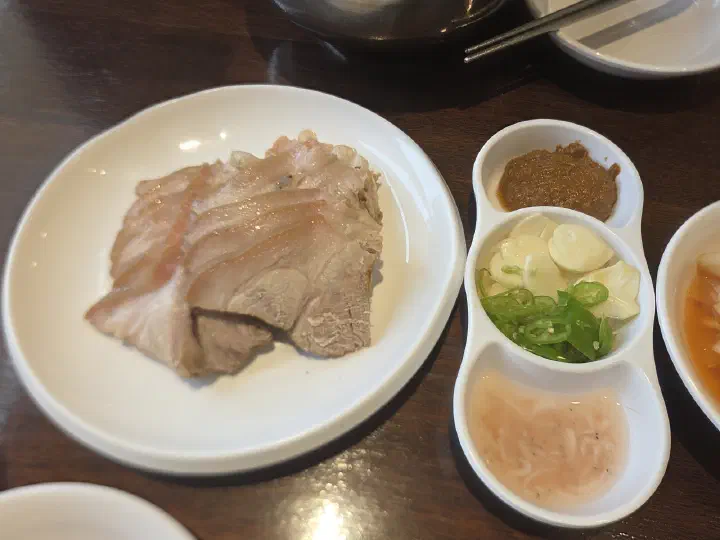
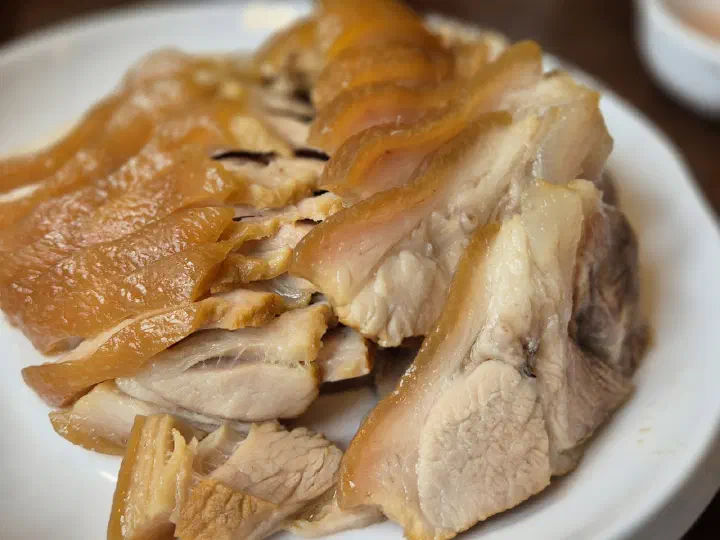
Suyuk, sliced boiled pork, runs 18,000 won for the small and 27,000 won for the medium.
Small suits two people, medium suits three or four.

The one thing to understand here is the add-on bowl.
Order one bowl per person, and after that you can add a mul or spicy makguksu for 6,000 won.
It’s called an add-on, but a full-size bowl arrives.
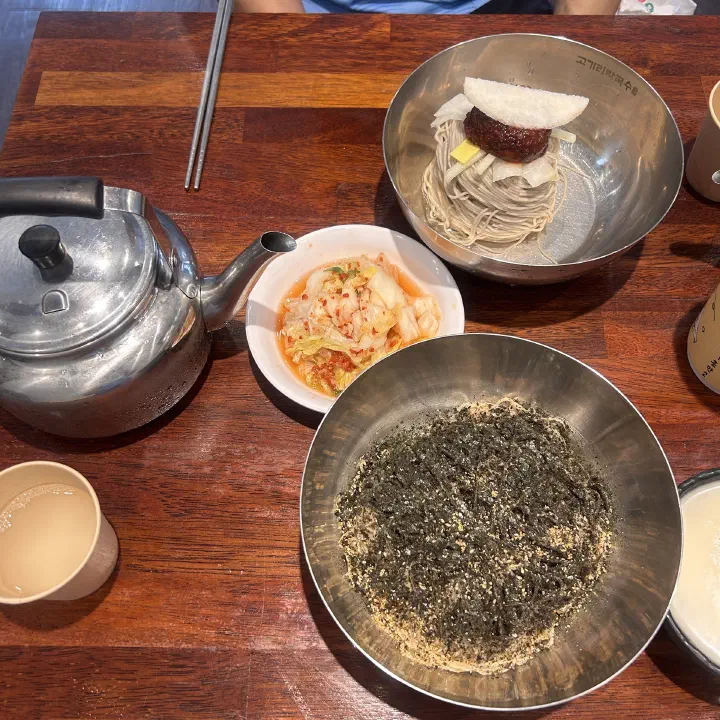
Two people ordering two perilla oil bowls plus one spicy add-on is the standard move.

The rule exists so everyone actually eats a full bowl of the perilla oil version instead of picking at three shared ones.
Which also means: no add-on unless you ordered one per head first.
Kids’ makguksu is 4,000 won, for children through elementary school.
Babies under 36 months get a small bowl free.
A glass of dongdongju, cloudy rice wine, is 1,000 won, capped at one glass per person or one bottle per two.
By the register they sell the house kimchi at 10,000 won per kilogram, along with old-fashioned rice crackers and candies.
Ordering isn’t hard even without Korean. The staff speak limited English, but the menu has pictures, and pointing works fine.
Nothing here is spicy by Korean standards. Even the spicy mixed noodles are mild.
How to eat the signature bowl
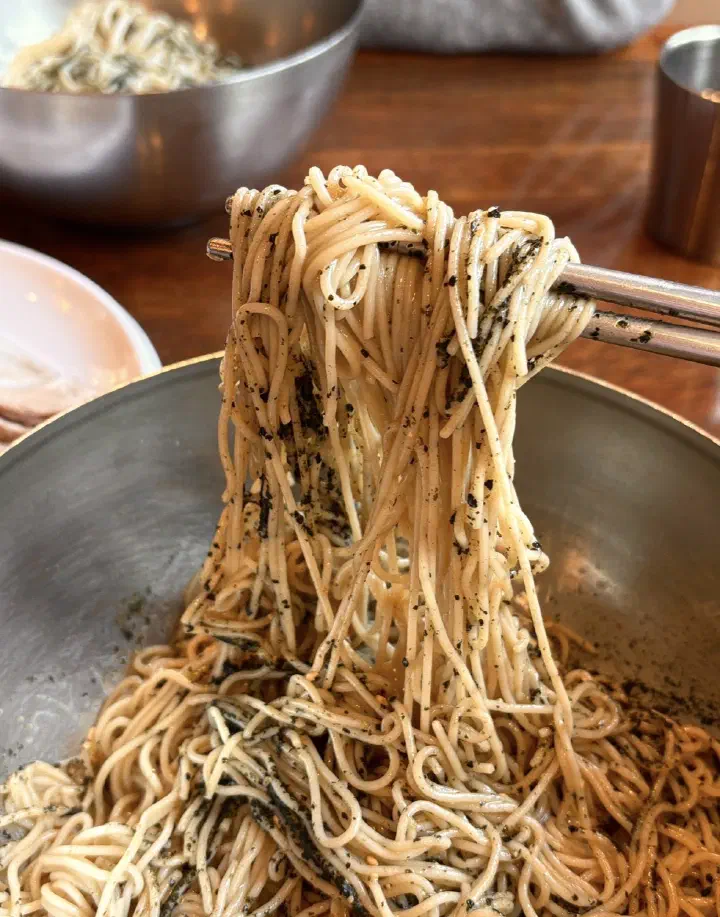
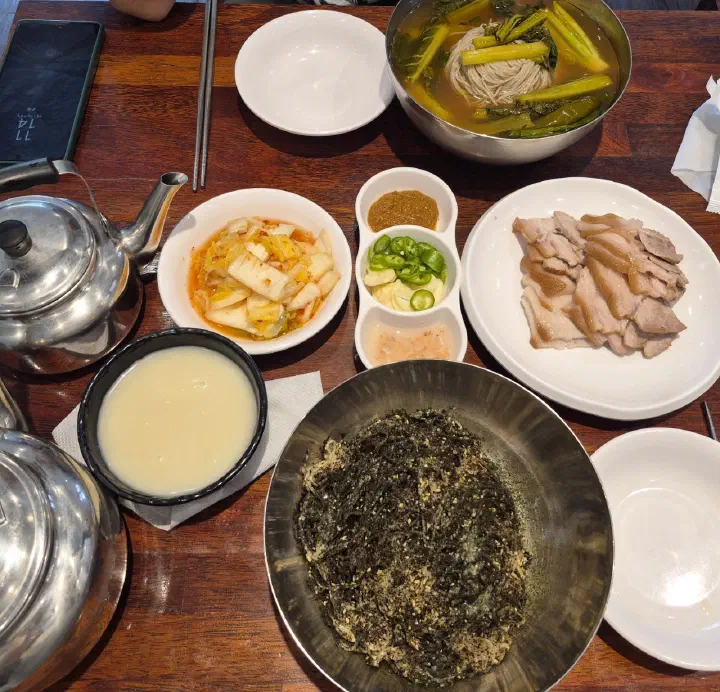
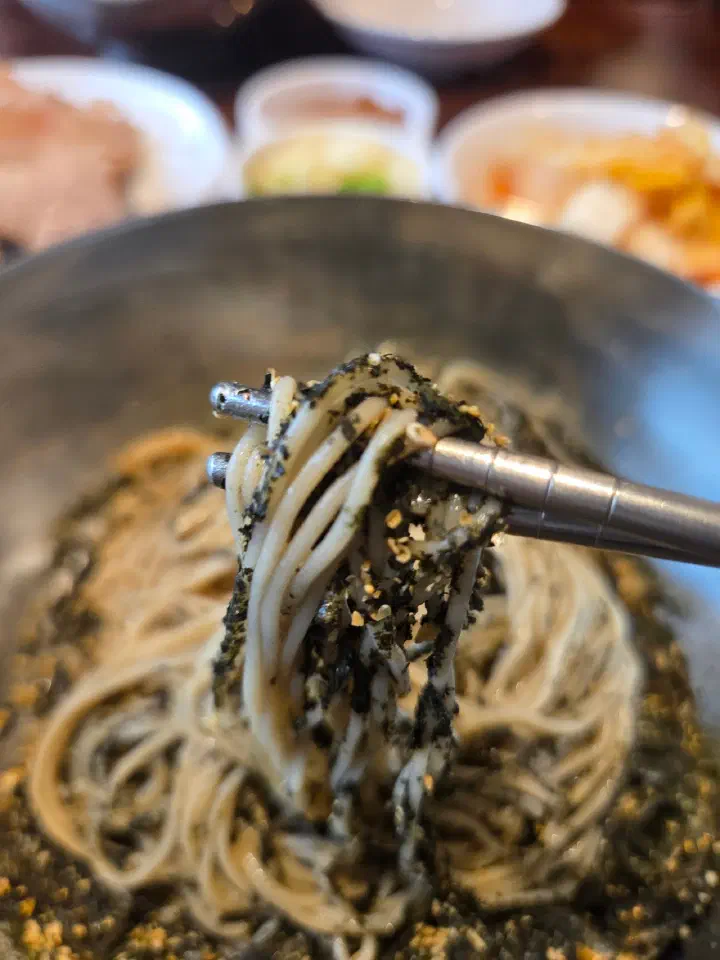
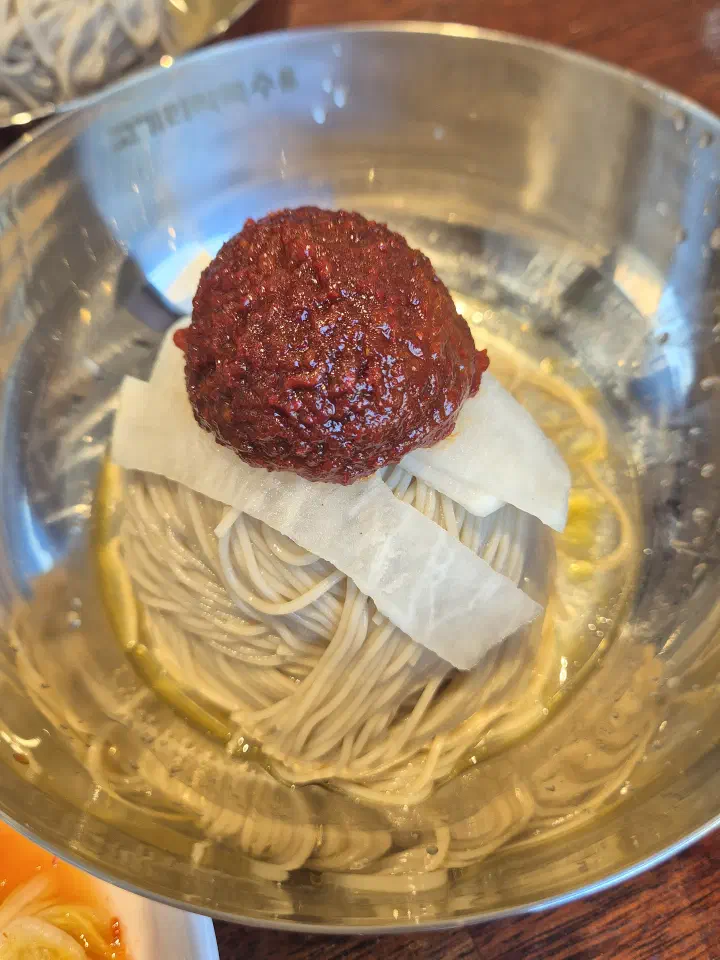
The perilla oil bowl arrives already tossed.
Don’t mix it again.
Staff explain this at each table: lift the noodles from the top and eat them as they are.
Your nose gets there before your mouth does.
Perilla oil comes up first, buckwheat follows.
The noodles are 100% buckwheat, so they snap rather than stretch.
The seaweed flakes carry enough salt to keep it from going flat, and nothing else is competing for attention.

About halfway down it starts to feel dry.
That’s when you pour the chilled broth from the kettle on your table.
The oil loosens into the broth and the whole thing turns into a cold noodle soup.
One bowl, two dishes.
A splash beats a full pour.
Hot noodle-cooking water comes out with the order too, and it tastes like weak buckwheat tea.

Pork and the other bowls
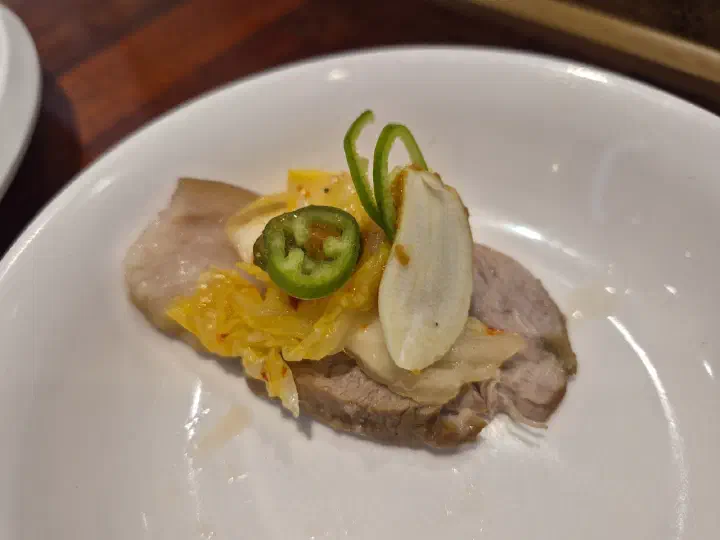
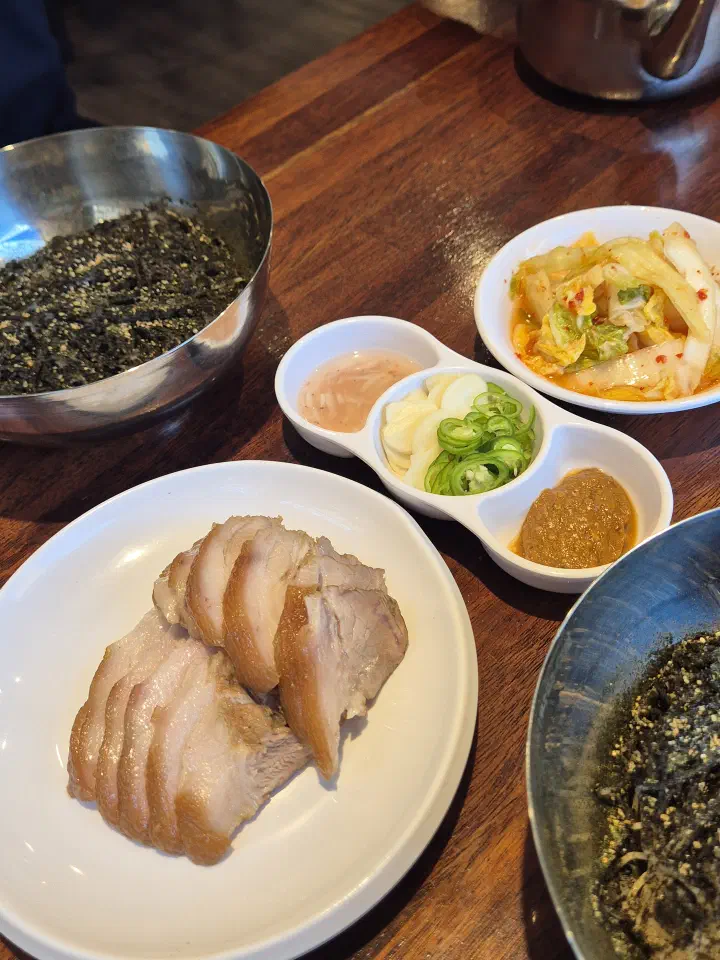
The suyuk is domestic pork, sliced thin, no gamey smell, and it comes apart without much chewing.
Lean parts aren’t dry; the fat has some bounce.

The salted shrimp on the side is all the seasoning it needs — or wrap a few noodles in a slice of the pork.
Garlic, green chili, and ssamjang, a thick soybean-and-chili paste, come alongside.

The pork isn’t universally loved, though.
Portions come out small for the price, and some batches carry more smell than others.
Think of it as ballast. The noodles won’t fill you up on their own.
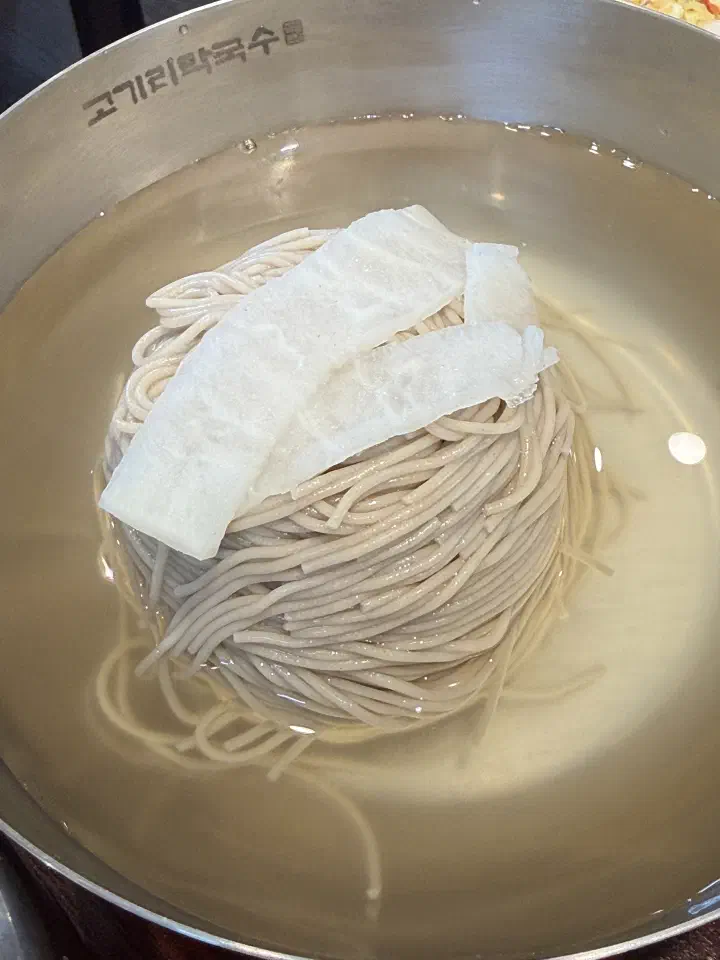
Mul makguksu is a clear, restrained beef broth built along the lines of Pyongyang naengmyeon — the famously understated cold noodle soup that Koreans argue about endlessly, where the point is what isn’t in it.
The spicy version has a substantial sauce, but it isn’t hot or sweet, and it doesn’t reek of gochujang the way most do.
Order it as your add-on after the perilla oil bowl and you can mix it into whatever oil is left behind.

Seasonal bowls rotate through the year.
Spring is mustard-leaf water kimchi and summer is yeolmu, young radish kimchi.
Winter brings dongchimi, a clear radish water kimchi, plus an old-style kimchi noodle bowl.
As of July 2026 the summer yeolmu bowl is running at 14,000 won, and the spring mustard-leaf version ended in mid-July.
Seasonal bowls are capped daily, so by evening they’re usually gone.
Kimchi does more work than it should
The kimchi that comes with the meal quietly does a lot of the work.
It sits between water kimchi and regular kimchi — cool, mild, not sweet.
It clears the palate without stepping on the buckwheat.
People finish the dish and then buy a kilo at the register on the way out.

One caveat: one serving per table.
In Korea side dishes are normally refilled free and without asking, so a no-refill policy stands out, and it does frustrate larger groups.
Coming with kids
Families make up a good share of the room.
High chairs appear without your having to ask.
The free bowl for under-threes is soft noodles in a mild broth.
The kids’ version is soy-based and slightly sweet. Children tend to finish it.

The air-conditioned waiting room with its own restroom makes the wait survivable with a child.
The walk up from the lower lots and the length of the wait itself are the two things to weigh.
Does the name hold up
The credentials are real.
It has been listed in the Blue Ribbon Survey, Korea’s long-running restaurant guide, every year since 2015 — twelve years running.
Two appearances on cartoonist Huh Young-man’s long-running food show, plus a string of other Korean TV spots going back to 2013.
Ottogi, one of Korea’s big food companies, put out a licensed meal kit version.
All of which raises expectations. That’s where opinions split.
The main fault line is how restrained the flavor is.
If you eat a lot of strongly seasoned food, this will taste underseasoned.
Some people also find the perilla oil less pronounced than they’d hoped.
If you like Pyongyang naengmyeon, you’ll get it immediately. If you don’t, the first bite may leave you wondering.

Service draws mixed notes too.
For a place moving this many people, the staff are genuinely good.
But there are a lot of house rules — shoes off, one bowl per head before any add-on, a set way of paying on the way out — and being walked through them can feel firm rather than warm.
Getting there and killing time
The restaurant sits on the road up to Gogiri Valley, which gives you somewhere to put the wait.
Walk about 700 meters uphill and you reach the upper part of the creek, where families cool off in summer and head back down when their number gets close.
Several cafes nearby work for the same purpose.
Public transit is thin out here. A car or a taxi is the realistic option, and the Kakao T app is the way to call one.
Google Maps walking and transit directions don’t really work anywhere in Korea, so use the pin below for reference and download Naver Map or KakaoMap for the actual route.
📍 View Gogiri Makguksu (고기리막국수) on Google Maps →
Where I land on it
Whether the wait pays off depends entirely on the number in front of you.
Under half an hour, there’s nothing to think about.
The perilla oil bowl isn’t something you can substitute elsewhere, and two people ordering two of those plus a small suyuk and one add-on eat well for under 50,000 won.

At two hours, ask yourself first whether you like restrained food.
If cold Pyongyang-style noodles are your thing, the time won’t feel wasted. If you want something loud, it will.
Which brings it back to timing.
On a weekend, either sign up at the kiosk before doors open or write off lunch entirely and come after 3 p.m.
Early lunch on a weekday means almost no wait at all, and it’s the only reliable way to still find the seasonal bowl in stock.