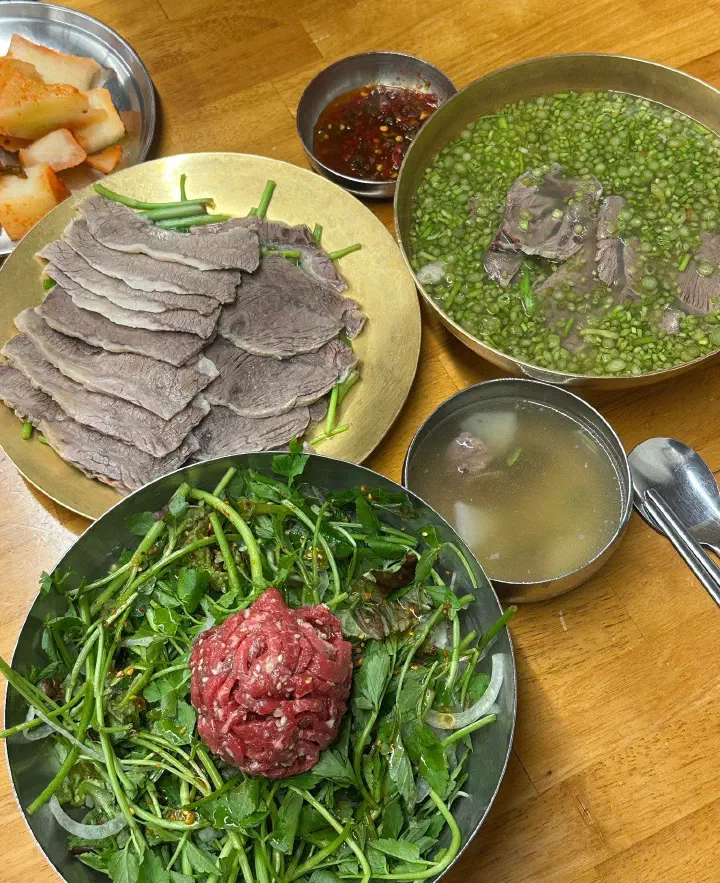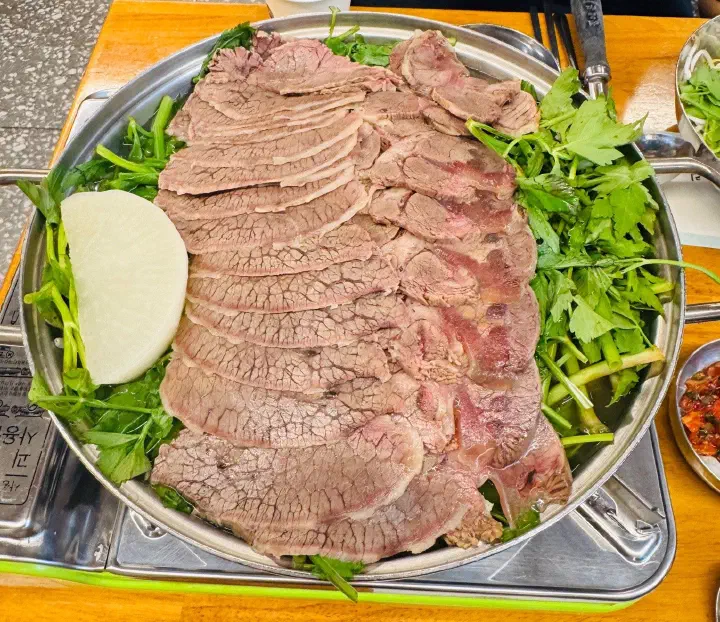
Beef soup with a mountain of greens on top.
That’s the quickest way to describe Neungdong Minari (능동미나리).
It sits right by Sinyongsan Station, in the middle of the Yongridan-gil strip.
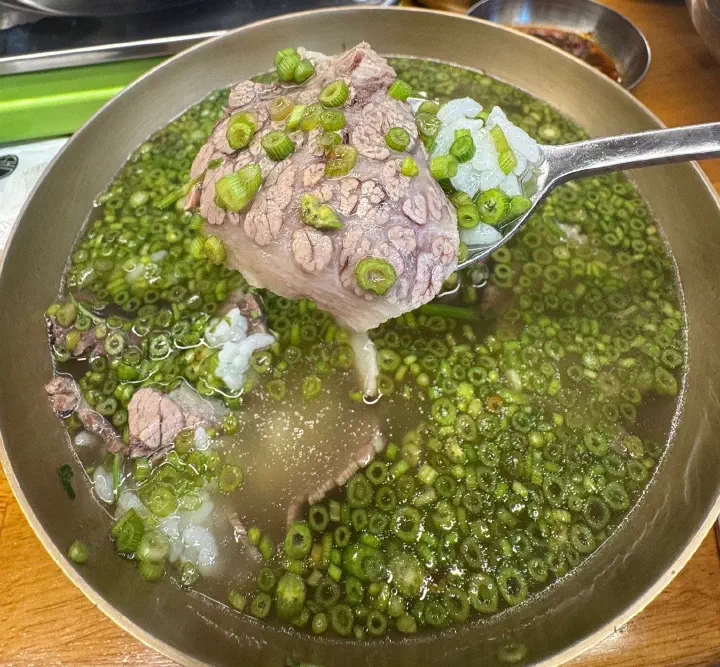
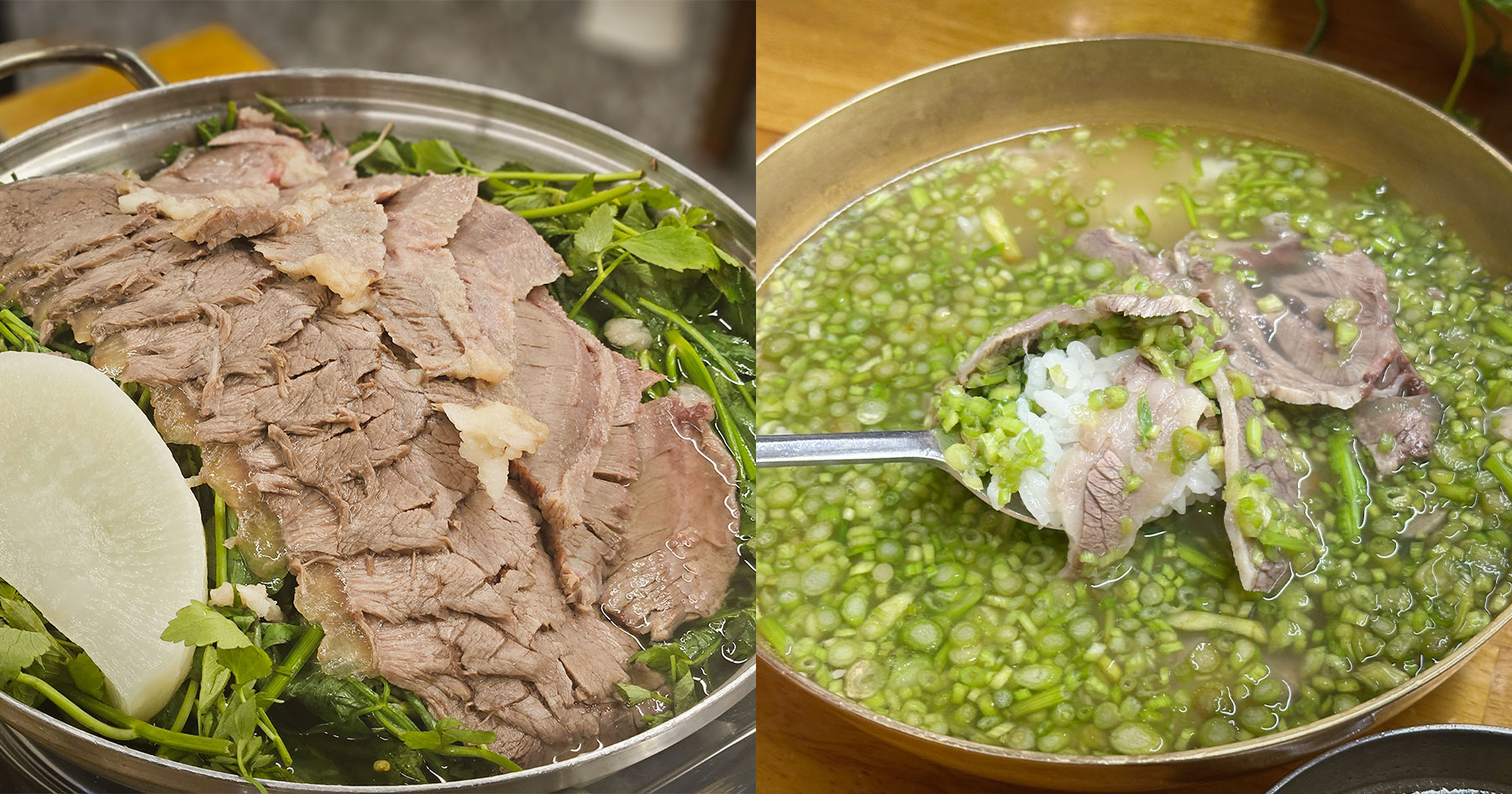
The clear gomtang arrives buried under fresh minari (미나리, Korean water dropwort), so much of it that the bowl looks more like a salad than a soup at first glance.
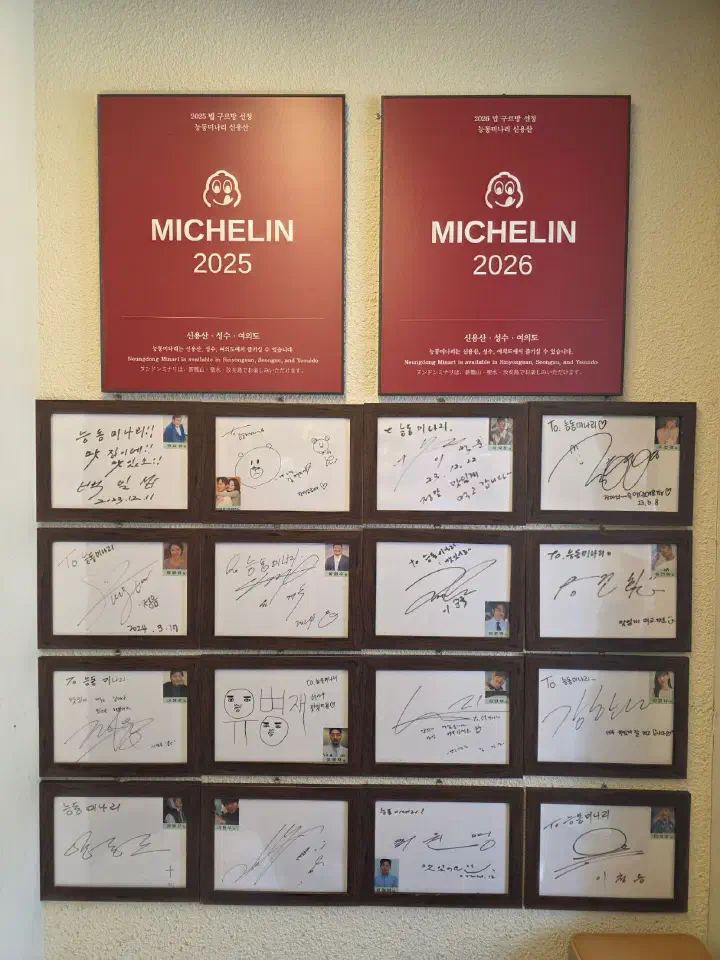
It’s got a couple of accolades to its name.
Two years running in the Michelin Guide Bib Gourmand, in 2025 and 2026.
It’s also turned up on Korean TV a few times.
So the line out front is basically permanent.
The real question is whether the food earns that line.
I think it mostly does, with a couple of caveats.

Good to know
Address: 28 Hangang-daero 40-gil, Yongsan-gu, Seoul (about a 3-minute walk from Sinyongsan Station, Exit 1)
Hours: Mon-Fri 10:00-23:00 / Sat-Sun 09:30-23:00
No mid-day break
Parking: no lot of its own, so most people use the nearby Samgakji temporary public parking lot
Waiting: walk-in line only, no reservations or remote waitlist app
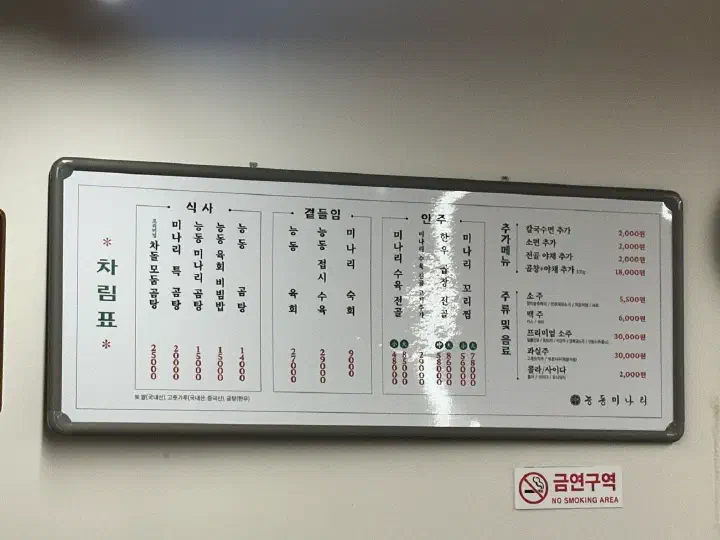
Signature dishes: Neungdong Minari gomtang 15,000 won / yukhoe bibimbap 15,000 won / minari suyuk jeongol (small) 48,000 won

📍 View Neungdong Minari (능동미나리) on Google Maps →
The gomtang that made the name
The flagship is the minari gomtang.
The broth is simmered from Korean beef bones for about twelve hours, and the shop makes a point of using freshly butchered 1++ grade Korean beef.
It’s served toryeom-style, meaning the rice comes already soaked in the hot broth, so it lands at a comfortable eating temperature.
The soup itself is clean and clear, with no gamey edge.
The minari adds a sharp, herbal lift on top of that, which is what sets it apart from an ordinary gomtang.
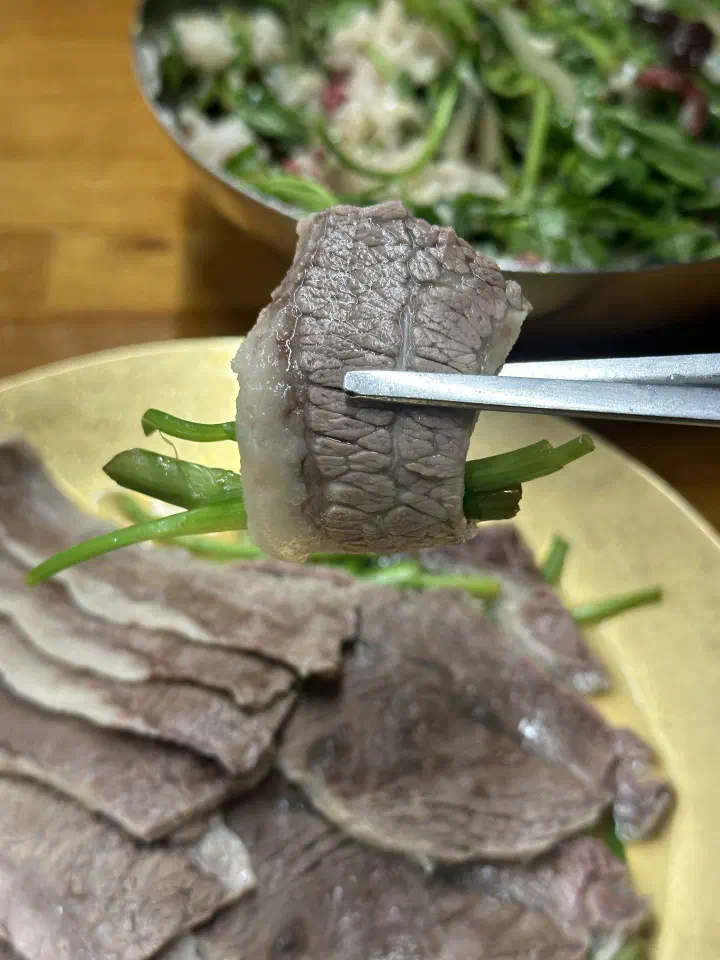
There’s a decent amount of beef in the bowl, cut into good-sized chunks.

Here’s the part I like.
The rice, the broth, and the minari are all refillable.
Even if two people share a single main, you still get one free bowl of rice.
You won’t leave hungry.
The yukhoe bibimbap steals it
Here’s the twist.
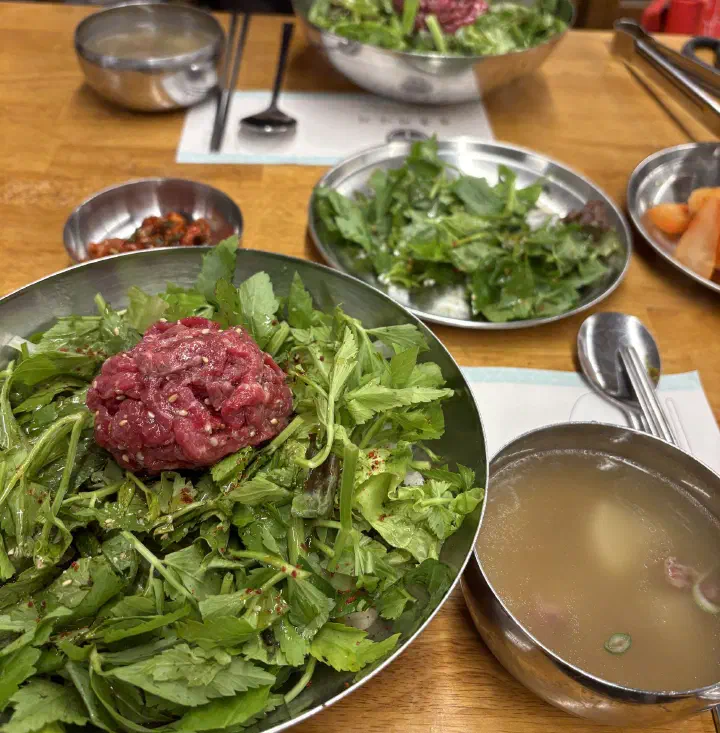
The gomtang is the headline, but the dish people actually rave about is the yukhoe bibimbap (육회비빔밥, raw beef over rice).
It comes down to the seasoning.
Instead of the usual gochujang base, it’s dressed with soy sauce and sesame oil.
So it reads savory and nutty rather than spicy or sharp.
There’s 1++ Korean beef tartare, a big tangle of minari, and little bits of dried radish worked in that give it a faint sweetness and a real hit of umami.

If it tastes underseasoned to you, just ask.
The staff will bump up the seasoning on request.
For two people, the move is one gomtang and one bibimbap, split between you.
A quick note for foreign visitors: spice isn’t an issue with either of these dishes, so you don’t need to brace yourself the way you might for a fiery Korean stew. Both are on the mild, clean side.
For a bigger group
Bigger table, or fancy a drink with dinner?
Go for the minari suyuk jeongol.
The small is 48,000 won.
It’s loaded with brisket and shank, and the trick is to wrap the beef with the minari and bean sprouts from the pot.

The broth leans light and delicate rather than rich, so it suits people who like a subtle soup.
Order the hot pot and kalguksu noodles come with it.
You drop the noodles in once you’ve worked through the meat.
They thicken the broth, though, so if you want to keep some of that clear soup, ladle a bit out before adding them.
At the very end you can fry the leftover rice right in the pot.
If you’d rather have the raw beef on its own as a drinking snack, there’s also the Neungdong yukhoe (능동육회, 27,000 won).
It swaps the usual radish sprouts for minari and the usual seaweed for gamtae (감태, a fine green seaweed), which is an unusual touch. The gamtae carries a distinct sea note, so it’s a love-it-or-hate-it thing.
How to keep the wait short
The waiting is what this place is known for.
It used to run on a remote waitlist app, but too many no-shows killed that, so now it’s walk-in only.
There’s no sign-in sheet either. You just join the line and wait.

In Seoul, where nearly every popular restaurant runs its wait through an app, going back to a plain old line is a rare and rather principled move.
The owner would rather seat the people actually standing there, and the notice on the door says exactly that, plainly blaming repeated no-shows.
It also promises to look after everyone while they wait, which the free omija tea backs up.
You lose some convenience, but the line is honest; nobody games it from a phone.
One rule to know.
Your whole party has to be present before you can be seated.
You can’t send one person ahead to hold a spot, so if someone’s coming separately, time it so you arrive together.
At peak times the wait runs anywhere from 20 minutes to an hour.
Even around 1 p.m. on a weekday there can be 40-plus groups ahead.
But the turnover is fast.
Food comes out quickly, so the line moves faster than its length suggests.
Your best bet is dodging the meal rush.
Before 11 a.m. on a weekday, or the 3 to 5 p.m. window.
Those in-between hours are the sweet spot.
While you wait they hand out cold omija tea, but there’s no shade out front, so in summer it helps to bring a hat or something to keep the sun off.
A few practical notes
The dining room is split over two floors.
The first floor is a little cramped, and the stairs up are narrow and steep.
The second floor is roomier with better light, so it’s the nicer place to sit.
With all those stairs, though, strollers and wheelchairs will have a hard time.
Side dishes are kkakdugi (radish kimchi), seasoned minari, and salted squid.
The kkakdugi sits in a big shared tub, and you cut off as much as you want yourself.

Payment is easy: Korean restaurants almost all take cards, and an internationally issued card will work fine here, so there’s no need to hunt for cash. Korea also doesn’t do tipping, so don’t leave any, it just causes confusion.
Ordering isn’t hard even without much Korean, since you can point at the menu and hold up fingers for how many you want.
There’s no parking lot, so the Samgakji temporary public parking lot nearby is the usual option.
If you can’t line up your timing, takeout is an option too.
The verdict
What Neungdong Minari really does is take one ingredient, minari, and run it through a whole menu.
If you like gentle, mild Korean food and a light, wholesome broth, you’ll understand the two Michelin nods.
If you’re after strong, bold, punchy flavors, it might read as a touch plain.
The minari is chopped fine, so it keeps turning up in every spoonful of soup.
Some people find that refreshing, others find it a distraction.
That’s the one thing that splits opinion here.
Still, it’s the kind of place that comes to mind when you want an easy, comforting meal, so if you’re already around Yongsan, it’s worth a stop.
There are also branches in Seongsu and Yeouido.
If your route runs closer to one of those, splitting off to another location is one more way to beat the line.